
A bold new way to get around Chicagoland.
- Regional Rail for Chicagoland
- Creating CrossTowners
- Two visions to #BuildTheTunnel
- Project News and Updates
Regional Rail for Chicagoland
Unlocking Chicagoland by leveraging our existing assets for a new way to operate trains to and thru downtown — with direct benefits for the entire region.

Connecting Chicagoland
Our current commuter rail system is very good at bringing riders from the entire region all the way to the Loop’s doorstep… and kicking them all out right at the edge of the Loop to fend for themselves to either walk or roll to their final destination, or figure out a challenging connection to the next leg of their transit trip. As a result, Metra is primarily seen exclusively as a suburbs-to-downtown service provider, and Chicagoland is at a loss for fast and frequent community-to-community trips beyond the reach of the existing CTA ‘L’ network.
The Regional Rail Advantage
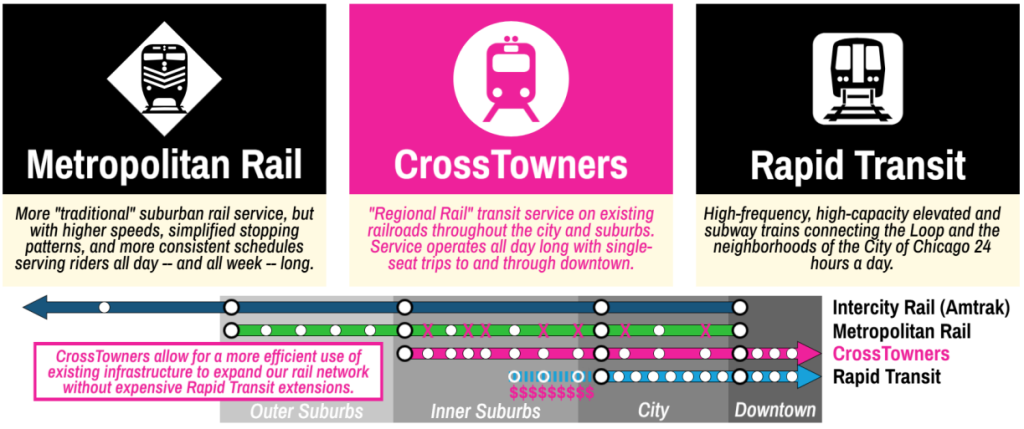
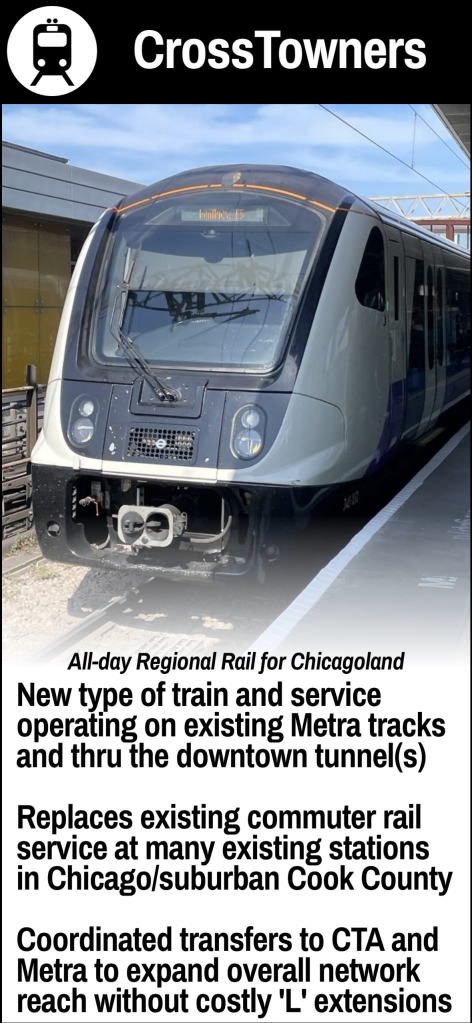
The solution is a new way of operating our existing commuter rail system called “regional rail”. More than simply “running more trains”, a regional rail network provides an innovative, cost-effective way to make our rail transit network operate far more efficiently and serving a much wider rider base than the traditional commuter model, with demonstrable benefits that reach every corner of the region. By connecting our downtown rail terminals together, we can allow trains to operate not only to but through the urban core, creating a new network of train service overlaid right on our existing infrastructure. Known by different names in different parts of the world including “S-Bahn” in central Europe, or “Réseau express” in the Francosphere, and more recently “Crossrail” in the United Kingdom, here in Chicagoland we can call them “CrossTowners”.
Expansion, not extension
By connecting existing Metra lines through the heart of downtown, we can convert some existing peak-oriented Metra operations to all-day, higher-frequency routes that are better suited to serve areas the CTA can’t, for a fraction of the $1-billion-per-mile price tag currently fetched by CTA rail extensions.
The “Ninth” CTA ‘L’ Line
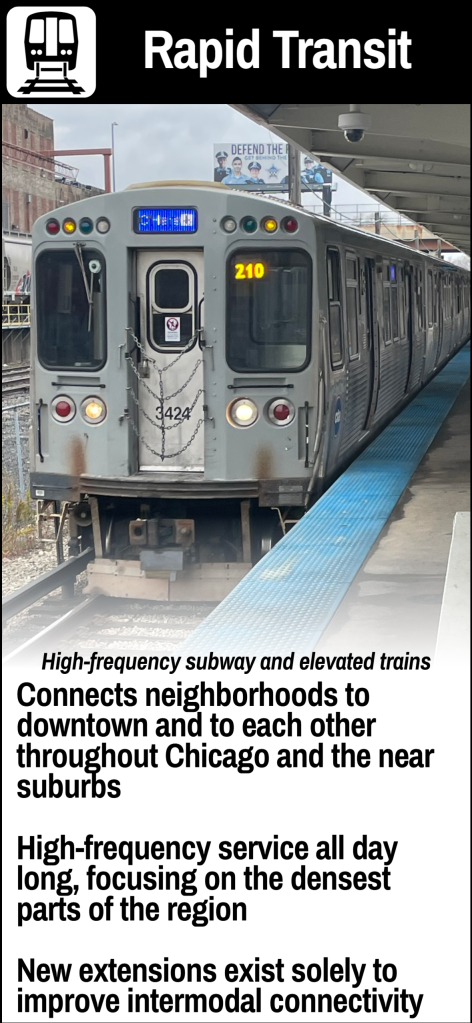
By channeling multiple suburban routes through a single city link, even relatively modest suburban frequencies can combine to create a high-frequency trunk line between downtown and Hyde Park with 5- to 8-minute headways, and sub-15-minute headways citywide.
All-Day Express Metra
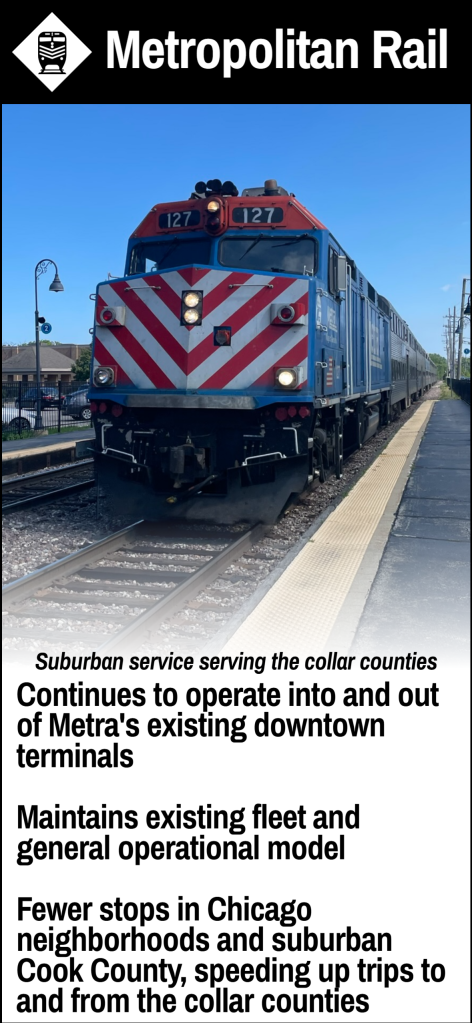
With CrossTowners serving urban and inner-suburban portions of the existing Metra system twice an hour, all day long, trains to and from the collar counties can make fewer stops with higher speeds, maintaining timed transfers to maintain connectivity. In other words, existing collar-county trains become express trains: all day long, seven days a week.
Creating CrossTowners
To create an effective regional rail network for Chicagoland, four key components are needed:
Thru-Running
Trains need to be able to continue beyond the downtown terminals to provide direct connections thru the urban core, rather than just to the Loop. The keystone of CrossTowner regional rail is the downtown tunnel that would connect the Metra Electric line near Soldier Field to the Metra Union Pacific North and Northwest lines near the new casino site at Chicago/Halsted, as well as new connections via Chicago Union Station.
#BuildTheTunnel
Interlining
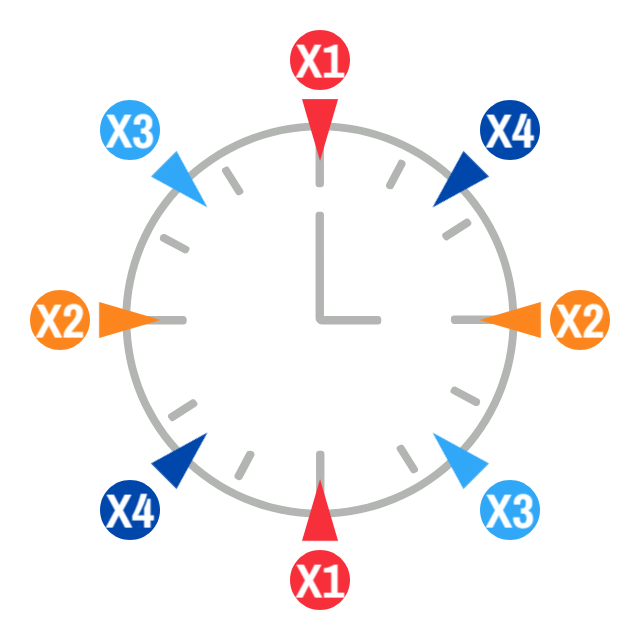
With these downtown connections, individual service patterns, even at relatively low (half-hourly) frequencies, can be staggered and overlapped with each other to create high-frequency corridors through Chicago to serve intra-city trips — especially to and from underserved South Side communities — with the same show-up-and-go convenience available on CTA ‘L’ lines.

Modern Rolling Stock
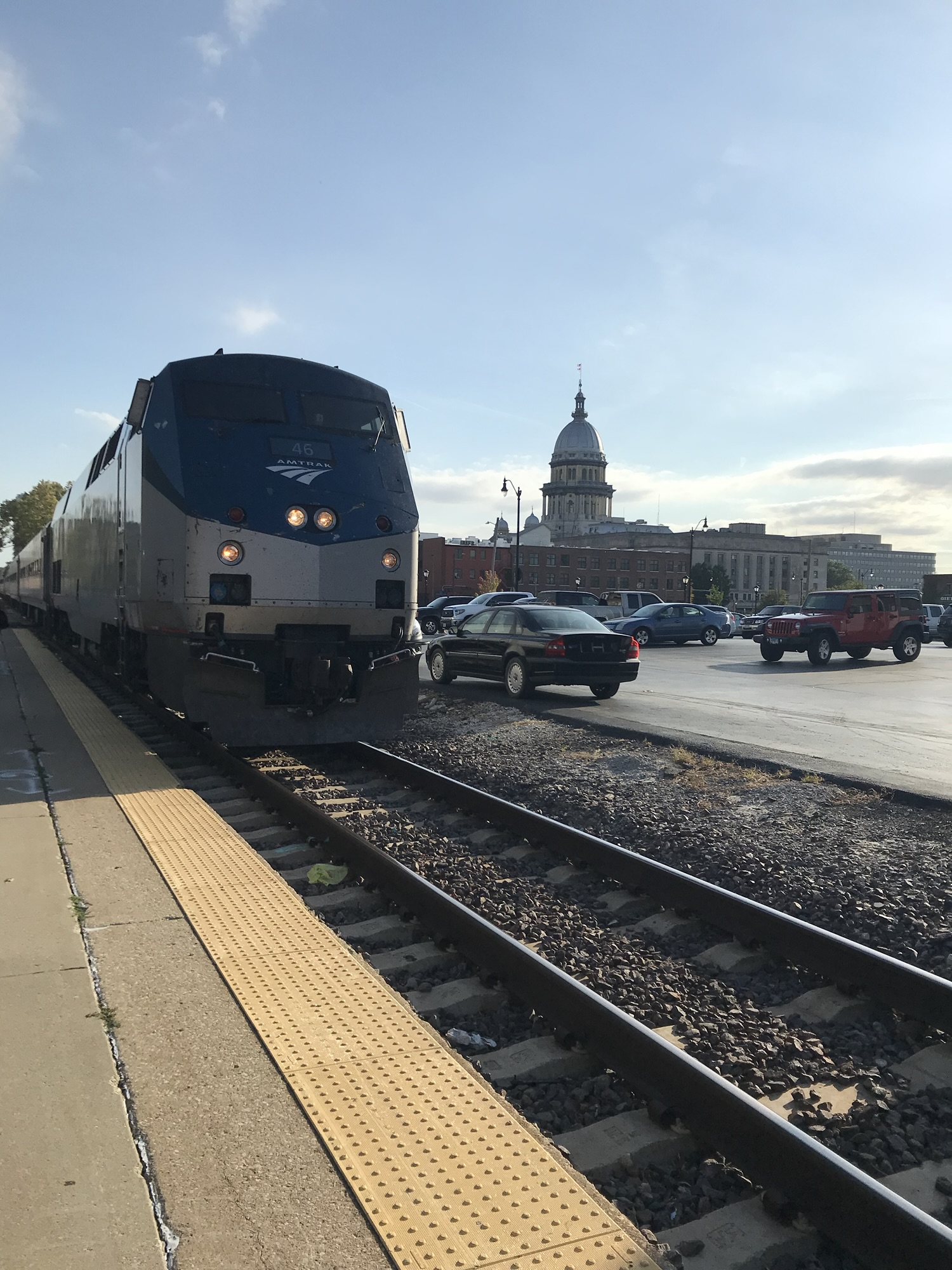
Metra’s existing rolling stock is perfectly serviceable for commuter rail operations but is ill-suited for high-frequency all-day regional rail service. Modern rolling stock is specifically tailored for regional rail service with amenities like more doors, single-step or step-free boarding, and better acceleration and deceleration. Given the extensive existing electrification of the Metra Electric, advances in battery technology may allow for zero-emission CrossTowner service without needing extensive overhead catenary retrofits elsewhere.
Political Will
CrossTowners can be a moonshot project to finally create a unified, regional vision desperately needed to create a modern 21st-Century transit network while breaking down the toxic siloed “city vs. suburbs” thinking that has hamstrung regional transportation in Illinois for decades. Extensive coordination and cooperation between our transit agencies, as well as other entities like Amtrak and host freight railroads, is crucial to the successful execution of regional rail.
Two visions to #BuildTheTunnel
2034sight
The comprehensive initial plan from 2023, the 2034sight Plan would transform downtown with a new tunnel under Ohio Street and Columbus Drive, creating a valuable new local transit amenity to residents and businesses of River North, Streeterville, and Lakeshore East, allowing for the primary trunk to avoid rail traffic and congestion at Chicago Union Station, which would be served later by a secondary tunnel alignment under Clinton Street. 2034sight would create a six-line, 150-station CrossTowner network using fewer than eight miles of new tunnels, or about one mile fewer than the CTA’s original State Street (Red Line) and Milwaukee-Dearborn (Blue Line) subways.

Learn more about the 2034sight Plan.
CRCL Plan
A more budget-conscious version of 2034sight that also cements Chicago Union Station as a singular rail hub for the entire Midwest, the CRCL Plan creates the Clinton-Roosevelt Connector Line (CRCL) tunnel for CrossTowner service. While the CRCL Plan would only minimally expand the walkshed of downtown’s existing train stations, and would not provide single-seat trips from the South Side to O’Hare Transfer, the CRCL Plan also creates a six-line CrossTowner network with 140+ stations but only requires about half as much tunnel mileage as 2034sight.
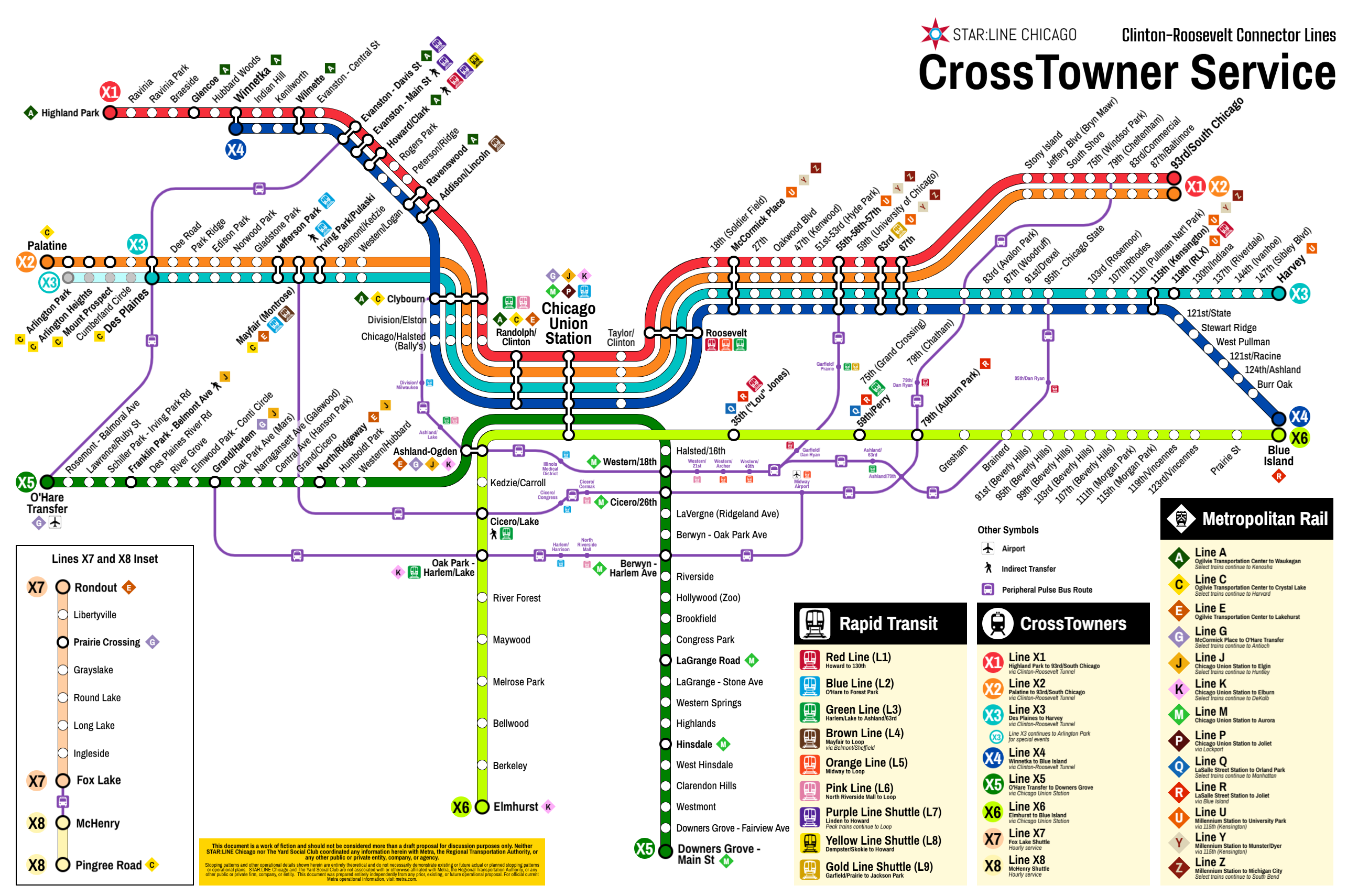
Learn more about the CRCL Plan.
Side-By-Side Comparison


2034sight + CRCL
The 2034sight Plan and the CRCL Plan are not mutually exclusive; a maximalist vision for the future can include both to maximize the benefits of both visions.
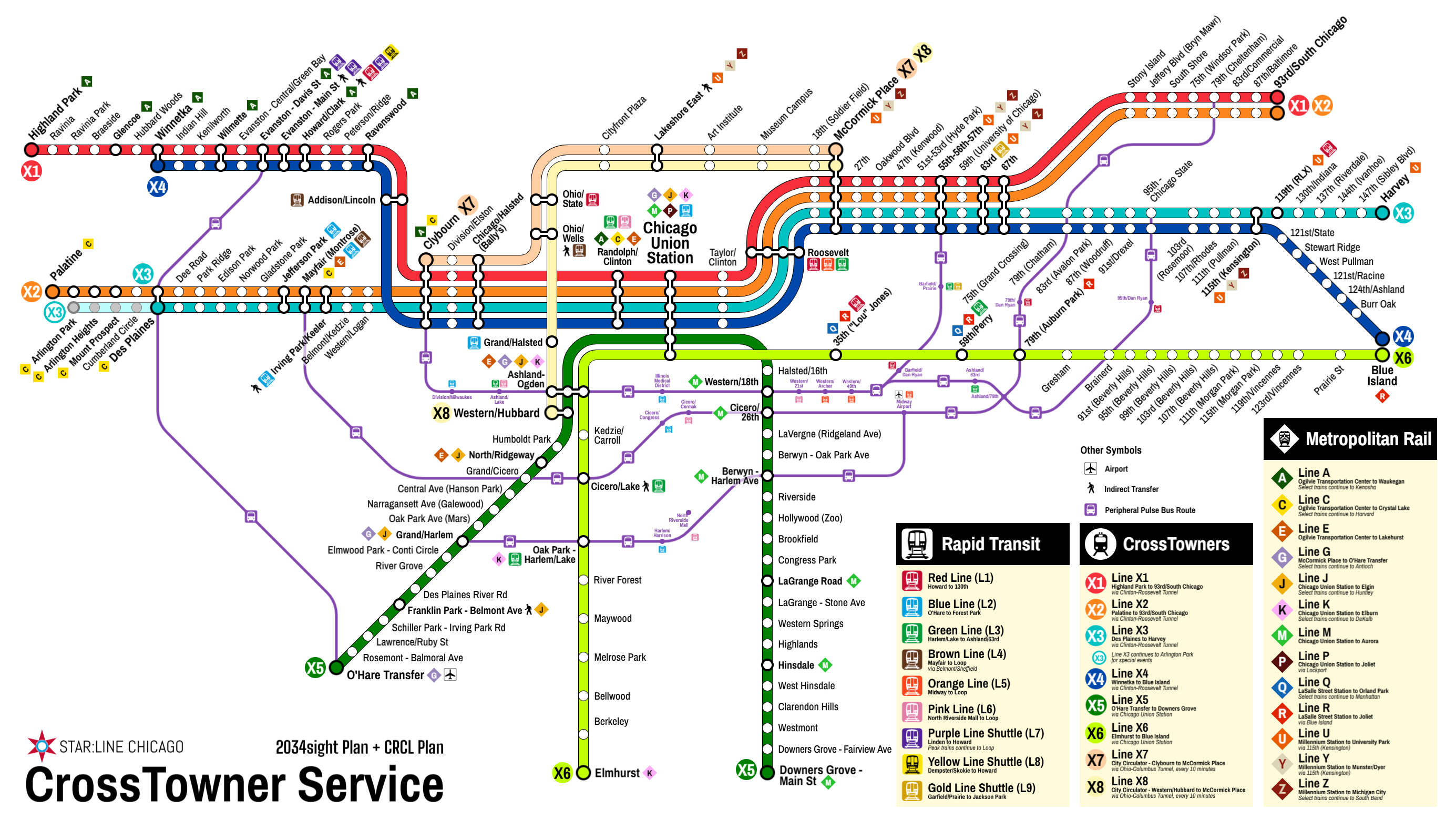
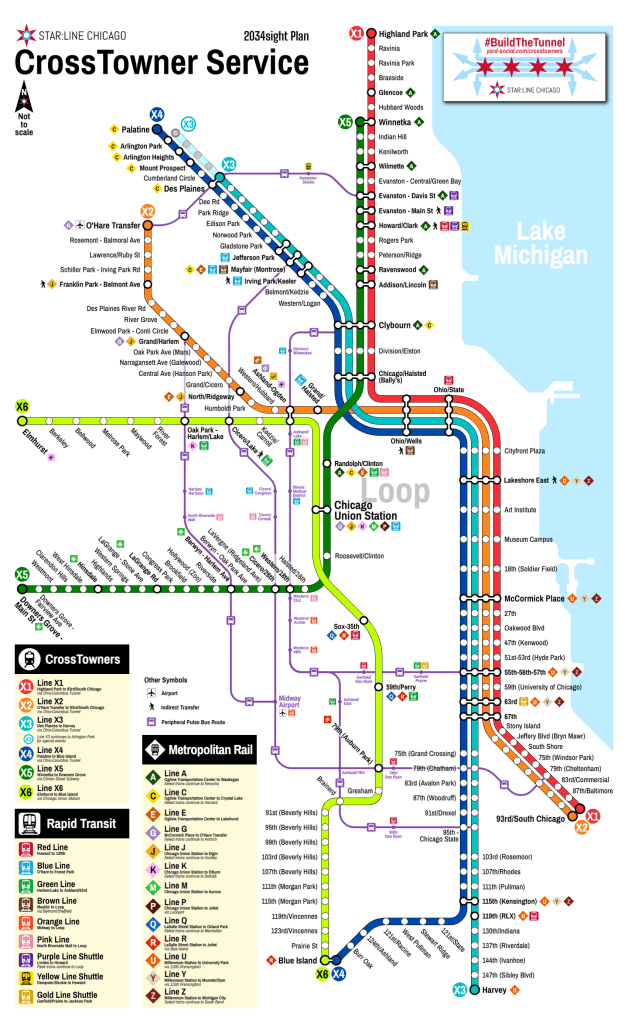


Comparison to CTA Thru-Running
New downtown tunnels would require a major capital investment in regional mobility, but the size and scope of the #BuildTheTunnel proposals are slightly smaller than the two existing CTA subway tunnels previously constructed in the mid-20th Century. Similar to what are now the CTA’s Red and Blue Lines, creating thru-running CrossTowners downtown would decrease travel times, improve connectivity and mobility, and help spur new development throughout the Chicagoland region.

Suburban Service
In either scenario, CrossTowners allow for existing Metra services on eight lines to be streamlined and simplified, resulting in higher speeds with fewer stops for riders throughout the region.

Download a PDF brochure for printable information about CrossTowners.
Project News and Updates
PDF Fact Sheets
- CrossTowners
- 2034sight
- CRCL Plan
- NEW: It’s Time to Build the Tunnel online | print
CrossTowners in the News
- July 19, 2024: Streetsblog Chicago
- April 15, 2025: Car Free Keith on YouTube
- April 29, 2025: A City That Works
- May 2, 2025: Active Transportation Alliance Movers and Shakers Ball
- January 7, 2026: “The future of Soldier Field is bear-ish without transit investment” (Streetsblog Chicago)
Contact
Follow/DM Star:Line Chicago on BlueSky: @starlinechicago.bsky.social