
Last Wednesday, Metra released the draft framework of their long-awaited 2024 fare restructuring. Readers may recall last fall, when Metra originally proposed more modest changes to the railroad’s pre-pandemic fare table and structure as part of the inevitable phasing out of the pandemic-era fare products such as the $100 Super Saver Monthly, the $10 Weekday Day Pass, and the $6 3-Zone Weekday Day Pass. Last fall’s proposal retained the current ten-zone system, converted Day Passes into a product akin to the pre-pandemic Round Trip Plus (a zone-based all-day ticket priced at the cost of two one-way tickets), and greatly lowered the multipliers for pricing monthly tickets. At the October 2022 board meeting, however, Metra’s board opted not to support the proposal, suggesting to Metra’s staff that they study more aggressive changes that better reflect changes in travel patterns post-2020.
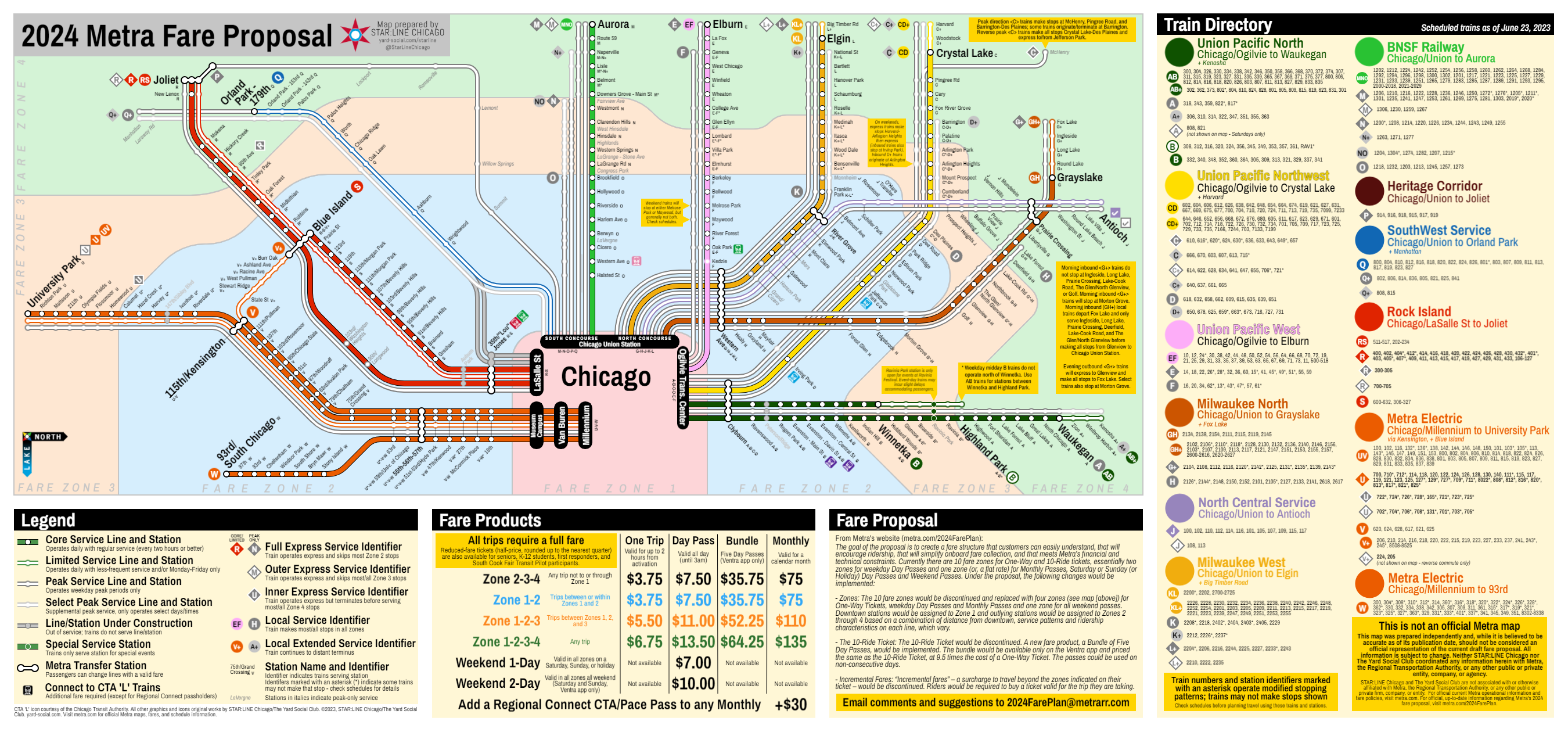
Thankfully, Metra’s staff took the board’s guidance to heart, and on Wednesday released their proposed plan. This blog created two alternative fare structures for consideration in the past, and if you squint there are some areas where Metra’s proposal at least rhymes with NEXT. Metra has official maps and fare tables posted on their website, but we’ve also created our own version for your review.
What We Like
The proposal consolidates the existing ten distance-based fare zones (lettered A through J) into four zones (numbered 1 through 4), based on various factors including geography, ridership patterns, and operational patterns. (The map above, which includes Metra’s current stopping patterns, highlights how in many places the dividing line between zones is where express patterns begin, which is a “value-capture” opportunity this blog has long supported.)
- Zone 1, the inner-most zone, includes only the four terminals (Ogilvie, Union Station, LaSalle Street, and Millennium Station) and the two downtown Metra Electric stations (Van Buren and 11th/Museum Campus).
- Zone 2, the next zone out, stretches out through the existing Zone C, generally overlapping the Chicago Transit Authority’s footprint. In a terrific move to improve regional equity, Zone 2 also extends deep into Zone D on Chicago’s South Side and into the south suburbs. (Rosemont and O’Hare Transfer, two current Zone D stations, are also included in Zone 2.)
- Zone 3, perhaps best described as the “inner express” zone, generally encompasses the inner-most stops in the collar counties (and the farther parts of suburban Cook), where on lines with express services most peak travelers have access to express trains. In the current fare structure, Zone 3 encompasses most of Zones D and E (and the entirety of the Metra Electric beyond Zone 2).
- Zone 4 is the outermost zone, encompassing the rest of the stations in the collar counties. Peak riders in Zone 4 generally have access to “superexpress” services on lines that run that style of service during the peak of the peak.
With only four zones, the fare table has been greatly simplified, with only three price tiers. As with the previous fare structure, the one-way fare is the base on which all other fares are calculated for each zone; in another positive change, the one-way fare has been replaced with a “One Trip” fare that technically is a two-hour pass, which therefore includes any transfers. Similar to last fall’s proposal, Day Passes will once again be zone-based and priced at the cost of a round-trip. One of the largest changes in this proposal is the elimination of 10-Ride tickets, to be replaced by Ventra app-exclusive 5-Pack Bundles of Day Passes with a similar 5% discount as current 10-Ride tickets. Finally, monthly passes will also be available, once again based on calendar month rather than any fixed 30-day product. (Regional Connect Passes, a $30 add-on to any monthly pass that includes CTA and Pace fares for the full month, will also continue to be offered.) Weekend Passes, both the $7 1-Day Pass and the $10 app-exclusive 2-Day Pass, will also continue to be offered. The fare structure also has no impact on the South Cook Fare Transit Pilot project, which is expected to expire before the new fares would take effect in early 2024. (An extension of the South Cook pilot is possible, but is likely considered independent of this fare proposal.)
In my opinion, the most exciting part of the new fare structure is the fourth “zone” fare: for any trip that does not require travel through Zone 1 — so any non-downtown trip — costs are the same as a Zone 1-2 ticket. In other words, Metra will offer flat fares for the entire region outside of downtown: Ravenswood to Clybourn will cost the same $3.75 as Harvard to Clybourn. This fare structure, combined with the same $3.75 price for Zone 1-2 trips, is a big step forward towards cost parity between Metra and CTA/Pace: indeed, the new $75 Monthly Pass for Zone 1-2 or Zone 2-3-4 trips matches the CTA/Pace 30-Day Pass.
Overall, the fare structure is a great step forward for Metra, and riders should support Metra’s efforts. While some riders will end up paying more out-of-pocket for fares, it’s important to acknowledge that the pandemic-era fares were always intended to be temporary, and eventually fares have to come back up to more sustainable levels. With this fare structure, however, the largest increases will only be borne by the riders who already receive the highest quality of services (collar county peak riders who get frequent express service to and from downtown) while promoting better fare equity elsewhere in the region, especially on Chicago’s South Side and in the south suburbs.
What We Don’t Like
That’s not to say the fare proposal is perfect, of course. There are still opportunities for improvement, and Metra’s actively soliciting feedback from the public anyway, so it’s worth taking some time to discuss these shortcomings and provide some potential alternatives.
First and foremost, the fare structure still lacks full integration with CTA and Pace fares, a long-standing issue that this proposal still does not address. While that initiative as a whole is likely out of scope for Metra’s fare structure (and should be spearheaded by the Regional Transportation Authority regardless), it’s still disappointing that more isn’t being done to break the fare barriers between agencies. While it’s great that some monthly passes will reach parity with the CTA/Pace 30-Day Pass ($75), there now needs to be a “reverse” Regional Connect Pass: a $30 add-on to a CTA/Pace 30-Day Pass that includes Metra rides between Zones 1-2 and/or Zone 2-3-4 trips. If Metra is going to become a proper regional rail operator, encouraging city residents to use Metra for more intracity trips requires better integration with the CTA.
Secondly, the ghosts of the commuter rail paradigm are still very present in this fare structure, even if it does represent a progressive step forward. Monthly tickets are still tethered to the calendar with tickets valid from the first day of the month through the last day of the month rather than providing a dynamic 30-day pass product like other 21st Century operations (including the CTA and Pace, of course). While I’m sure there’s some esoteric reason why they’ll say that isn’t feasible — something about Ticket by Mail or 30-year-old commuter benefits programs with private companies restricting the process to calendar months or something else along those lines — as long as Metra is using Ventra app-exclusive ticket products elsewhere, there’s also no good reason why a 30-Day pass can’t also be offered on the app.
That leads to another point of criticism: “paywalling” discounted fare options like the new bundled Day Passes and the $10 2-Day Weekend Pass as app-exclusive products that require a smartphone and a Ventra account to utilize. In the pandemic era, the only fare product where prices were raised — cash customers wanting to purchase a 2-Day Weekend Pass, who now must buy two $7 1-Day Weekend Passes for a 40% markup — also coincides with Metra’s strongest ridership recovery periods (weekends, where recovery rates are consistently better than 75%, compared with weekdays skimming along at or below 50%). With Metra’s forthcoming systemwide deployment of ticket vending machines likely coming online before this new fare structure takes effect anyway, it’s time to do away with app-exclusive fare products.
A combination of the previous two paragraphs leads to my perhaps largest critique: it’s a bad idea to eliminate incremental fares. For the uninitiated, incremental fares are distance-based “add-ons” that allow riders with a ticket for a particular zone pair to ride beyond the zone pair on the ticket to a further zone, with a discounted rate that was generally just the difference in ticket prices rather than requiring a whole new fare. For instance, when I lived in Itasca and was a downtown commuter, I would purchase a Zone A-E monthly ticket. However, if I were to visit a friend in Hanover Park (Zone F) after work, rather than purchasing a Zone A-F ticket ($7.25) I could show my A-E ticket and purchase an incremental Zone E-F ticket from a conductor for only $1.00. Metra’s incremental tickets are priced at $1.00 for the first zone and $0.50 for every additional zone thereafter. In the pandemic era, incremental tickets are rarely used, since Super Saver Monthly tickets are a flat $100 across the board and conductors accept them as valid fares regardless of purchased zones, which means the only real market for incremental fares are on 10-Ride tickets. Metra also doesn’t particularly like selling incremental tickets: they are not listed on Metra’s (current) fare website, and you have to go all the way to Page 9 in the official fare policy document to see them mentioned. They are not offered in the Ventra app and are only available from conductors (which also means they’re a cash-only product), which makes incremental fares a relatively time-consuming transaction on board that forces the conductor to do some quick math for ultimately only a buck or two. As such, Metra is proposing eliminating incremental fares entirely as part of the new fare structure; instead, every trip will require a valid full fare.
In a commuter rail paradigm, this would not be a major issue; after all, the system is designed to bring a rider “in” during the morning and back “out” in the evening, so most riders would have no real reason to travel further into the hinterlands, and even so, all non-downtown trips are only $3.75 anyway for those rare occasions. However, if Metra is serious about becoming a regional railroad, that trip binary is the antithesis of what a fare structure should provide. This will acutely affect riders in Chicago neighborhoods and in inner-tier suburbs within the new Zone 2. If a monthly pass effectively only covers a fraction of trips to be taken in the course of a month, with a passenger paying out of pocket for the rest of the trips, the attractiveness of a monthly pass product decreases — even though the trips are ostensibly the same cost and theoretically should be covered by the monthly pass. For instance, a Zone 1-2 Monthly Pass can be defined as a $75 ticket that encompasses unlimited $3.75 trips between Zones 1 and 2, and a Zone 2-3-4 Monthly Pass can likewise be defined as a $75 ticket that encompasses unlimited $3.75 trips between Zones 2, 3, and 4. A rider who is commuting to an office five days a week — let’s say 20 days a month for 40 total trips — would pay the same $75 as someone traveling 10 days a month for 20 total trips. However, if that second person also heads out into the suburbs on the weekend, that rider will now have to pay for those trips out of pocket despite being the same per-ride cost of $3.75 that the Zone 1-2 monthly pass would otherwise cover, creating a system where a rider ends up paying more on fares despite riding fewer trains at the same price point. Since Metra’s data shows that monthly pass holders ride more frequently than non-monthly pass holders, it’s in Metra’s best interest to close this “donut hole” of fare policy.
There are relatively easy fixes to this issue: for instance, Metra can simply make policy that any monthly pass also includes Zone 2-3-4 rides for the month, similar to how Metra’s pre-pandemic policy provided that all Monthly Passes include Weekend Passes regardless of fare zone. (The omission of a similar program in the new fare structure is also noteworthy and another potential negative, and more clarity is needed as to whether that initiative will resume.) However, that would not resolve the scenario I mentioned earlier, traveling outside the zones on a monthly ticket and paying an incremental fare instead of a new full fare. In that case, despite holding a $110 Zone 1-3 Monthly Pass for Chicago-Itasca, a trip continuing to Hanover Park would require a new $6.75 One Trip fare instead of an incremental product. Once again, this is a policy that would discourage additional train trips even by monthly ticket holders, which means a remedy should be considered.
On Metra’s new fare proposal website, there’s a dedicated section regarding why incremental fares are not included:
We are proposing to eliminate incremental fares – a surcharge paid to the conductor to cover travel beyond the zones indicated on your ticket – because one of our goals is to simplify onboard fare collection. Selling incremental fares slows down fare collection for conductors.
–Metra
There are three issues with this rationale, however: first and foremost, the aforementioned ticket vending machines should be deployed systemwide before the new fare structure takes effect, and therefore all fare payment should be handled pre-boarding; there’s no reason why incremental tickets can’t be required to be pre-purchased like any other fare, taking the conductor out of the equation entirely. (Pre-payment is also a prerequisite if Metra ever ends up moving to proof-of-payment anyway.) Secondly, since Metra is using other app-exclusive fare products anyway, there’s no (additional) harm in offering incremental tickets as app-exclusive purchases for monthly riders who purchased their monthly pass via the app. The point of sale once again is entirely off the train, the app can be automatically programmed to calculate incremental fares as needed, and the zone pairs on the digital ticket can be automatically updated to reflect the new validity for that particular trip. Finally, with a much more simplified fare structure, there’s also far fewer incremental products that would be needed anyway. Rather than having conductors try to figure out on the fly how much an incremental Zone D to Zone H ticket should cost, there are really only two options:
| Monthly Ticket | Distant Zone | Product |
| Zone 1-2 Monthly | Zone 3 | 1-Zone Incremental |
| Zone 1-2 Monthly | Zone 4 | 2-Zone Incremental |
| Zone 1-3 Monthly | Zone 4 | 1-Zone Incremental |
| Zone 2-3-4 Monthly | Zone 1 | 1-Zone Incremental |
In the interest of fairness and to ensure no one can “game” the system, it’d be reasonable to prohibit incremental tickets for Zone 2-3-4 Monthly Pass holders, or to require a 2-Zone Incremental regardless of boarding/alighting zone. That said, to promote more regional use for non-commute trips, there needs to be a more reasonable option that both encourages more monthly pass sales as well as inclusion (or at least discounting) of “extra” trips to farther zones.
Extras
All said, the proposal is still quite good, and I wholeheartedly support its implementation with the aforementioned tweaks. The shortcomings listed above are hardly fatal flaws and can be easily managed or mitigated within the existing contours of the proposal. Metra’s staff should be proud of the hard work they’ve put into this proposal, and I hope the proposal receives the strong support from the public that it deserves.
But, of course, there are other add-ons that would really take this proposal to the next level:
- Lengthen the One Trip validity to three hours. Moving One Trip tickets to a time-based pass that includes transfers is a huge step forward, but until Metra gets further along with converting their regional rail goals into schedules that better reflect that commitment, a two-hour window may not actually be enough time to accommodate a transfer. (Plus it already takes 110 minutes to get from Harvard to Ogilvie.) If Metra wants to ensure that a One Trip window couldn’t cover a round trip errand — or maybe they’d be fine with that, that’s also an option — the One Trip could officially only be valid for trips heading away from the origin station. (It’d be easy enough to print a station code on tickets, but that would be one more thing for conductors to check as they validate fares.)
- Make Fridays weekends. Metra’s monthly data has consistently shown that, while weekday ridership as a whole continues to inch up, Fridays are continually lagging behind and only have a fraction of riders compared to Tuesdays, Wednesdays, and Thursdays. The May data tells a really interesting story: Fridays were the worst-performing weekday of the month once again, but ridership on the day before Memorial Day went up despite the long weekend. To me, this suggests that despite lower commuting rates on Fridays, a significant portion of the riders on Fridays are traveling for leisure. As such, Metra should consider offering the $7 1-Day Weekend Pass on Fridays as well to generate more ridership. (Metra should also consider Fridays weekends from a scheduling perspective as well, reallocating underutilized Friday peak trains to Saturdays and Sundays to close those multi-hour headways, but that’s a different blog post.)
- Night passes. Similar to leisure trips on Fridays, there’s stuff to do downtown all week long, and Metra should offer discounted fares for night trains as well. Especially during off-peak periods when Zone 3 and 4 riders are still being asked to pay premium fares for trains that make all stops to get to and from downtown, Metra should either offer $7 passes or expand the Zone 2-3-4 $3.75 fare to include Zone 1 after a certain time on weeknights.
- Official pre-payment policy. Touched on this earlier, but with a new fare structure and new ticket vending machines coming online, now is the time for Metra to officially create a pre-payment policy for all trains. Pre-payment allows conductors to focus on the safe operation of their trains rather than selling tickets onboard and is a necessary precursor to a true proof-of-payment system or eventually going to a tap-in-tap-out structure. (Personally I’m still not sold that Metra needs to invest in full tap-in-tap-out capabilities or have official “paid” versus “unpaid” areas of stations, but the option should be eventually considered regardless.)
What do you think? Love it or hate it, or if you thought of stuff I didn’t, Metra is actively seeking comment on the proposal. Visit metra.com/2024FarePlan, and send your comments to 2024FarePlan@metrarr.com. More widespread public outreach activities will likely be hosted by Metra throughout the summer and into the budget season this October, so there will be plenty of time to make your thoughts heard. However, this fare proposal is pretty solid already, and I look forward to its future implementation next year.
