While the Bears continue to suck most of the political oxygen out of the room with their current will-they-or-won’t-they soap opera between Arlington Heights and Indiana, thankfully the city still has a few major irons in the fire regardless of wherever the McCaskeys end up deciding to exploit build.
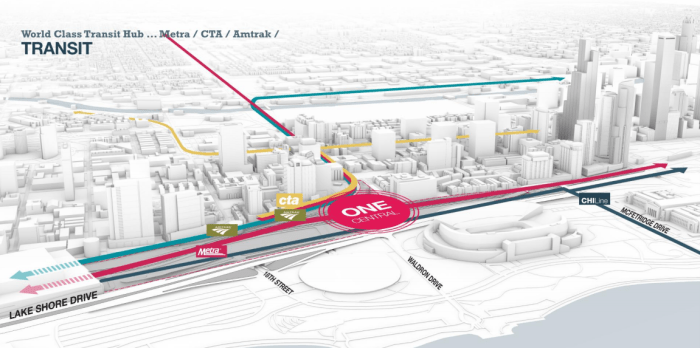
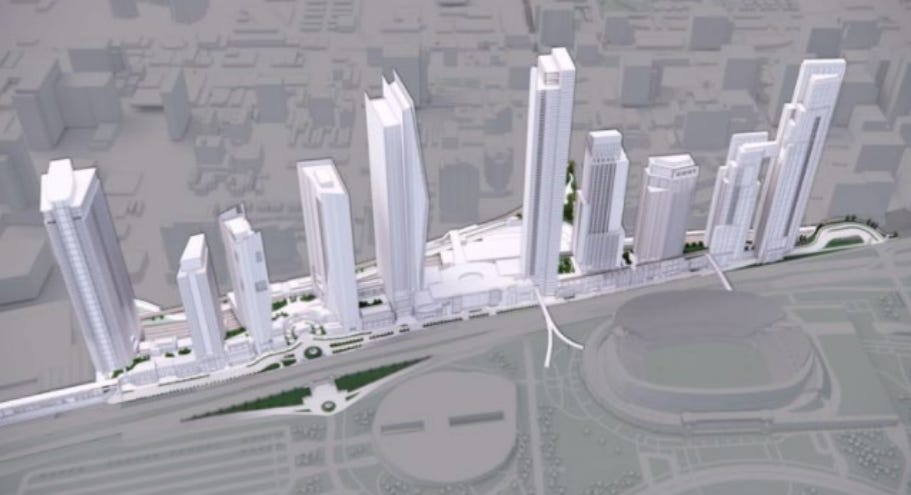
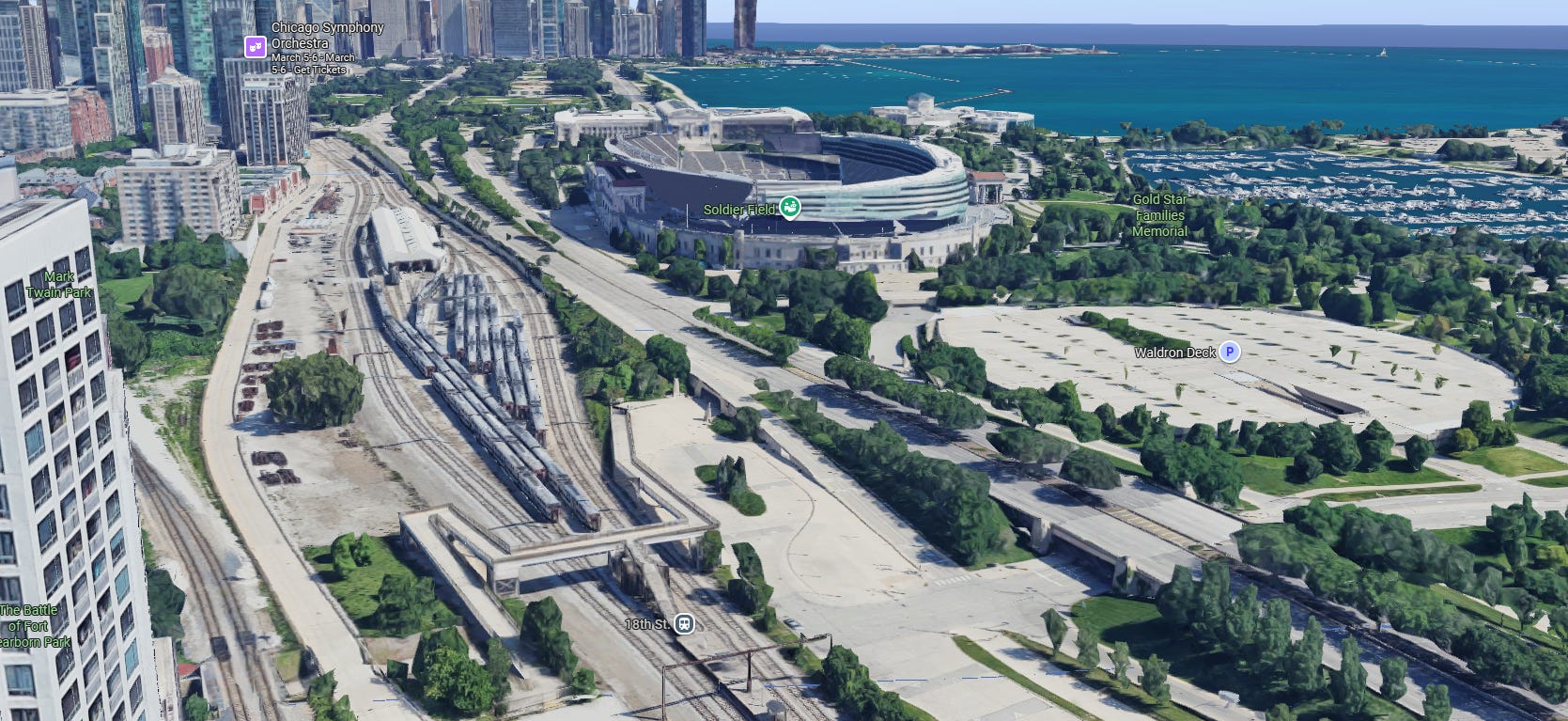
All eyes might be on Soldier Field, but just across DuSable Lake Shore Drive lies another potential megaproject site: ONE Central. A true megaproject, ONE Central was first pitched back in 2019 to add a bunch of skyscrapers over the Metra Electric tracks between McCormick Place and the Field Museum. With a site spitting distance from the Lake and adjacent to the burgeoning South Loop neighborhood, a megaproject to add thousands of commercial, office, and residential tenants on railroad air rights seems to make a lot of sense… unless the pedestal to build it on ends up costing $6.5 billion.
Of course, any rational developer would try their hardest to get the state to pay for that instead of having it come out against their bottom line, and the best way for a developer to make a case for state support to build that sandbox for them to play in is to play up the public benefits of the project. In this case, ONE Central’s pedestal wasn’t simply the base for supertall skyscrapers, but rather it would actually be a world-class transit center for CTA, Metra, NICTD, Amtrak, and anyone else the developer could think of. As a result, the General Assembly passed the Public-Private Partnership for Civic and Transit Infrastructure Act, authorizing the State of Illinois to contribute nearly $6.5 billion for the project.
Unfortunately for the project, transit and transportation advocates were extremely skeptical of ONE Central’s transit-oriented claims, and many of the initial transit projects themselves were dubious: the project would include an ‘L’ branch from somewhere in the vicinity of 17th Junction (where Midway-bound Orange Line trains currently split off from the Green Line), but with no clear indication of how the service would actually operate: is it a new line? Are we adding a branch to the Orange Line or Green Line or Red Line or something totally different? Would these trains go to the Loop or to Midway? Is anything actually constructable over — or under — Canadian National’s freight tracks? Would additional properties beyond the project envelope be needed to tie into the existing network?
On the commuter rail side, the project called for reverse-branching Metra’s busiest line (BNSF), meaning half of Metra’s busiest trains would now miss downtown entirely, cutting across the St. Charles Air Line and terminating at ONE Central rather than Union Station. This would almost certainly be a non-starter for Metra (to say nothing of the significant additional amounts of operating funding, logistics, and additional infrastructure needed to turn and/or lay over rush hour trains somewhere near McCormick Place, also not included within ONE Central’s footprint), and for the suburban communities along the BNSF.
Many readers may also remember that in 2020, there was a global pandemic that dramatically upended day-to-day lifestyles and work patterns in urban cores around the world. Additionally, with the Bears announcing their intent to vacate Soldier Field, the fundamentals of the ONE Central project became even shakier. As part of the state’s due diligence, Illinois commissioned a feasibility study on the project, which was completed in 2025. The results of the study convinced Gov. JB Pritzker to pull the plug on public support for the project entirely. Today, the OneCentralChicago.com website is still live but only consists of a static “coming soon” page that appears to have not been updated since 2023.
Alas, today ONE Central remains a megaproject in search of a megaproject.
A Brief Post-Mortem
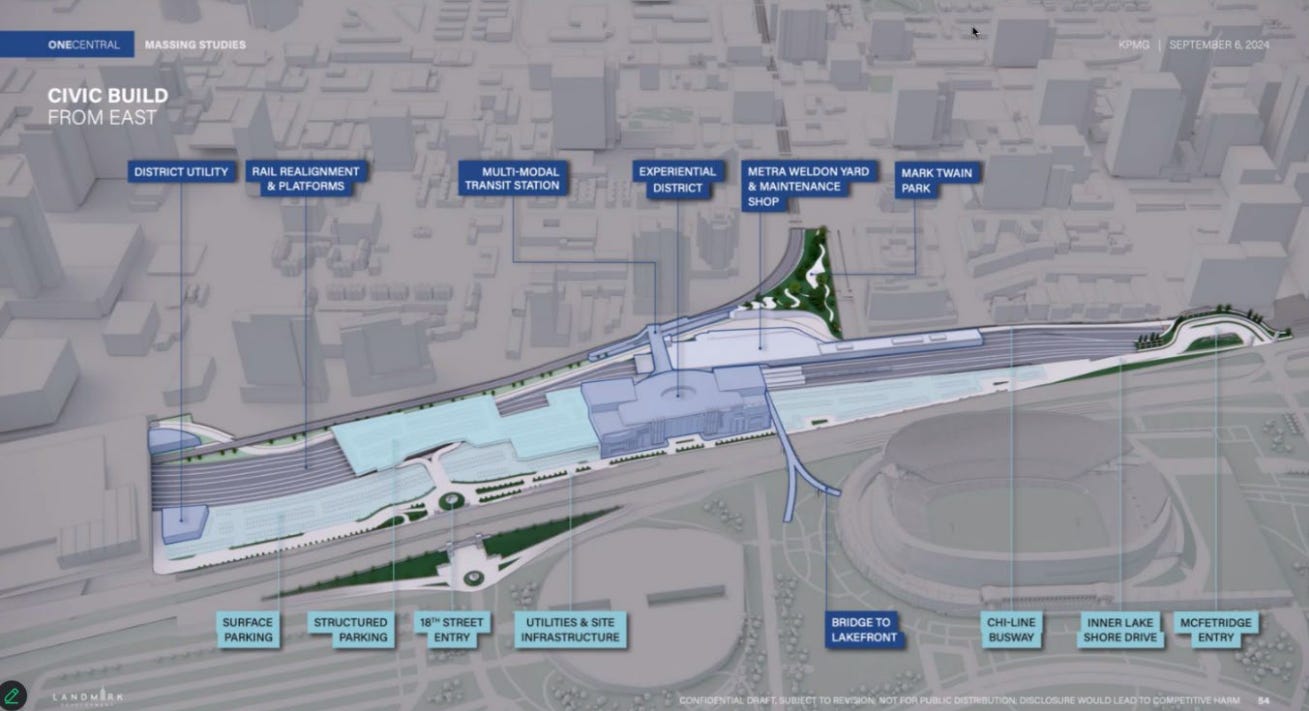
Let’s dive back into the latest transit proposal for ONE Central. Prior to the feasibility study’s initialization, ONE Central modified their proposal to drastically lower the public-facing cost to an estimated $2.75 billion, or a 58% decrease from the previous $6.5B price tag. The modified proposal relies on far less decking over the Metra tracks, with more of the key vertical infrastructure on terra firma rather than a bridge deck by shoving the Metra tracks and the McCormick Busway1 as far west as possible within the site envelope.
“Civic Build” ONE Central proposal as published in the 2025 Feasibility Study (that is publicly available online).
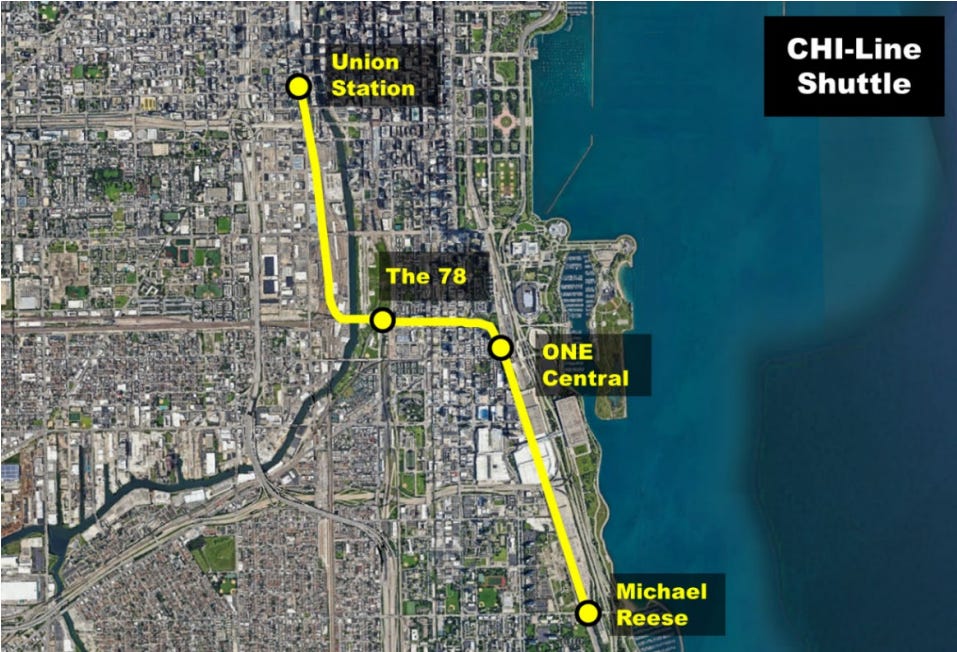
In addition to reducing the amount of decking required, the latest ONE Central proposal also gives up any direct CTA ‘L’ connection, now relying on a “CHI-Line Rail Shuttle”, a train that would connect ONE Central to the Red Line (a new transfer station in the southern portion of The 78 is proposed, but not included in the cost) and to Union Station.
“CHI-Line Shuttle” concept, with trains connecting ONE Central to the Michael Reese Hospital site, The 78 (with a Red Line connection at a future infill station), and Union Station. (Source: Feasibility Study)
The feasibility study notes some potential impacts that could negatively impact the potential success of the CHI-Line Shuttle: namely, the concept relies upon Amtrak’s completion of CHIP, being able to use the St. Charles Air Line bridge, and negating potential conflicts with Metra at the Rock Island crossing as well as freight traffic on the Canadian National line.
Not mentioned in the feasibility study but also a concern: whether a Red Line station at The 78 is financially (and physically) feasible. Where the CHI-Line Shuttle would cross the Red Line, the Red Line is on a downward curving slope between the subway portal near 16th Street and the Roosevelt subway station. Notably, some local neighborhood groups have shifted towards advocating for an infill Orange Line elevated station rather than a Red Line subway station.
Can’t help but wonder if there’s an alternative to the CHI-Line Shuttle that could avoid those potential pitfalls…
Zooming Out
Let’s quickly take a look at some of the other megaprojects discussed in this post:
Strategically investing in infrastructure to support and leverage private investment is a smart move for the public sector, especially if those infrastructure investments are proactively coordinated, seamlessly integrated with the regional network, and will provide all-day, seven-days-a-week, year-round benefits to Chicagoland residents, workers, shoppers, and visitors.
ONE Central’s transportation proposals didn’t pencil out at least partially because they largely failed to account for regional benefits. But, if the CHI-Line Shuttle instead looked something like this…
…and if these trains connected not only ONE Central and Union Station but also:
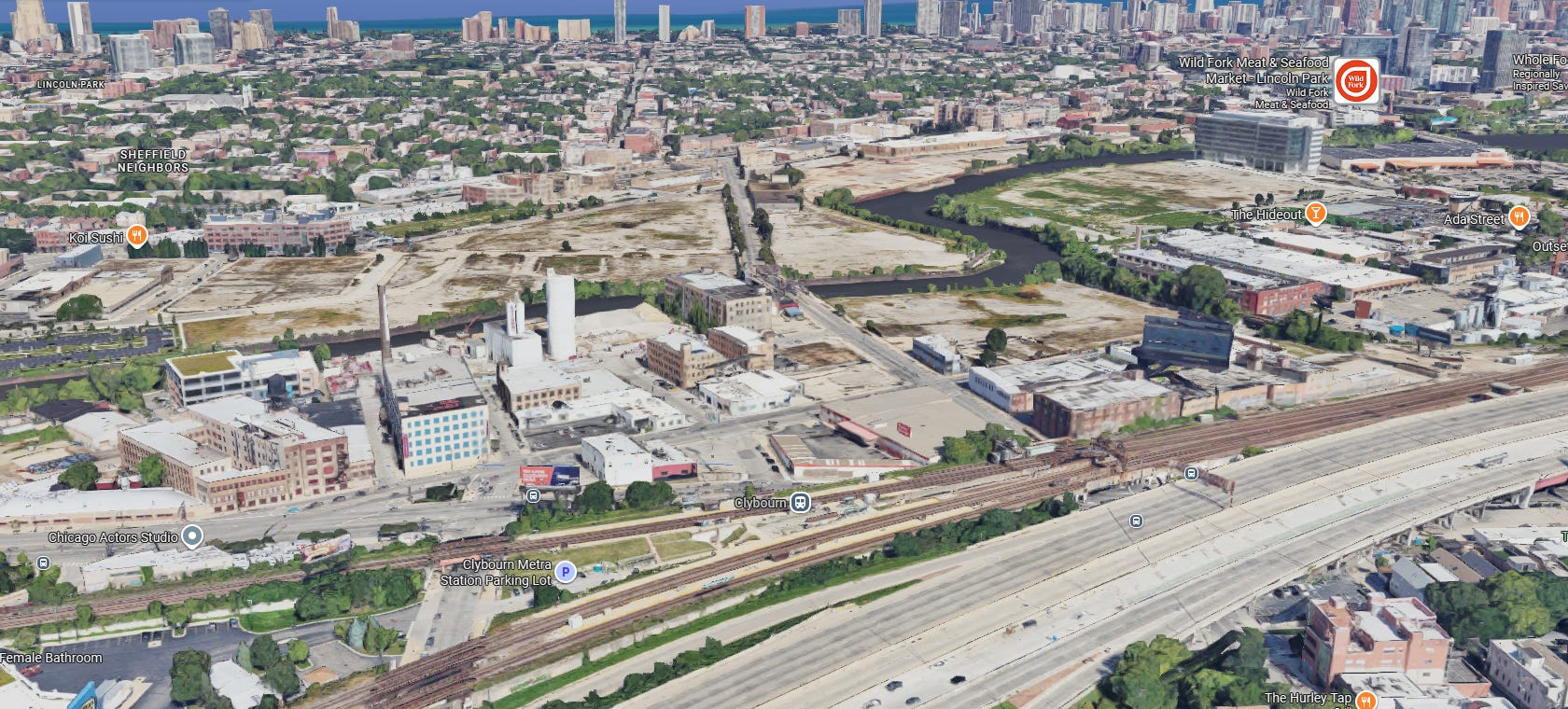
Foundry Park (Clybourn)
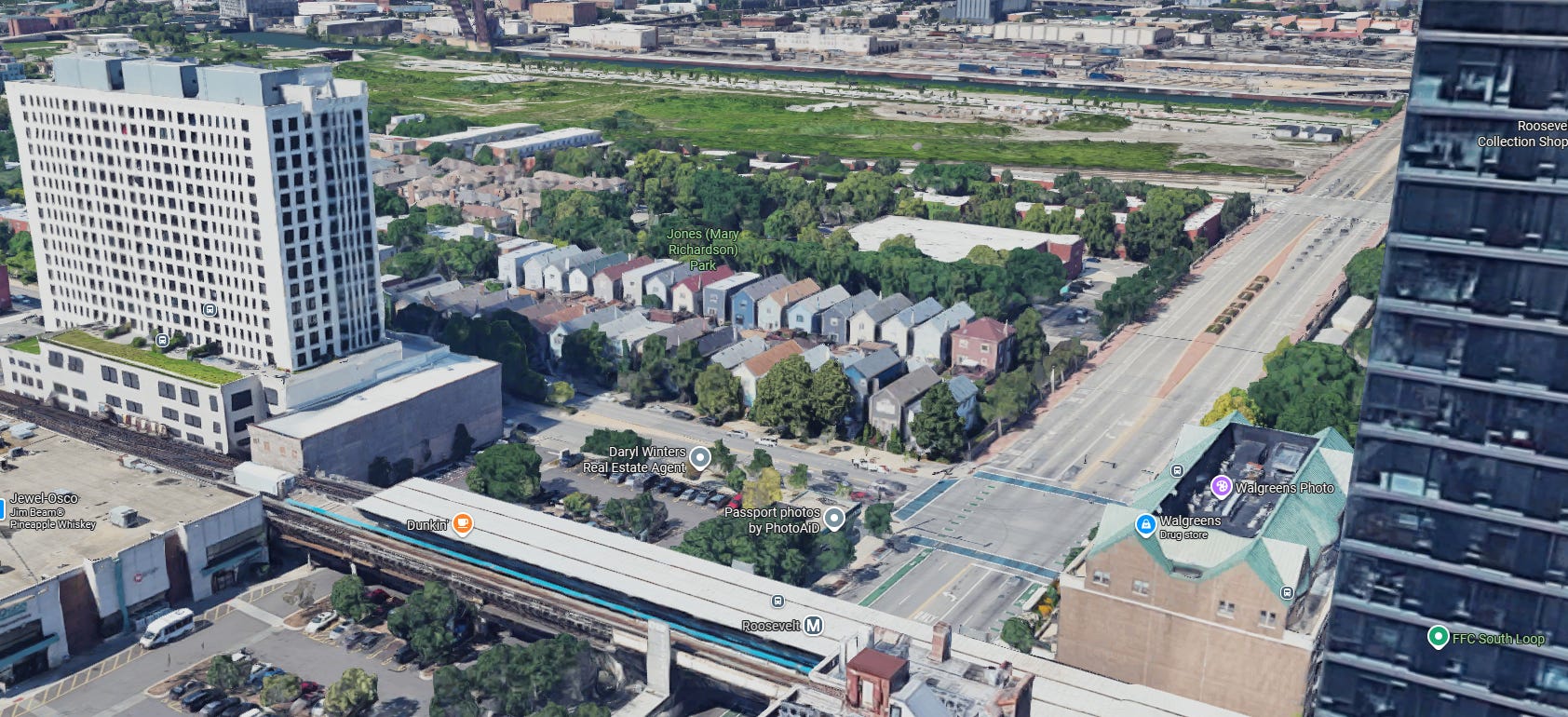
and The 78 (Roosevelt)
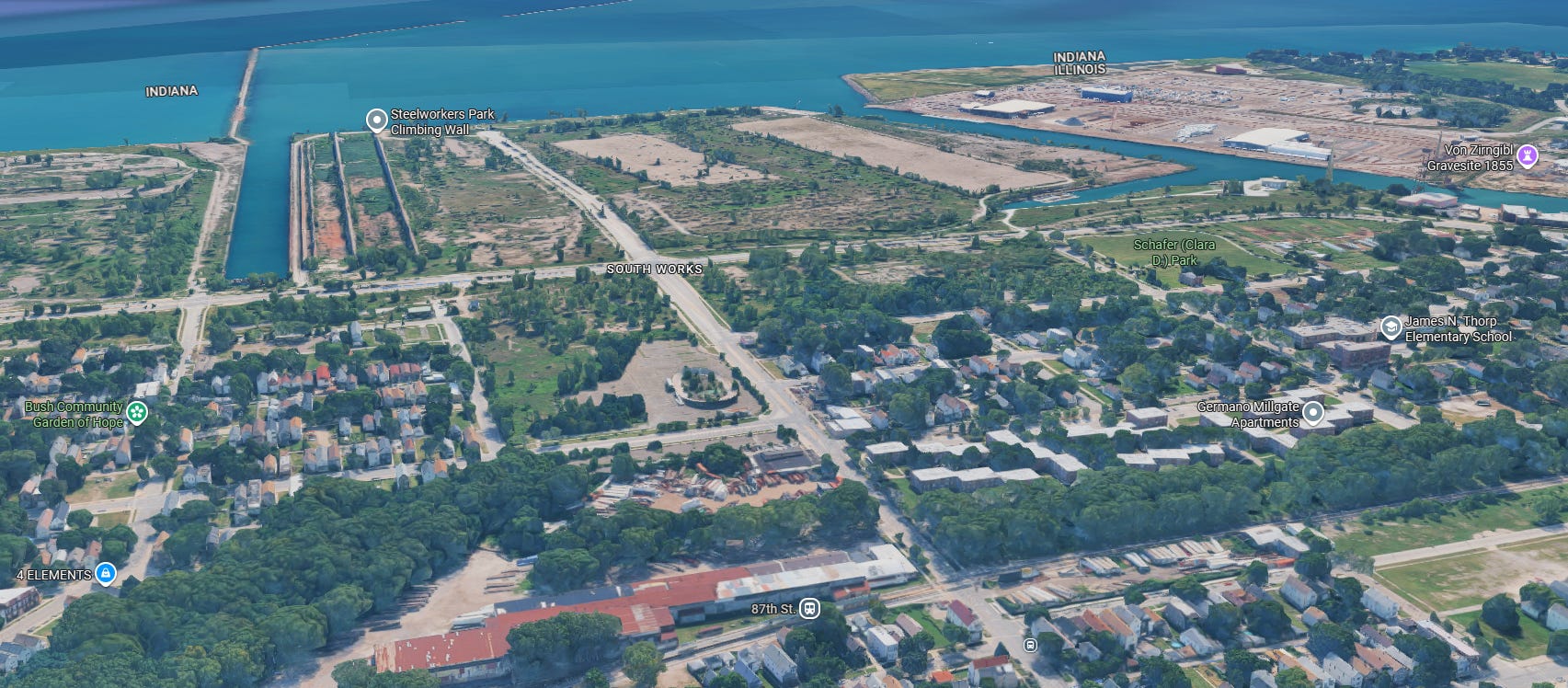
and the Quantum Park (87th/Baltimore)
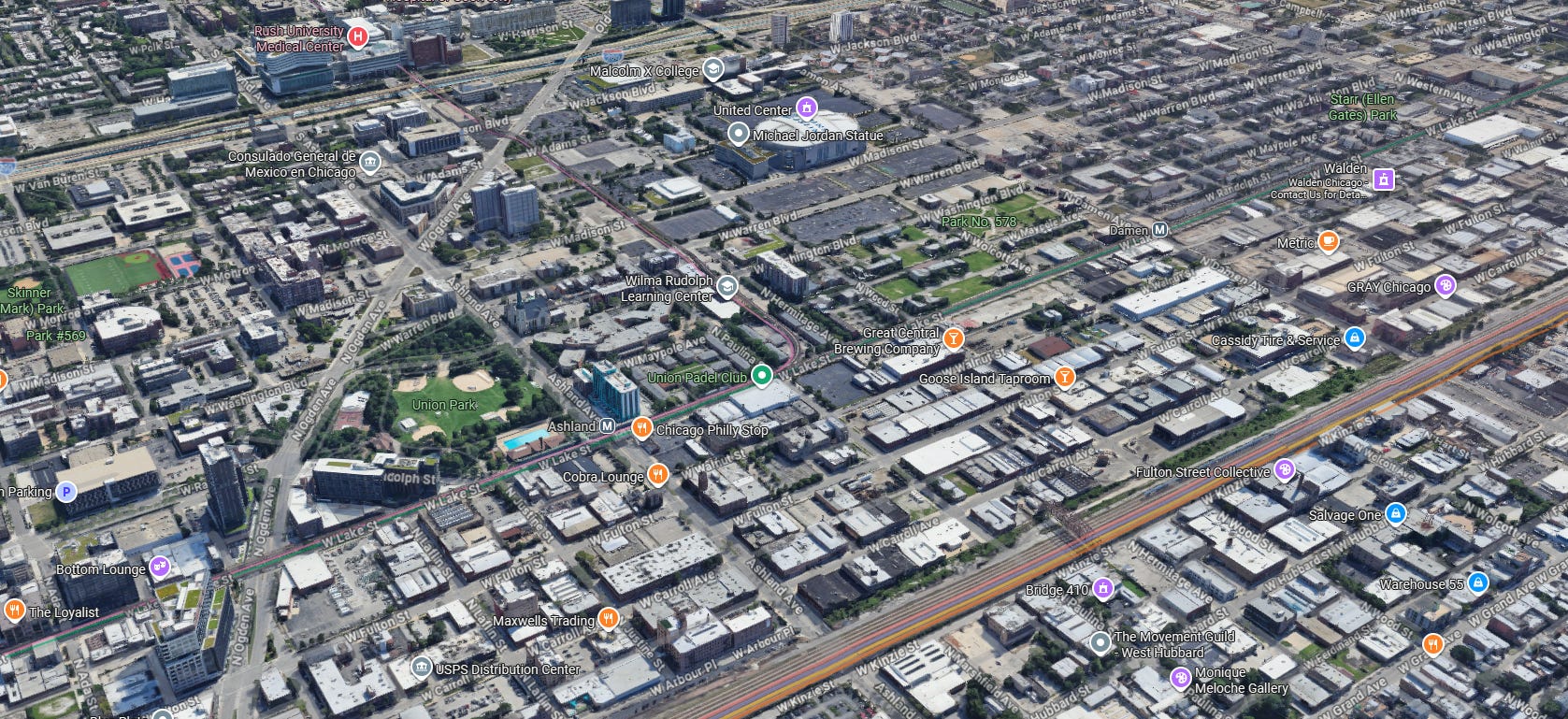
and The 1901 Project (Ashland-Ogden)
and Soldier Field (18th)
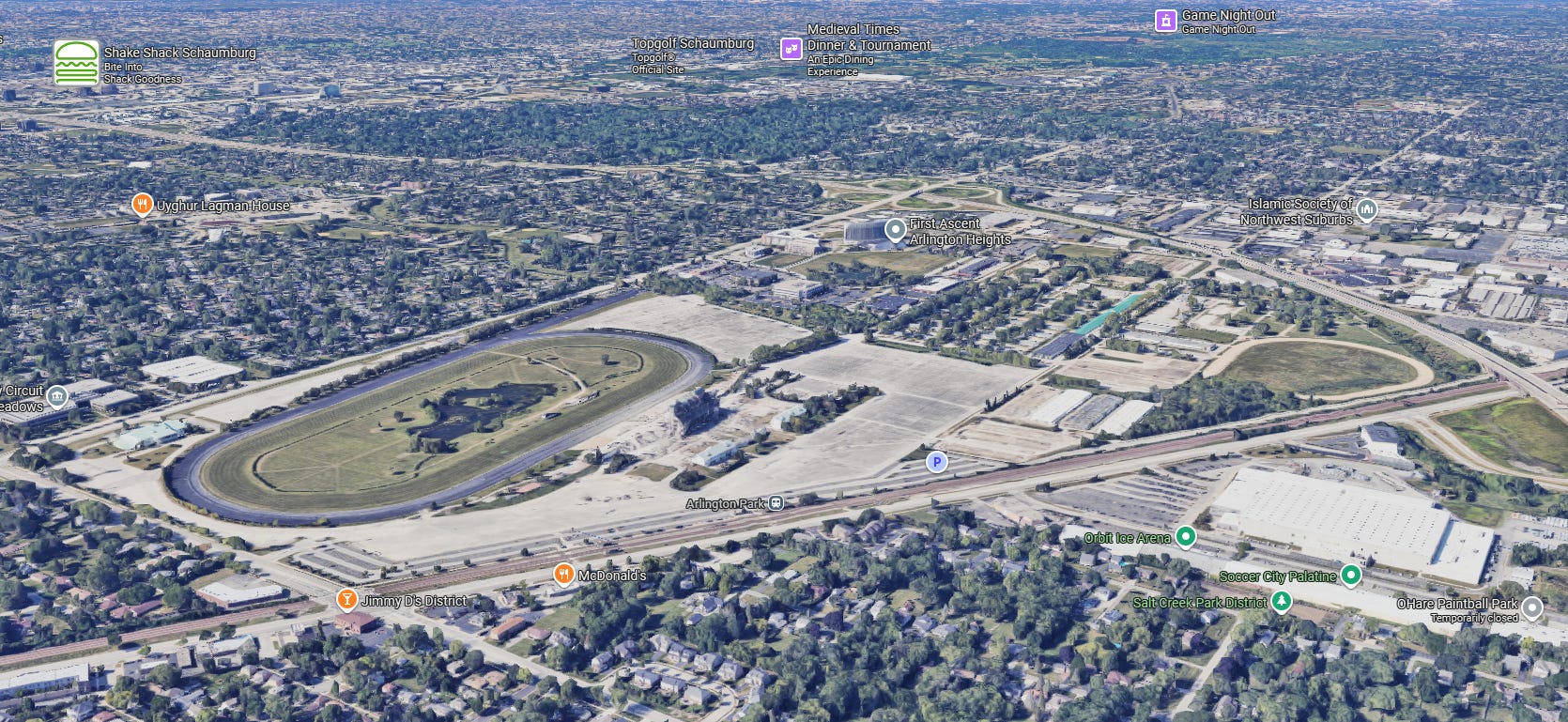
and Arlington Park (Arlington Park)
(and Northwestern University)
(and O’Hare)
(and the University of Chicago)
(and Sox Park)
(and… well, you get the idea.)
Regional rail is the megaproject’s megaproject: with a handful of strategic projects to connect the infrastructure we already have, we can stretch our public investments far beyond what was previously possible to better leverage private-sector capital throughout all of northeastern Illinois.
Strategic, transformative, ambitious-yet-attainable transit investments to unlock Chicagoland.
It’s time for CrossTowner regional rail. It’s time to #BuildTheTunnel.
The revised transit proposal includes the previous “CHI-Line Circulator” bus corridor concept utilizing the McCormick Busway to connect ONE Central to Lakeshore East. In the interest of brevity, this post does not detail the Circulator, but additional detail can be found on pages 14-16 of the feasibility study. ↩︎
It can be challenging, however, to envision how such a system could be crafted, developed, built, and operated; indeed, it is one of the most common questions we’ve received. There are multiple existing constraints that need to be identified and mitigated, and major capital projects that would need to be built. The Chicago Terminal, as railroaders generally refer to the Chicagoland rail network, is an incredibly complex place to operate trains.
To this end, this post will attempt to identify a potentially-plausible phased approach to get Chicagoland from today to the regional rail network our region deserves. The service plans and proposals included herein are, of course, entirely unofficial: the CrossTowner regional rail proposal has always been, and continues to be, an exercise in imagining what could be rather than an official or professional regional plan. These plans have not been vetted by any of Chicagoland’s transit agencies, and rely exclusively on publicly-available materials and observations. Much further study and planning would be required before any implementation begins, but this post is an attempt to show how we could eat the proverbial elephant one bite at a time.
Before We Begin
Some housekeeping before we get into the details: this post will rely heavily on maps that document different phased implementation components of the larger CrossTowner regional rail network vision. In some cases, the phases are irrelevant: some infill1 stations, for instance, could be constructed at any time (or not at all). In other cases, it may make sense to move certain components up or push them back based on cost, constructability, political realities, and so on.
These maps also use a standardized “netgraph” approach to displaying service frequencies: each line represents one round-trip per hour. This allows an easier way to communicate average headways, or times between trains. Note, however, that these are averages: more detailed service planning would be required to determine more realistic schedules. Additionally, due to the realities of needing to balance local service with express service in some cases on shared tracks, perfectly-balanced headways all-day may not be entirely feasible.
Note that these maps all show proposed off-peak service levels. Additional trains would operate during peak periods, likely including Metra’s typical battery of suburban express services; these trains are not shown.
A quick mathematics cheat sheet:
One line = one train per hour = 60 minutes between trains
Two parallel lines = two trains per hour = 30 minutes between trains
Three parallel lines = three trains per hour = 20 minutes between trains
Four parallel lines = four trains per hour = 15 minutes between trains
Five parallel lines = five trains per hour = 12 minutes between trains
Six parallel lines = six trains per hour = 10 minutes between trains
Eight parallel lines = eight trains per hour = 7.5 minutes between trains
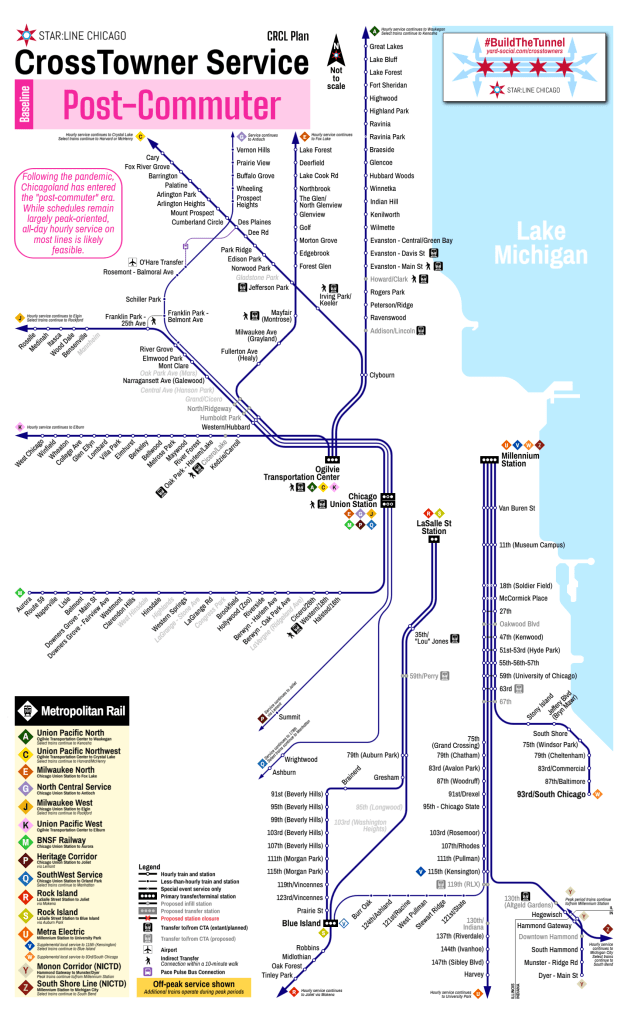
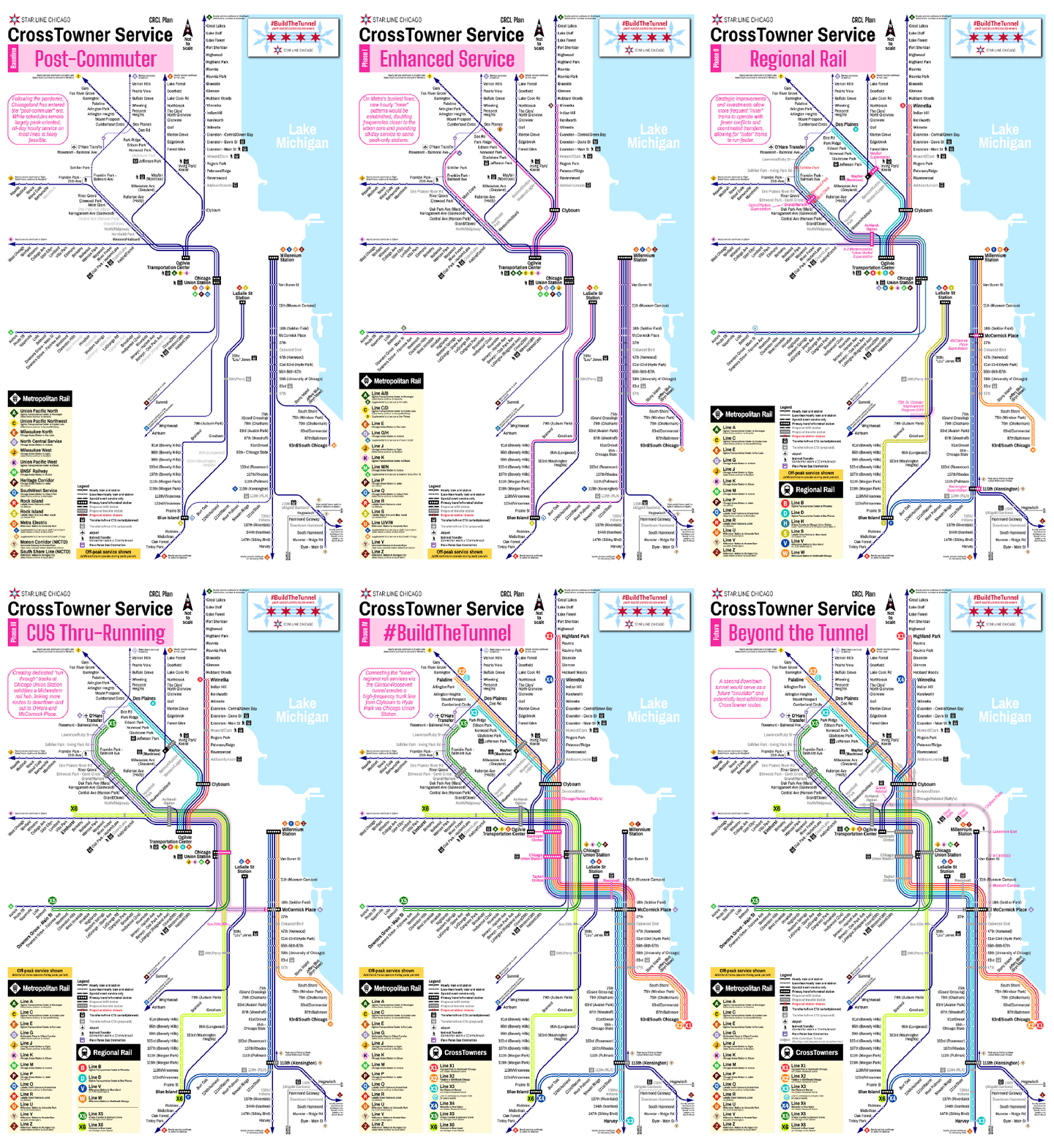
Thinner lines indicate lines that operate less than hourly; these stations are shown “inverted” (a solid-colored station with a white border, rather than a white circle with a colored border). Additionally, lines in future phases are shown by their “Yard Social Standard” identification scheme that is also shown on other CrossTowner materials. The below “baseline” map provides a comparison to that scheme and the existing line naming system.
The Regional Rail Road Map
Baseline: The Post-Commuter Era
We begin with the “Post-Commuter” era: Metra has already committed to transitioning their fundamental operating model from “commuter rail” to “regional rail”. Preliminarily, this can be best summarized as “hourly everywhere”: while some level of peak-period focus is warranted based on present ridership, the larger goal is to provide bi-directional all-day service throughout the service area. At present, Metra has been activelymoving towards hourly headways wherever possible.
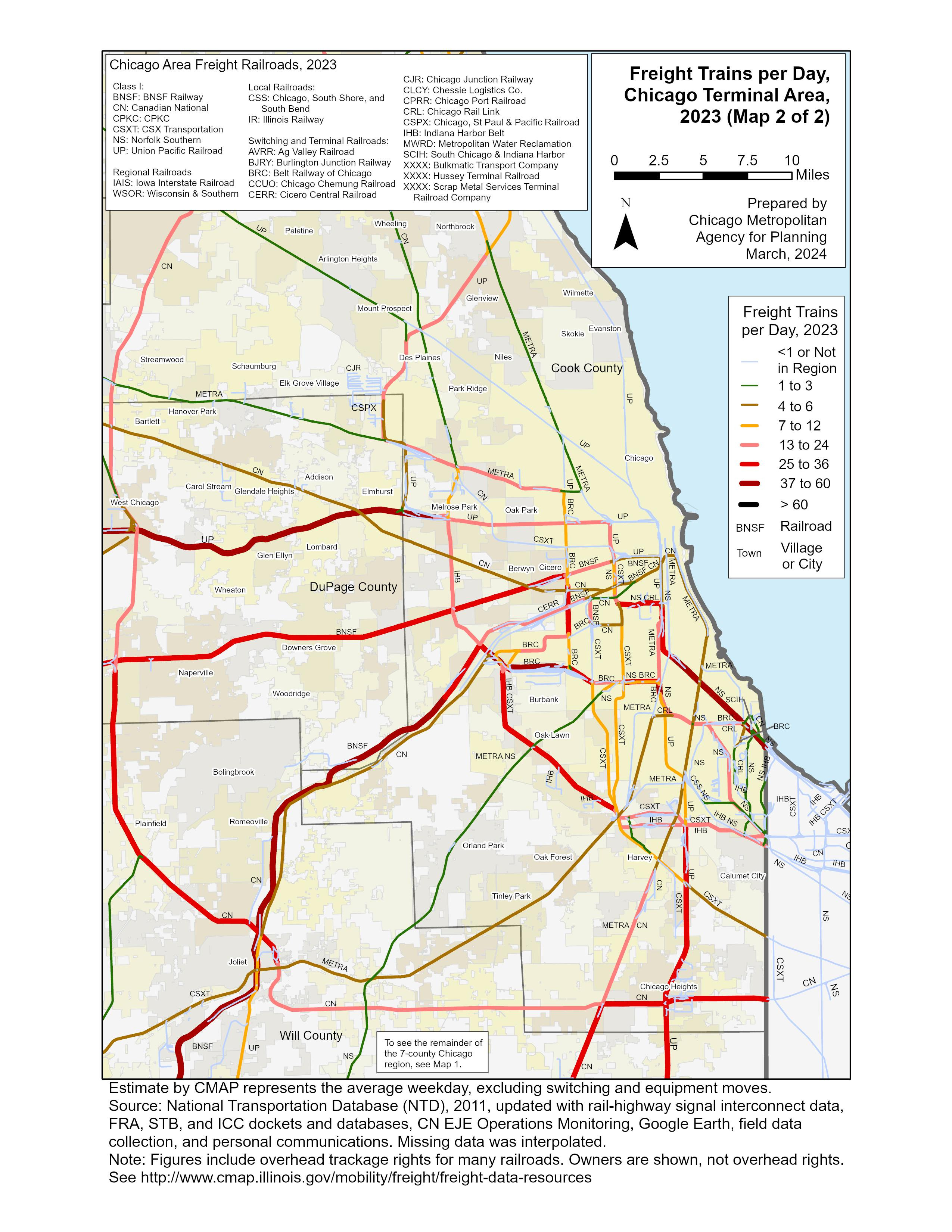
Unfortunately, that is not feasible everywhere: freight conflicts at numerous locations on the Heritage Corridor and SouthWest Service, as well as some single-track chokepoints on the North Central Service, will make all-day hourly service challenging from an infrastructure perspective. Additionally, on most lines Metra remains at the whims of freight railroads that either control the lines outright or exercise a high degree of autonomy that prevents Metra from easily increasing service. These constraints are one of the primary reasons why Metra cannot easily add additional service, and they need to be a political priority for our region as the NITA era begins.
For the purposes of this post, let’s assume that they can be mitigated to some degree: Metra will need to continue to share tracks with freight traffic, and will need to ensure freight railroads can still reasonably operate throughout the day, but where freight traffic is lighter, Metra and the freights could come to some sort of agreement to add service.
For reference, here is a recent CMAP freight rail volume map, as of 2023.
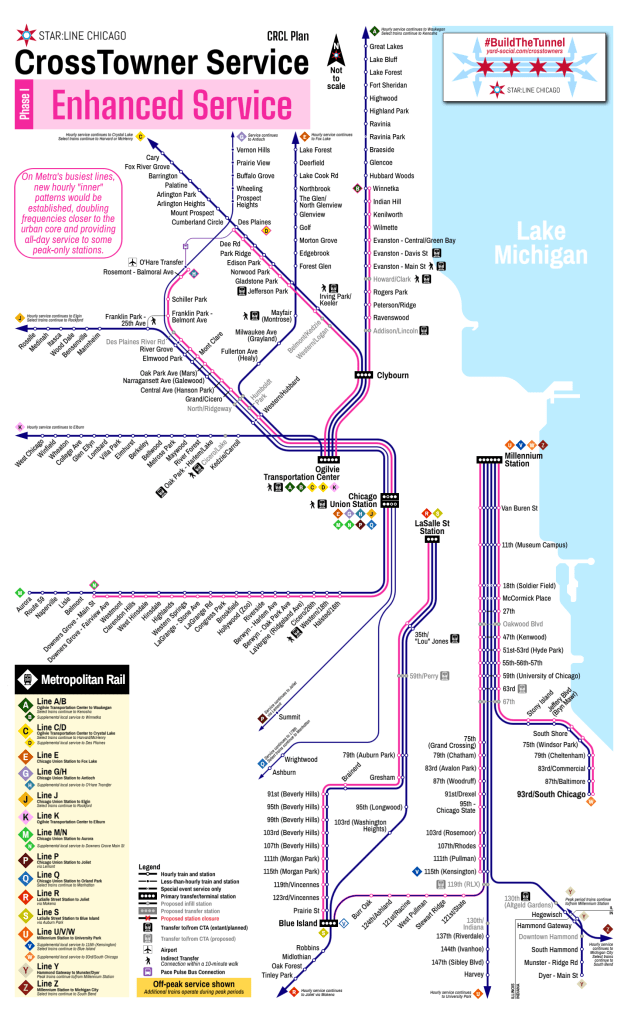
As Chicagoland takes concrete steps to move towards a proper “regional rail” paradigm, the first step would be adding additional trains to the central part of the region, where population densities are more supportive of increased service on some of Metra’s busiest routes. While “hourly everywhere” remains the goal for the region as a whole, supplemental service would be offered such that frequencies would improve to half-hourly closer to the urban core, while also beginning to provide all-day (hourly) service to some current peak-only stations, especially along the BNSF and Milwaukee West lines.
Supplemental hourly trains (to create half-hourly headways) would begin running on the Union Pacific North (“A/B”), Union Pacific Northwest (“C/D”), BNSF (“M/N”), Rock Island Beverly Branch (“S”), and Metra Electric South Chicago (“W”) lines. Supplemental trains would also operate on the Metra Electric Main Line and Blue Island Branch (“V”), to provide half-hourly frequencies north of Kensington and hourly service on the Blue Island Branch. Combined with half-hourly service on the South Chicago Branch, this would provide 15-minute service between Hyde Park and Millennium Station, not including Main Line (“U”) and South Shore Line (“Z”) express trains.
A “new” line would also be created: Line “H” would serve as the supplemental hourly local pattern combining Milwaukee West and North Central Service stations between Chicago Union Station and O’Hare Transfer. Line “H” would also relieve the NCS of the need to make stops at Franklin Park, Schiller Park, and Rosemont, speeding trains up from the northern suburbs as well as speeding up express trains to O’Hare.
Following Phase I, most Metra stations in Chicago and some inner suburbs would be able to provide half-hourly service all day long, with only seven additional trains per hour region-wide.
Phase II: Regional Rail
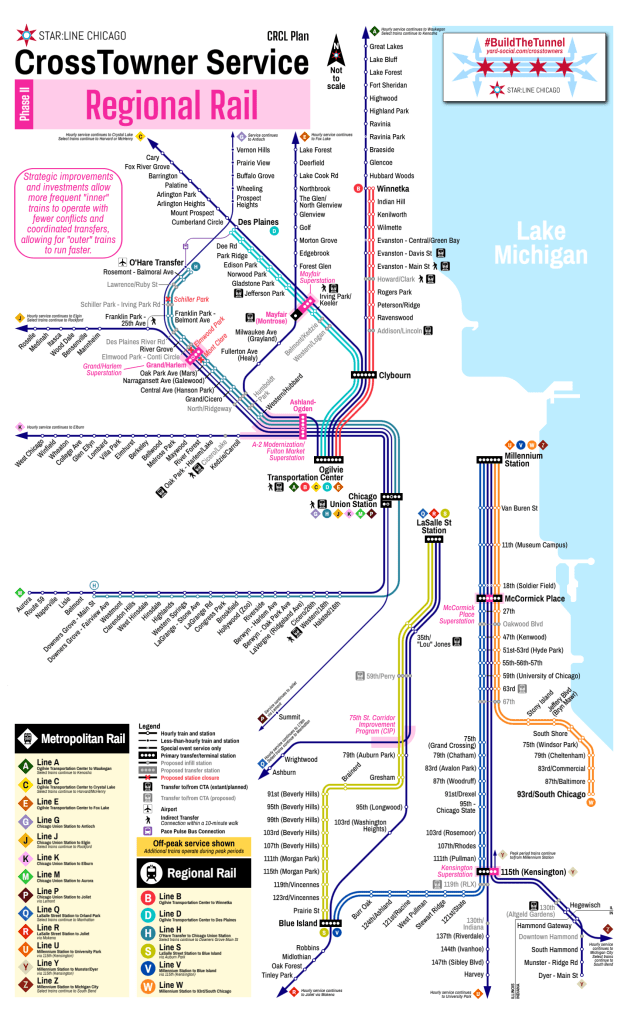
Following the Enhanced Service in Phase I, Phase II would take a stronger step towards a proper “regional rail” network. At a high level, the goals of Phase II are to separate “inner” supplemental service trains from “outer” suburban trains, allowing the latter to run express all day long.2 To allow this, strategic station investments are needed to create better transfer stations — “superstations” — that allow “inner” and “outer” trains to coordinate service, maintaining connectivity throughout the region while speeding up express services. The six “regional rail” lines also now have their own distinct identification, and would likely also use a more modern rolling stock similar to Metra’s forthcoming Stadler FLIRT fleet.
Phase II has six primary infrastructure improvements:
A-2 Modernization and Fulton Market Superstation: Perhaps the most important project in this phase, this effort would reorganize Metra’s complicated A-2 interlocking on the West Side near Western Avenue, minimizing crossing conflicts by re-routing Line “K” (UP-W) trains into Chicago Union Station and Line “E” (MD-N) trains into Ogilvie Transportation Center. This reconfiguration would almost certainly be required before increasing frequencies between Chicago Union Station and O’Hare. This phase would also include a new Fulton Market Superstation to allow transfers and connections, as well as serve a burgeoning part of the city. (This project has been on Metra’s radar for a while.)
Grand/Harlem Superstation: A station consolidation on the Northwest Side would create a contiguous Harlem Avenue bus corridor that connects express and local rail service to O’Hare to two other Metra lines (UP-W at Oak Park and BNSF at Harlem Avenue) as well as two3 CTA ‘L’ lines (Green Line at Harlem/Lake and Blue Line at Harlem-Congress). The full CrossTowner vision includes this bus route as a Pace Pulse corridor that would extend to Summit, then east on Archer/55th to the Orange Line ‘L’ terminal at Midway Airport.
Mayfair Superstation: A new station on Line “C/D” (UP-NW) that would connect with the existing Line “E” (MD-N) Mayfair station and the existing Blue Line Montrose station. While the UP-NW also has Blue Line connections north and south of Mayfair, creating a unified Northwest Side superstation could anchor a future Brown Line western extension, as well as create far easier Amtrak connections between Hiawatha/Borealis/Empire Builder trains and O’Hare Airport via the Blue Line. Thinking far further into the future, a Mayfair superstation could also allow for reuse of the Weber Spur as a transit artery, as well as bookend a northern Cicero Avenue transitway.
75th Street Corridor Improvement Program (CIP): Another project that has been on the books for years, the 75th Street CIP would allow Line “Q” (SWS) trains to connect to LaSalle Street Station instead of Chicago Union Station while also bypassing key freight bottlenecks. While this project would not have a direct impact to the “regional rail” lines, it would be a significant improvement that makes hourly SWS service more feasible.
Kensington Superstation: On the Far South Side, the existing 115th (Kensington) station would be (re-)expanded to (once again) allow for NICTD trains to make stops, supplementing the local/express patterns of the Metra Electric. Additionally, with NICTD operating the new Monon Corridor as an off-peak shuttle operation between Dyer and Hammond Gateway, Monon (Line “Y”) shuttle trains could be extended to the Kensington Superstation, doubling frequencies to Hegewisch.
McCormick Place Superstation: To better serve a major trip generator, as well as to provide another local/express transfer location along the Metra Electric, additional platforms would be added at McCormick Place in advance of future phases and service expansions. These new platforms would also allow special-event services on the express patterns to more easily serve McCormick Place without interfering with all-day local services.
On the North Side, these improvements, combined with three additional round-trips per hour, would allow for the busy “A” (UP-N) and “C” (UP-NW) lines to run express to speed up trips from the north and northwest suburbs, and on the West Side, local Line “H” trains could run twice an hour between Chicago Union Station and O’Hare Transfer to provide more robust all-day transit service connecting working-class neighborhoods to the region’s two largest job centers. The added hourly Line “H” train could also utilize the single existing thru-track at Chicago Union Station to replace the “N” BNSF supplemental pattern, creating a single-seat trip between Metra’s busiest line and O’Hare. Furthermore, with half-hourly service, Line “G” (NCS) trains could skip more stations, providing an early “O’Hare Express” operation between Chicago Union Station and the airport.
Phase III: CUS Thru-Running
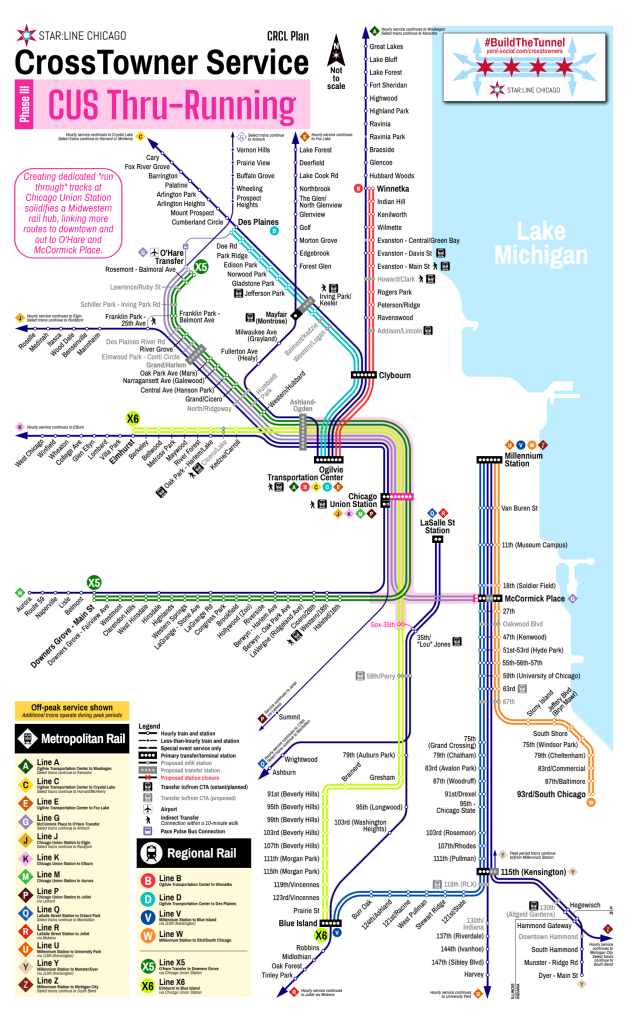
The larger regional CrossTowner network starts to take shape in Phase III, when dedicated thru-running tracks at Chicago Union Station are constructed. This improvement can allow for proper thru-running operations at Chicago Union Station for regional rail service at higher frequencies. Combined with Amtrak’s Chicago Hub Improvement Program (CHIP), three primary routes could be implemented:
X5: Building on the work of Phase II, the other hourly Line “H” train would also be thru-run to Downers Grove Main Street and rebranded as the X5 CrossTowner. This change would allow Line “M” (BNSF) trains to run essentially express east of Downers Grove, with stops only at Hinsdale, LaGrange Road, Harlem Avenue, Cicero, and Western.
X6: To create a future unified hub at Chicago Union Station, Line “S” (Beverly Branch) trains would turn off of the Rock Island District to connect with the vacated4 SouthWest Service tracks, run through Chicago Union Station, and provide regional rail service along Line “K” (UP-W). The CrossTowner vision suggests this connection be made through the parking lots of Rate Field, but several alternative options could be feasible and require further study. This route would be rebranded as the X6 CrossTowner.
O’Hare Express (Line “G”): Thru-running Chicago Union Station, combined with fewer stops between downtown and O’Hare for Antioch-bound trains, and improving the St. Charles Air Line (SCAL) bridge over the Chicago River, creates the opportunity to operate an oft-desired airport express service between the McCormick Place Superstation, downtown, and O’Hare. Unlike other airport express operations, however, this would functionally be just an extension of Line “G” (NCS) suburban trains.56 While not officially a CrossTowner line, this service would be an important component of the larger system and would provide single-transfer connections from the Metra Electric lines to Chicago Union Station and O’Hare prior to the construction of the tunnel.
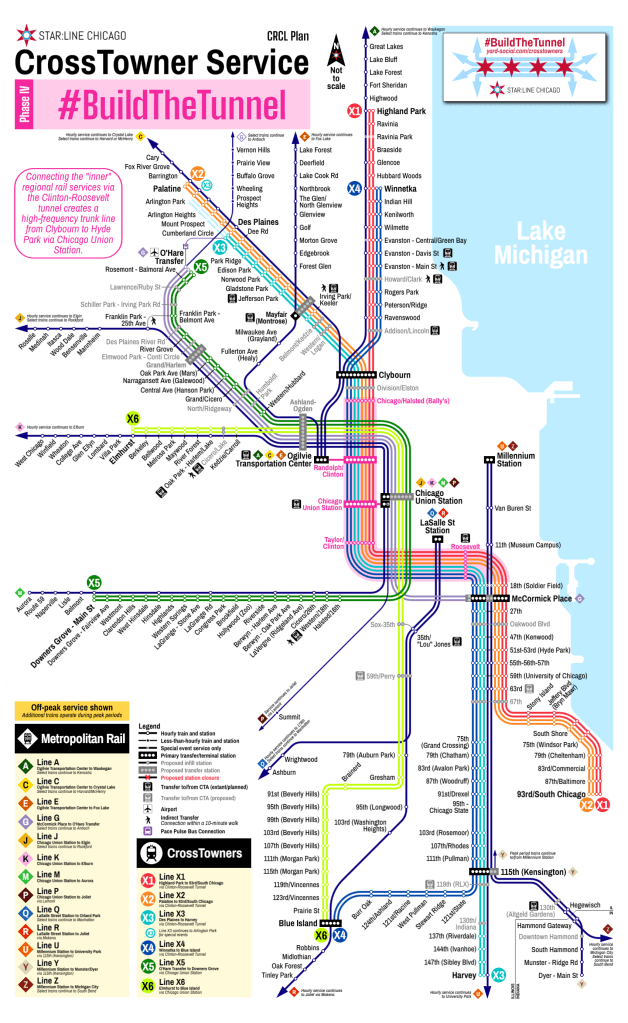
Phase IV: #BuildTheTunnel
By the time we get to building the tunnel, operationally it ends up being an extremely straightforward enhancement. The tunnel gets built under Clinton Street and Roosevelt Road, and each of the four remaining regional rail lines (“B”, “D”, “V”, and “W”) simply continue through the tunnel and out to regional rail lines on the other side as CrossTowners. Doing so halves headways on the rest of the regional rail network, while expanding half-hourly service further out into the suburbs. Within the tunnel itself, and indeed down the entire “trunk” between Clybourn and Hyde Park, CrossTowner trains now operate every 7.5 minutes, and every 15 minutes as far as Kensington, South Chicago, Winnetka, and Des Plaines.
The tunnel would greatly enhance regional intermodal connectivity with stations at Randolph/Clinton (connecting to Green and Pink Line ‘L’ trains at the existing Clinton/Lake station and Metra trains at Ogilvie), Chicago Union Station (connecting to Blue Line ‘L’ trains at the existing Clinton/Congress station as well as Amtrak, Metra, X5 and X6 trains at the station), Taylor/Clinton (to seed a new transit-oriented development neighborhood), and Roosevelt (connecting to Red, Orange, and Green Line ‘L’ trains at the existing Roosevelt station).
The core CrossTowner network is now complete.
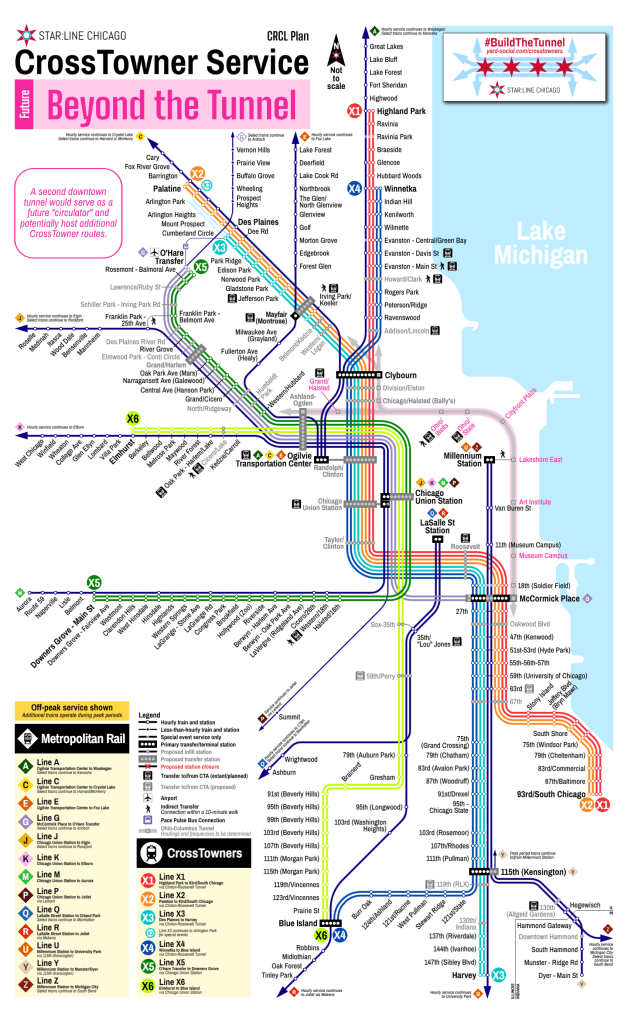
Beyond The Tunnel
While the initial vision would be complete, that doesn’t mean there wouldn’t be additional opportunities for expansion. With no freight conflicts on the Metra Electric District, additional regional rail routes could be added later; more frequent service to O’Hare, or expanding regional rail to the Milwaukee North, or entirely new services could be added in the future. The original 2034sight Plan calls for a tunnel under Ohio Street and Columbus Drive, a corridor that remains ideal for additional high-frequency, high-capacity transit options to serve River North, Streeterville, and Lakeshore East. This alignment could also provide single-seat trips from the Far South Side to O’Hare more feasibly, and closer to downtown the Ohio-Columbus tunnel is bookended at each end by “superstations” to provide universal connectivity between lines as needed. Rather than precluding these service alternatives, the CrossTowner vision is intentionally open-ended and forward-compatible for the continued growth of Chicagoland’s transit network.
CrossTowner regional rail network map, showing 2034sight and CRCL Plan enhancements.
The time is now
As the new Northern Illinois Transit Authority (NITA) launches this summer, Chicagoland transit is in a position to not only survive but to thrive on regional coordination, integration, and bold visions for the future. Nothing worth having is ever easy, but CrossTowner regional rail can be the bold, achievable, pragmatic vision Chicagoland needs to once again shoot for the stars.
It’s time to unlock our regional potential. It’s time for regional rail.
Justification for individual infill stations are generally not included in this post, but additional information will eventually be posted somewhere. These posts are long enough without getting truly into the weeds. ↩︎
Ideally three in the more distant future with a Pink Line extension to North Riverside. ↩︎
Metra operations would have been moved off of this segment following completion of the 75th Street CIP, but Amtrak and occasional freight traffic would still likely use portions of the route. ↩︎
Amtrak could plausibly extend Midwest intercity trains to O’Hare on the same routing; however, there is potential for that to be a net-negative at a local Chicagoland level if that operation would come at the cost of more frequent suburban service on the NCS. ↩︎
It is not shown on these maps, but O’Hare Express (Line “G”) trains could also serve the proposed One Central megaproject near 18th Street in lieu of that project’s proposed reverse-branching of the BNSF. ↩︎
While NITA’s forthcoming mandate includes regional rail — a prospect that can truly connect our region like never before — it’s also important to honor the humble workhorse of our public transportation network: the bus. Buses are the real backbone of our transit network — CTA’s 2025 ridership ended up being roughly a 3:2 ratio between bus trips and rail trips, and improving our bus network will be one of the most important tasks NITA will need to address very early on in the agency’s tenure, so it’s never too early to start thinking about what a better bus network should look like.
However, there’s no silver bullet to better buses, as “better buses” will mean different things in different parts of the region:
In the densest parts of Chicago, “better buses” need to focus on improved reliability with a focus on faster speeds and more frequent service. To do this, NITA will have to work more closely with CDOT, IDOT, Cook County, and other agencies to get buses out of traffic with Bus Rapid Transit (BRT) elements and to keep buses moving at frequent, balanced headways with other creative measures, above and beyond the other staffing and maintenance issues we know the CTA needs to continue focusing on. (The CTA currently has a survey out seeking public input on specific implementation strategies included in their Better Streets for Buses plan.)
Further out in the outer neighborhoods and much of suburban Cook County, “better buses” need to focus on breaking down the silos between the CTA and Pace networks, creating a seamless, agency- and geography-agnostic integrated network of buses. Other than for quirks of history and politics, there’s no inherent reason why the bus network of Austin and Little Village should be fundamentally different than Berwyn and Cicero, and NITA’s role here will be steering processes required to, ideally, spearhead a reimagining of the “middle tier” of the bus network in an operator-agnostic manner. While well-known transit consultant Jarrett Walker has recently completed network redesign concepts for the CTA and for Pace, these studies were inherently flawed (at no fault of the consultant) since they largely looked at each agency’s system in a vacuum rather than taking a regional approach to how our network is fundamentally structured. With new boards being seated later this year, and with a clear mandate to think regionally with the oft-quoted “one network, one timetable, one ticket” mantra that shows up in the NITA legislation three times, we should once again reimagine our bus network but more holistically: on the urban fringe, routes should first be planned at the regional level and then the agencies are assigned to operate the respective routes based on the most efficient and effective ways to operate the service.
Finally, out in the collar counties, “better buses” should focus on creating any sort of cohesive network at all. Besides the small legacy urban systems Pace inherited in Waukegan, Elgin, Aurora, Joliet, etc., there is little rhyme or reason to how many of our regional buses are structured beyond Cook County. Routes generally have little regard for regional connectivity, and Metra stations are treated as just another amenity to be served — like a doctor’s office or a grocery store — rather than a crucial transfer node in a regional network. In some cases, Pace service actively competes against parallel Metra service (e.g., Interstate 55 service vs. the Heritage Corridor) when these mainline operations should be complementary, allowing for rail riders to more seamlessly be able to use the bus when trains are not able to operate and vice versa. The collar county bus network needs a clear hierarchy of routes that can support intra-regional connections as well as core local bus services: above and beyond simply connecting suburban residents with local amenities like health care, educational opportunities, recreation, and job access, collar county buses need to also create a true network throughout Chicagoland. At a regional level, suburban buses need to proactively function as an extension and expansion of the Metra rail network to provide usable suburb-to-suburb trips without riders needing to come all the way into the urban core to change trains, just to go all the way back out again on a different line.
Given the pockets of resistance from suburban politicians during the crafting and passing of SB 2111, NITA will have to take the collar county bus network task very seriously, and will have to devote a fair amount of resources to ensure reforms do end up providing an improved experience for suburban riders, especially for collar-county suburb-to-suburb trips that are near impossible to make on transit today.
There are plenty of additional concerns that also need to be addressed with the bus network, and this is by no means an exhaustive list:
How does our bus network maintain mobility and accessibility for all Chicagolanders, including riders who also rely on paratransit services?
How does Pace’s Pulse network scale, both in the suburbs as well as within the city proper?
Should the “Pulse” branding be expanded to include existing express/limited-stop CTA service?
What is the appropriate role of on-demand and/or subsidized TNC service, if any?
It should be clear that there will not be any one-size-fits-all solution to “better buses” region-wide, but nevertheless the bus network should be the bread-and-butter of our transit network from McHenry and Midlothian to Michigan Avenue. NITA will need a robust toolbox of techniques to refer to and implement to successfully improve the bus network in every corner of Chicagoland.
Unfortunately, it’s also very easy to see how a blanket “better buses” mandate can end up splitting back down the city-vs.-suburban silos that NITA is ostensibly being created to tear down. As we enter this crucial transition period, as a region we need to make sure NITA, and the constituent service boards, are structured and populated by members who are committed to better buses throughout the region, but also with the full acknowledgment that what works in one part of the region won’t necessarily work elsewhere.
NITA’s mandate for better buses should be: one frequent and reliable network, one coordinated interagency timetable, one unified regional ticket.
Over the past few weeks, this blog has explored what we’ve been calling the “Grand Corridor”, what should be a high-performing intermodal transit corridor straddling Chicago’s Northwest and West Sides as well as suburban Cook County that, ideally, could connect these working-class neighborhoods to Elgin, O’Hare, and the Loop with fast and frequent transit service, but due to Chicagoland’s byzantine, balkanized approach to transit operations and planning, result in only modest plans that fail to fully leverage this incredible asset.
However, it is the editorial policy of this blog that it does not offer criticism without also offering potential solutions, so to conclude this series, this post will detail a governance proposal to address some of these challenges and set the groundwork for a more efficient, more effective option to better position Chicagoland to operate and build a proper 21st-Century transit network that better levels the regional playing field, streamline processes, and break down harmful silos of governance, all without throwing the proverbial baby out with the bathwater.
If you’re reading this, there is an extremely high likelihood that you are already at least somewhat familiar with two primary pieces of legislation working their ways through the Illinois General Assembly down in Springfield that would both address transit governance issues in Northeastern Illinois: the Metropolitan Mobility Act, supported by the Partnership for Action on Reimagining Transit, which would dramatically transform our governance model by merging the RTA, CTA, Metra, and Pace into a single agency; and a more modest reform bill (that would simply delegate to the RTA some additional limited powers to oversee the three service boards) colloquially known as “the labor bill” in honor of the United We Move labor coalition that is championing the legislation. Much ink has been spilled already in taking deeper looks at both of these approaches; I personally suggest reading RIchard Day’s (pro-MMA) City That Works post about the larger reform efforts and the benefits of the Metropolitan Mobility Act in the context of less-comprehensive reform. However, MMA opponents have also made some very fair critiques of the legislation, most notably the idea that simply putting everyone under the same roof does not necessarily guarantee a more efficient transit operation for riders; any frequent user of the CTA undoubtedly has a few stories about missed bus-to-bus or train-to-train connections even within the same agency. There are also fears that with the MMA’s singular board split between the different “factions” in Chicagoland, someone will get (pardon the pun) railroaded by joint governance. Of course, these fears simply reinforce the existing siloed thinking that got us into this mess in the first place, and depending on who you talk to it’s either going to result in the suburbs running roughshod over the city, or the city running roughshod over the suburbs. In addition to concerns about Naperville calling the shots on the ‘L’, or the Fifth Floor deciding what transit in Will County should look like, there are also concerns from the folks who do the hard work of operating the buses and trains themselves: while union contracts could undoubtedly be resolved eventually, adding uncertainty and requiring new negotiations with any new agency is a level of instability the unions would understandably prefer to avoid.
On the opposite side of the argument, of course, is history: faced with a “doomsday” budget scenario in 2008, Illinois empowered the RTA with additional oversight tasks and duties as part of additional revenues to stabilize transit operations. Today, there’s understandably a healthy skepticism that, faced with a “doomsday” budget scenario in 2026, empowering the RTA with additional oversight tasks and duties as part of additional revenues to stabilize transit operations would not necessarily be a long-term solution. While the RTA’s “Transforming Transit” vision document, for instance, calls on the legislature to empower the RTA to create things like a unified fare product, this overlooks the inconvenient fact that the RTA was empowered by the legislature to create a unified fare product years ago, and has missed the statutorily-mandated deadline by a decade and counting.
While the MMA and the labor bills continue to work their way through Springfield, there is a potential third option that has not yet been fully explored in the legislation, a middle ground that could finally have found its moment: an RTA-like agency tasked not merely with “oversight” but explicitly tasked with managing a unified network and contracting out operations to publicly-owned operating units, which could then remain officially standalone agencies with their own boards of directors and local control of day-to-day operations and service delivery. This is something along the lines of the German verkehrsverbund model, of which Steven Vance has previously written a terrific primer on the subject. Since it can be an intimidating idea (and, of course, an intimidating German word to try to pronounce), let’s walk through what something like that could look like in Chicagoland in a much more user-friendly vernacular.
Introducing: Cartesian
For the purposes of this hypothetical, we will create a “new” agency named CARTESIAN: the Chicagoland Association of Regional Transportation Enterprises, Strategy, Innovation, and Accessible Networks. While it is quite a lengthy acronym, and for legibility purposes we’ll use “Cartesian” in mixed-case in this post, it is meant to be as widely-encompassing as possible, tasked with all aspects of creating a single, unified, regional transit network. From an artistic standpoint, the name also deliberately invokes the Cartesian coordinate plane, an infinite two-dimensional grid stretching to the horizon, which, let’s be honest, is more or less what Chicagoland’s transportation network looks like from the air.
We love our limitless grid, don’t we folks? (Google Maps aerial screenshot)
Whether Cartesian ends up becoming a totally new agency that would replace the RTA, or a public RTA rebrand, or simply a shorthand way to refer to the new tasks delegated to the RTA, is ultimately a political question best left up to the politicians. However, Cartesian would officially become the provider of transit for all of Chicagoland: capital planning, service planning, procurement, communications, fare structures, and more would all become part of Cartesian’s core mission, and the Cartesian board would represent a broad geographic cross-section of Chicagoland, just like the RTA board currently does. To ensure one geographic “faction” could not overrule another, the Cartesian board would be required to have unanimity among its factions, but not necessarily among its full board. In other words, assuming Cartesian’s board would be constituted the same way as the proposed MMA board — 3 gubernatorial appointees, 5 collar county appointees, 5 Cook County appointees, and 5 City of Chicago appointees — board actions would need 11 out of 18 votes, but would require a majority of each appointing unit (2/3rds of the Governor’s appointees and 3/5ths of each of the other three constituencies) to ensure that everyone’s on the same page.
Cartesian, as a “transit association”, would be the sole agency responsible for coordinating present and future transit services for the entire region, including presenting a unified network vision for Chicagoland transit to ensure our entire system functions as a single, cohesive, expansive transit network. With a unified vision, Cartesian can take the lead on applying for discretionary funds and working with agencies like CMAP and our Departments of Transportation to identify, coordinate, and execute capital investment opportunities that are most beneficial to the region as a whole, avoiding potentially expensive duplication — or worse, competition — between projects currently segregated by mode or by operator. Similar to existing efforts by all three service boards and the RTA, Cartesian would also be empowered to help municipalities and neighborhoods create station-area plans and support local efforts to build and enhance transit-oriented development opportunities; unlike the current paradigm, however, Cartesian would be a “one stop shop” for these initiatives, rather than leaving station-area stakeholders to try to figure out who they should be working with based on mode or operator.
The Enterprise System
There is one key role that Cartesian would not have, however: like the RTA today, Cartesian would not directly operate any transit service in Chicagoland. Instead, Cartesian would contract out all day-to-day operations to enterprises, which would be the new name for the service boards. The primary difference between an enterprise and a current authority or service board would be replacing annual budgets with fixed-duration contracts between Cartesian and each individual enterprise. Rather than simply giving the CTA, Metra, and Pace’s annual budgets a thumbs-up or a thumbs-down as they do today (although a “thumbs down” has never been publicly issued anyway), there would be an agreed-upon contract between the enterprises and Cartesian, which spell out key performance indicators (KPIs), required minimum service levels, and incentives for meeting these targets. Contracts would not necessarily be competitive — there’s only a single enterprise that could operate the ‘L’, for instance — but they would provide verifiable, quantifiable, actionable metrics and service standards. By shifting from budgets to contracts, these accountability measures can be consistently managed throughout the life of the contract, with the boards of each enterprise empowered to directly hold accountable their respective management staffs based on contractually-required KPIs and service standards. When contracts need to be renewed, they can then also be renegotiated between Cartesian and the individual enterprises based on changing conditions, along with sweeteners for good performance — and perhaps mandatory accountability for unsatisfactory performance. (Note that “accountability” can take many forms and does not necessarily mean a funding reduction.) These contracts can also provide more stability with discretionary funds while also providing for reviews of discretionary fund allotment at regular intervals to help ensure the various enterprises are all appropriately funded based on overall revenues even as operating conditions may change and evolve over time.
Enterprises would be tasked exclusively with day-to-day operations, which also includes things like security as well as preventative and routine maintenance. Since capital planning and programming would become the responsibility of Cartesian, the enterprises would also have no need for bonding authority and would be required to maintain balanced operating budgets. Enterprises also allow for pass-through funding to guarantee each enterprise a financial “floor” — for instance, the Chicago Transit Enterprise could be guaranteed a very high percentage of all sales tax revenues generated within the city proper, with supplemental funds determined by the contracts with Cartesian based on farebox revenues (since Cartesian would own and operate all fare media and equipment) or other revenue sources that will inevitably be needed to bridge the fiscal cliff. With the near-entire focus on simply running high-quality regular service, the boards of each enterprise could focus exclusively on service performance and rider experience issues, providing a direct avenue of accountability both internally within each enterprise and for the riding public; enterprise boards could also include members of organized labor to ensure that front-line employees also have representation in each operating unit.
This is an important distinction between the two sides of public accountability: while Cartesian would be responsible for (and held accountable for) service planning — for instance, regional network planning, procurement, capital project prioritization, and so on — the enterprises would be responsible for service quality, like balanced headways, cleanliness, and reliability. This could ensure additional protection against something like a purely hypothetical scenario where executive staff allows service quality to severely deteriorate but an executive director politically could not be forced out because they have, say, a supposed knack for winning federal discretionary funding awards. While that scenario — again, totally hypothetical and in no way based on recent events — is entirely possible under our current governance paradigm and under less-ambitious RTA reforms, under the Cartesian system those particular skill sets would be entirely separated and responsibilities more explicitly delineated, ultimately improving accountability for service planning and for service quality.
The enterprise system also allows the larger Cartesian model to remain forward-compatible with future operators or entire modes. Maybe someday the South Shore Line joins, or Illinois Tollway becomes part of the fold, or even Divvy or a scooter operator wants to expand their footprint beyond the city proper. Rather than determine where to try to cram any of those entities into the existing enterprises, or make individual municipalities have to enter into new agreements on an individual basis that creates service gaps, Cartesian can simply create a new contract and/or adapt existing contracts at the next scheduled negotiation point.
In the context of this blog series though, service planning is where the rubber really starts to hit the road under the Cartesian model.
Cartesian Service Planning
At its most elemental and speaking operator-agnostically, Chicagoland has four primary modes of transit:
Commuter/regional trains (Metra)
The ‘L’ (CTA)
Fixed-route buses (CTA and Pace)
Microtransit (ADA paratransit, on-demand/dial-a-ride, vanpool, e-scooters, bike share, etc.)
Cartesian’s mandate would treat each of them accordingly, creating a single regional network plan and service schedules focused purely on what individual routes (and at what frequencies) would be the most efficient and effective to best serve the traveling public, regardless of who happens to be operating them or where they happen to operate.
As we discussed in Part 2 of this series, the mode with the most restrictions in terms of operating frequencies and schedules is Metra, considering the agency’s reliance on and constraints with sharing tracks with freight railroads. First, Cartesian would work with Metra on an annual or semi-annual basis to establish regional rail schedules based on operating, funding, and labor constraints, and agree to a systemwide framework schedule.
With the regional rail schedule in place, Cartesian would then move onto updating and creating service goals and schedules for the bus network, ensuring bus routes have intermodal connectivity throughout the entire region wherever possible and planning schedules accordingly.
90X Routes
Cartesian’s service planners would identify certain routes as 90x routes. The 90x designation (note: this is not necessarily a route number, but rather an internal categorization) denotes a high-frequency route, which would be defined as meeting the following criteria:
The route operates seven days a week, with
An average at least six trips per hour (average 10-minute headways) on weekdays, for
At least 15 hours a day (5am-8pm) on weekdays, and
No scheduled gaps of longer than 15 minutes during the same hours, as well as between 8am and 8pm on weekends.
Routes that would meet these criteria would operate at least 90 trips in each direction per weekday (6 trips per hour x 15 hours), hence the “90x” designation. Given the high frequencies, connections to regional rail trains would be assumed to be convenient enough to support show-up-and-go transfers; accordingly, the operating enterprises for these routes — which likely also would include most or all of the ‘L’ network — would handle scheduling entirely in-house, and the contracts for these routes would measure headway reliability rather than on-time performance. (This also provides an incentive for bus operators to find ways to operate more service, as routes that meet the 90x threshold would be scheduled and controlled internally rather than the enterprise being forced to operate schedules determined by Cartesian’s schedulers and service planners.) Likewise, 90x routes would have no restrictions on operating more frequently than the minimums established above, if the enterprise chooses to do so; this is intended to ensure city residents that Cartesian couldn’t “take over” busy city routes, considering a vast majority, if not all, of the 90x routes would likely be concentrated in Chicago proper. For routes that do not meet the 90x threshold — and, if needed, on 90x routes during early mornings and late evenings — scheduling would be centrally planned by Cartesian to ensure more convenient timed transfers to regional rail trains based on those schedules, as well as timed transfers (wherever possible) between non-90x bus routes.
As part of the regular contract negotiations, bus enterprises (Chicago Transit Enterprise and Pace) would bid on all bus routes, likely at the garage level. While it’s unlikely that the CTE would ever seriously compete with Pace for a collar-county route, and vice versa for routes in the urban core, this process would help ensure more efficient operations in the city/suburban “fringe” (like the Grand Corridor), as well as add a measure of cost control by allowing the two bus agencies to “compete” with each other in some areas without necessarily opening the market to private contractors who could undercut labor agreements. In either case, however, a typical rider would not be aware of the difference: publicly the system would be presented as a single network, using a single fare structure, with coordinated schedules between different routes and different modes, creating a seamless riding experience regardless of which enterprise happens to be operating the bus.
Ultimately, the Cartesian system would solve the problem that the Metropolitan Mobility Act is not guaranteed to solve, and what modest RTA reform efforts by definition cannot solve: existing oversight and coordination of our transit governance network is inherently passive and reactionary. Service boards are of course encouraged to work together and while they all claim to, our current governance structure can do no more than politely ask them to do so: the agency that ostensibly serves to unify the region’s transit network is only able to approve or reject whatever the service boards send them, rather than proactively creating and maintaining a unified network. While it’s true that the public transit needs of, say, 79th Street through the South Side are totally different than dial-a-ride services in rural McHenry County, it also is not a binary of “city transit” vs. “suburban transit”, even if plenty of elected officials (and transit users) on both sides of the 606XX divide may believe otherwise. The Chicagoland region is diverse in every sense of the word (except perhaps topographically), which means our transit needs exist on a broad spectrum of frequencies, modes, and geographies. We can’t afford to continue only hoping for the best that our four different agencies are all actually moving in the same direction.
This series has focused on the Grand Corridor because the corridor is emblematic of all the reasons why our current transit governance and operating paradigm doesn’t work, but also because of the incredible potential the corridor has if we’re able to reorient how we govern, how we operate, and how we fundamentally think about our transportation network as a whole. This is not a hopeless situation; nothing is broken beyond repair, but rather it’s just frustrating and inefficient. The impulse to want to blow it all up and start over is understandable, as is the fear that doing so would take things too far and cause undue disruption and burden. Likewise, approaching the situation cautiously and easing our way into considerable reform efforts is also understandably appealing, but may result merely in reform in name only, with no serious changes and ending up in yet another doomsday governance scenario once again another decade or so down the line.
We cannot afford to go over the fiscal cliff; significant new revenues are sorely needed simply to keep the lights on at our transit agencies, to say nothing of the need for generational investments in transformative transit. However, there is no — nor should there be — appetite for major new investments without also modernizing our transit governance structure, expanding accountability and creating a unified regional approach to improve transit for all of Chicagoland.
For nearly 80 years, Chicago-area transit funding, operations, and governance have been defined in some variation of a looming structural failure and finding a way to prop up the failing system: whether that was creating the Chicago Transit Authority to bring the ‘L’ and bus companies under public control after World War II, or creating the Regional Transportation Authority in the early 1970s to subsidize the railroads struggling to operate commuter service as well as saving failing suburban bus operators, or spinning off Metra and Pace a little over 40 years ago to directly operate suburban transit services, or tweaking board structures and funding formulas in 2008 to keep buses and trains running, every iteration of reforms have been focused on keeping a faltering 20th-Century model sputtering along until the next “doomsday” inevitably comes back around. A quarter of the way into the 21st Century, we have the opportunity — and responsibility — to finally break that cycle by making the effort to start imagining the unified, cohesive, coordinated regional transit network we want, and then determining how we can reform and retool our agencies to get us there.
We are Chicagoland. We are a region that gets things done, whether that’s raising our city out of a swamp, or literally rising from the ashes to become one of the fastest-growing cities in human history, or reversing the flow of an entire river to protect our drinking water, or building a sprawling network of tunnels throughout the region to fight floods, and throughout all of that our transit and transportation networks have always quite literally been the circulation that pumps prosperity and vitality throughout our city, our region, our state, and the entire Midwest. We owe it to ourselves and future Chicagoans and Chicagolanders to do better than just keeping the lights on.
Welcome back to the ongoing Diverging Approach profile of the Grand Corridor, one of Chicagoland’s most underutilized transit assets. In Part 1 of this series we defined the current lay of the land of Metra’s Milwaukee West corridor between Grand/Cicero and Mannheim, a stretch of nine stations straddling the city of Chicago and the Cook County suburbs. Today the Grand Corridor is served by a disjointed mismatch of CTA and Pace bus routes, as well as legacy Metra schedules, that struggle to effectively serve local neighborhoods and communities despite existing, in-use transit infrastructure that connects to both the Loop and O’Hare.
The good news is that each of our major regional transportation players are all are working on improving the Grand Corridor, and in this post we’ll take a closer look at some of these initiatives, and how they fit into other regional improvement initiatives. But an early spoiler alert: different paths forward with different champions pushing different overall priorities has limited upside in the absence of a single, unified, cohesive regional network.
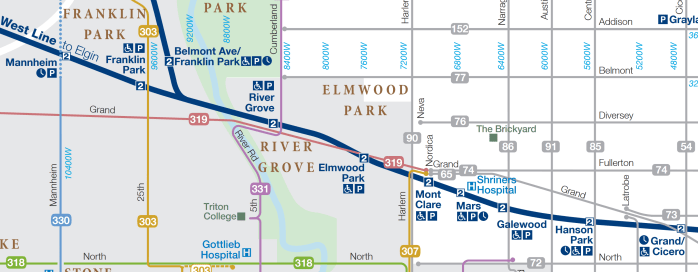
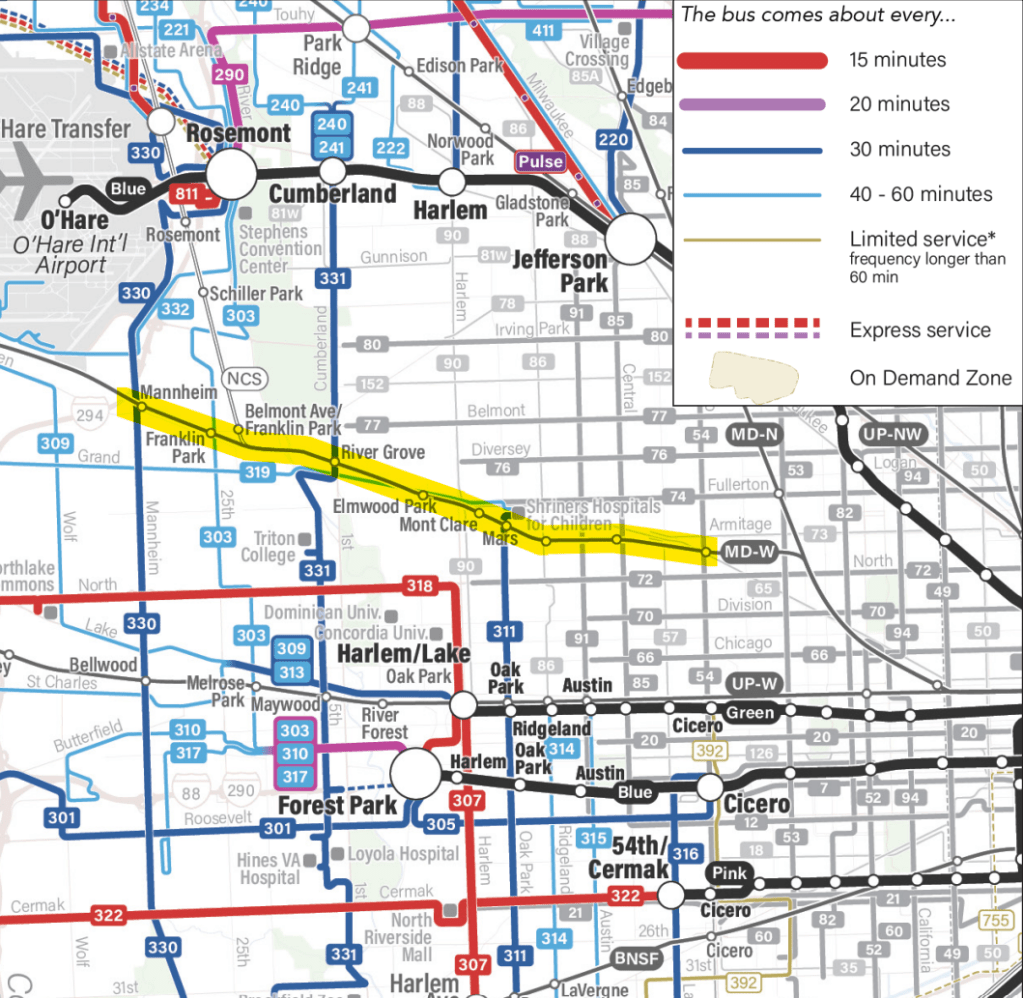
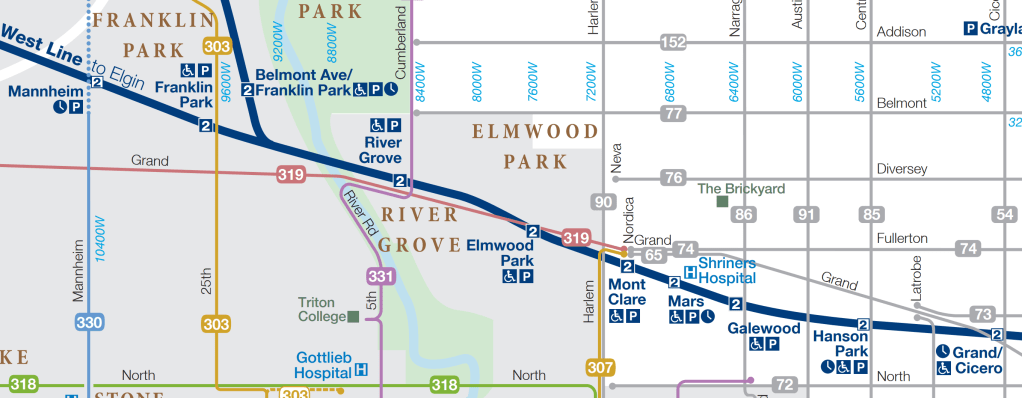
RTA system map screenshot of the Grand Corridor, nine Metra MD-W stations between Grand/Cicero and Mannheim (inclusive).
Chicago Transit AUthority
The Grand Corridor lies relatively far beyond the current reaches of the CTA’s ‘L’ network, a little over two miles north of the CTA Green Line and almost exactly equidistant between the two branches of the CTA Blue Line. Unlike certain other Metra corridors in the city, an extension of the ‘L’ system to provide rail service in this part of the city is not an option. As a result, the city portions of the corridor are served exclusively by CTA bus service.
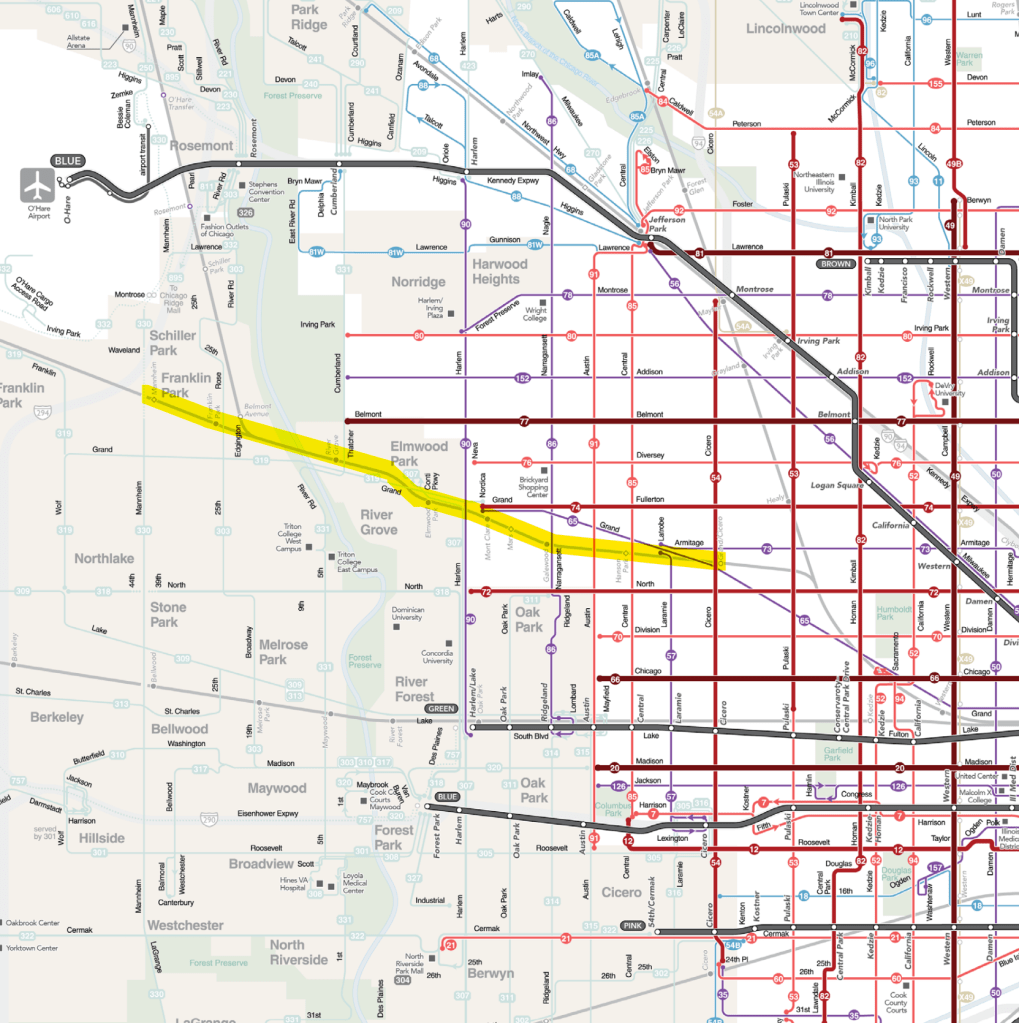
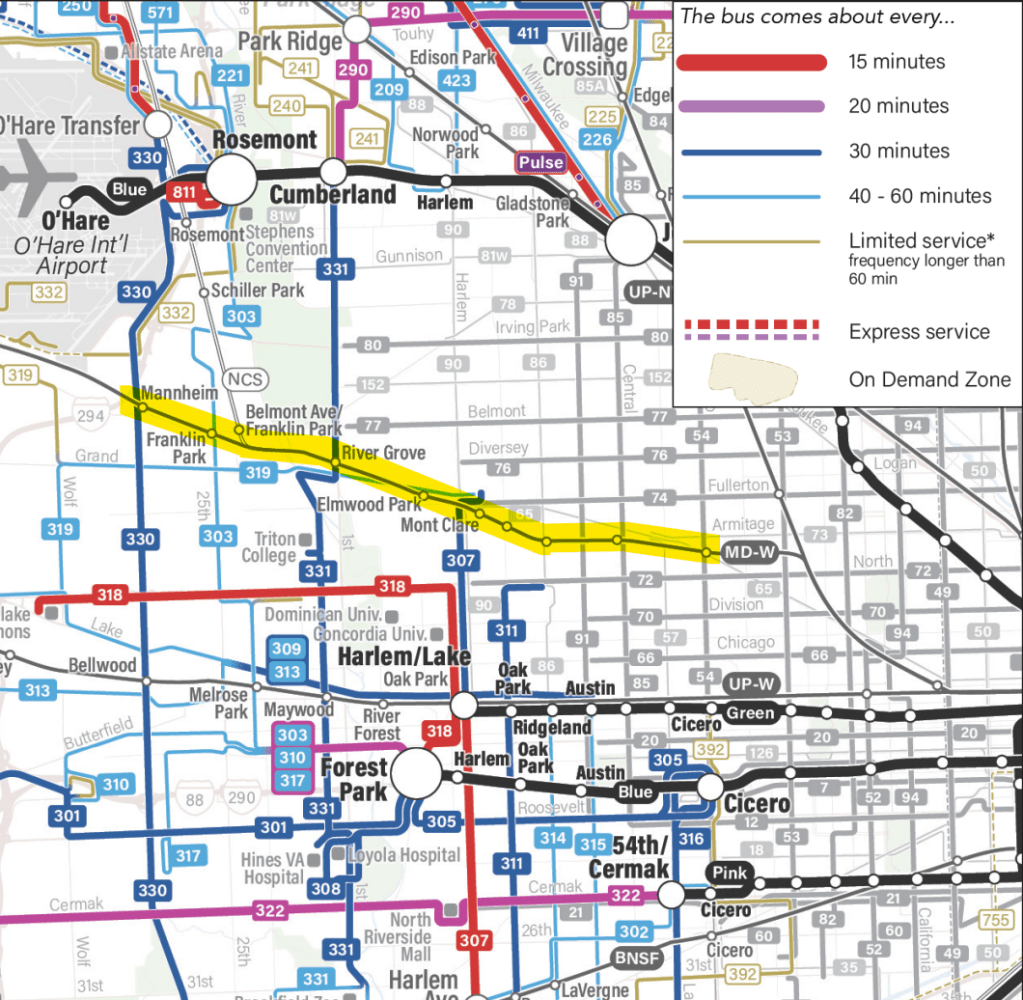
Map of the pre-pandemic CTA bus network, as shown in the CTA Bus Vision Project Framing Report. CTA routes are shown by scheduled frequency, with darker colors/wider lines indicating more frequent service. The Grand Corridor is highlighted in yellow.
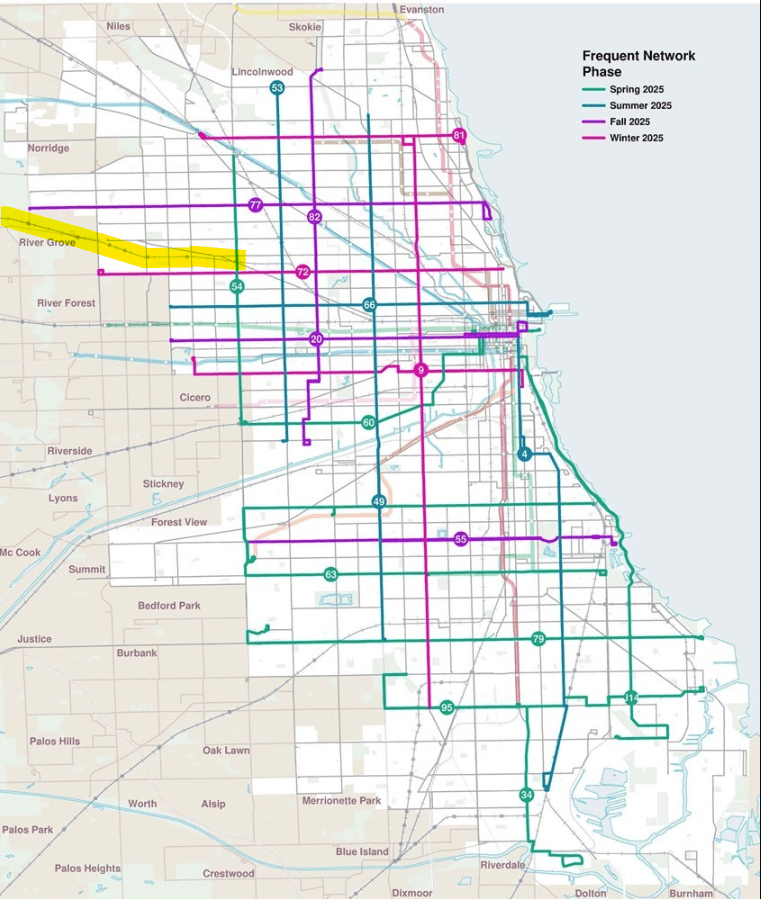
One of the preliminary results of the CTA’s Bus Vision Project is the establishment of the “Frequent Network”, a grid of bus routes throughout the city with headways of 10 minutes or less, seven days a week. Within the Grand Corridor, the 54-Cicero will be one of the first routes to see service improvements, namely a 30% increase in service on Sundays. Of course, since Grand/Cicero is a weekday-peak-only station for Metra, this bus improvement will have zero benefit in the context of this corridor. Next winter, the 72-North — a line that somewhat closely parallels the Grand Corridor, but does not interact with it — will also see service enhancements.
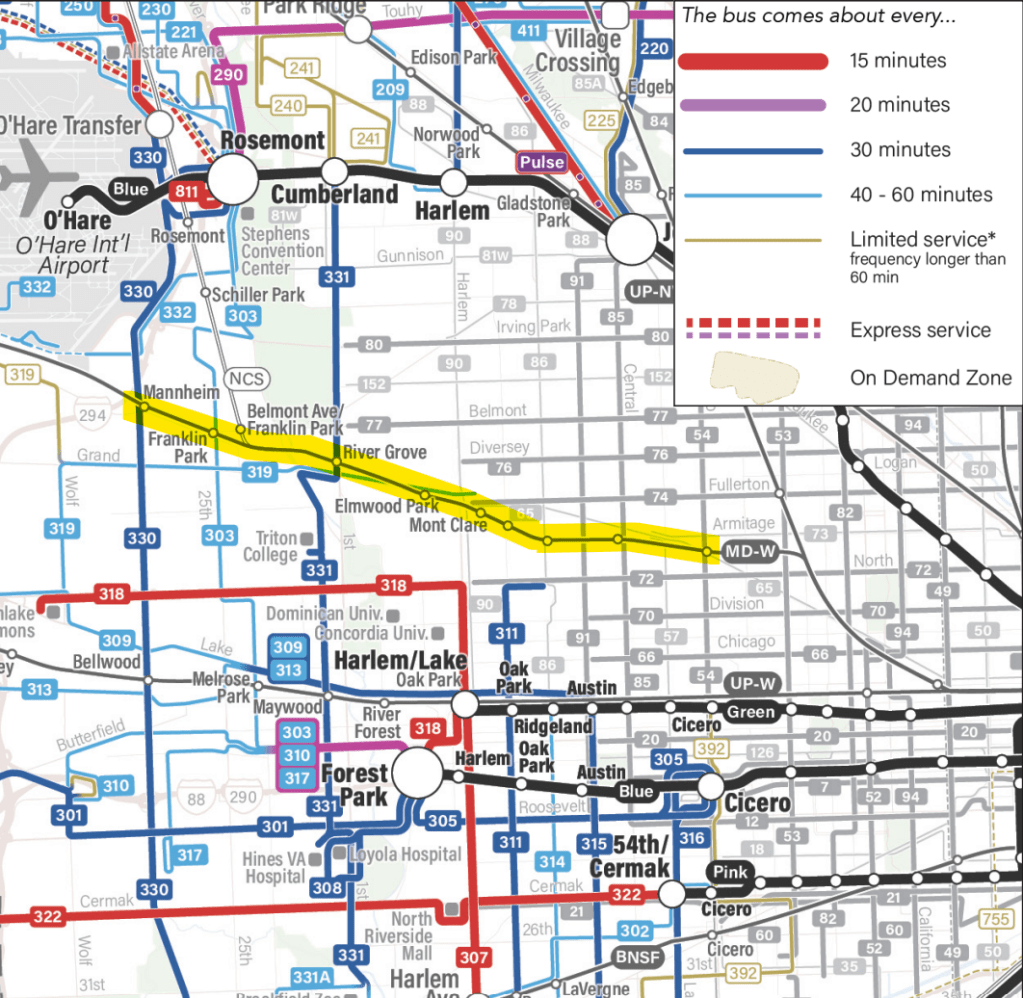
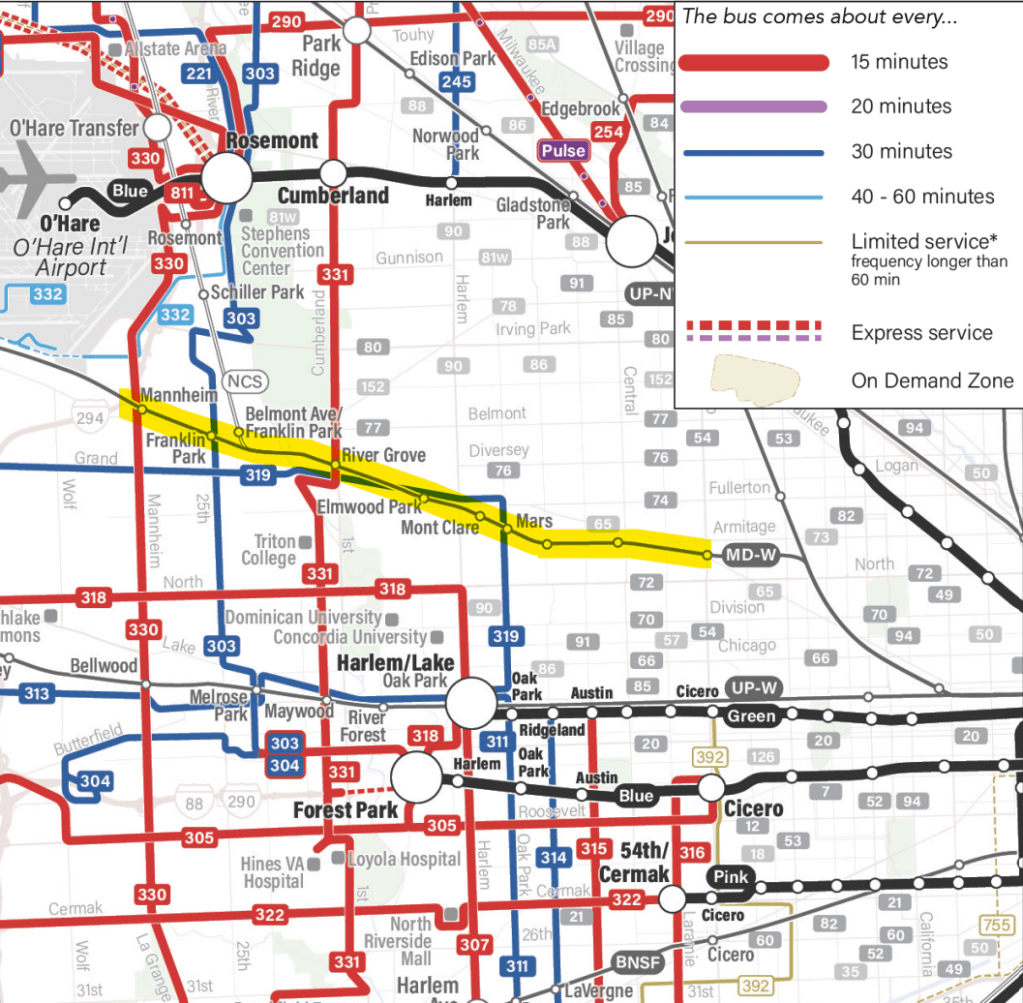
CTA Frequent Network map with scheduled roll-out of enhanced service. The Grand Corridor is highlighted in yellow. (Note that the western portion of the Grand Corridor is cut off.)
Perhaps the CTA bus service enhancement with the most untapped potential will be this fall’s enhancement of the 77-Belmont bus, which also ranked among the top ridership routes in 2024. The 77-Belmont terminates a mere half-mile north of the River Grove MD-W/NCS station at a turnaround near the intersection of Belmont and Cumberland Avenues. Despite somewhat recursively defining their service area as essentially “the areas we already serve“, there unfortunately seems to be zero incentive to extend the 77-Belmont to a two-line Metra station1 that is officially within the CTA’s defined service area. While the CTA has recently extended the 9-Ashland bus to a Metra connection at Ravenswood, since River Grove lies outside the city proper, it will be more challenging to get a city alderperson to champion this particular connection to Metra — and, of course, speaking more holistically, relatively minor transit extensions and connectivity should not need to be aldermanic passion projects.
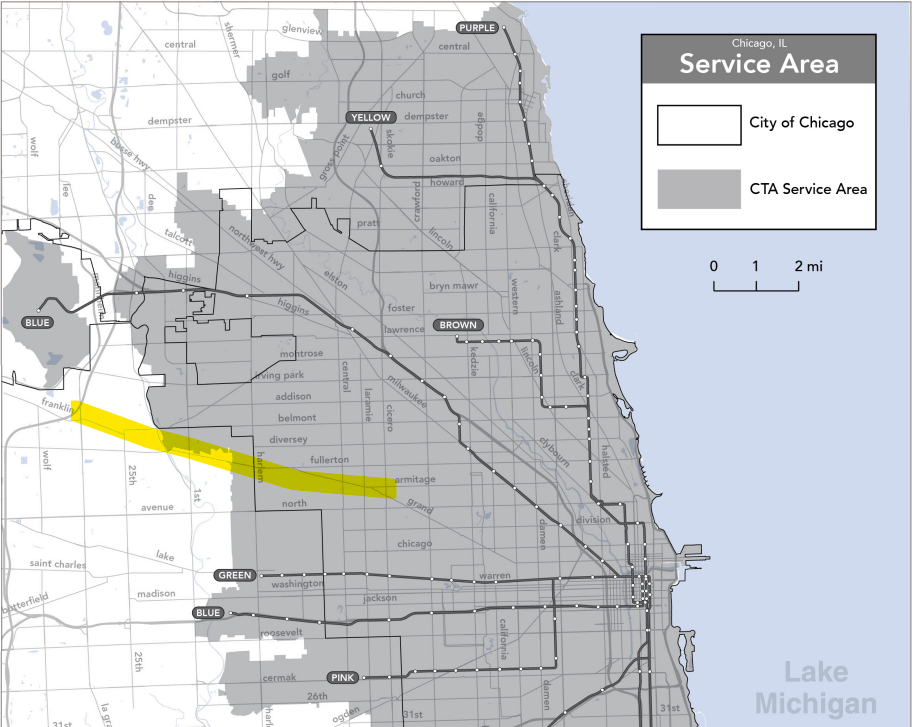
Approximate location of the Grand Corridor overlaid on a cropped CTA Service Area map as seen in the CTA Bus Vision Study Framing Report. The River Grove Metra station is considered an existing part of the CTA service area, as it is in a census tract that is within a half-mile of an existing bus route.
While we want to focus on the future, it’s also important to understand the past. Up until 2006, Harlem Avenue south of Grand was served exclusively by Pace: the 90-Harlem only operated between the [northern] Harlem Blue Line station and Grand Avenue, where the 90-Harlem turned east and terminated at the Grand/Nordica turnaround. Setting aside the Part 1 rant about how the bus turnaround is tantalizingly close to the Mont Clare Metra without actually serving it, this formed a little mini-hub for this part of the Northwest Side: CTA buses on Grand, Harlem, and Fullerton, as well as Pace’s Grand Avenue bus, all had a direct connection; and connections between the northern Harlem Avenue bus (90) and the central Harlem Avenue bus (307) could be relatively easily made by simply walking across the Grand/Harlem intersection2.
In 2006, CTA completed their West Side/West Suburban Corridor Study, a more holistic look at transit service on the West Side and the CTA-served western suburbs. While the headline improvement of the West Side/West Suburban Corridor Study was what would eventually become the Pink Line, the study also ended up recommended extending the 90-Harlem bus south to the Harlem/Lake Green Line to improve CTA rail connectivity to the Far Northwest Side. Unfortunately, there’s nothing in the study materials to suggest that Pace service was ever seriously considered, either as a way to improve said connectivity or in regards to impacts to Pace’s ridership. Since the structure of the RTA essentially leaves every service board up to their own devices (more on that in Part 3), the change to the 90-Harlem ultimately ended up shifting ridership from Pace’s 307 (and, further south, the 318) to the CTA’s 90-Harlem.
12-month rolling averages of weekday bus ridership on the CTA 90-Harlem, Pace 307, and Pace 318 bus routes from December 2003 to November 2024. Following the extension of the 90-Harlem bus to Harlem/Lake, Pace ridership plateaued and never fully recovered until 2017. (Source: RTAMS ridership data)
In the immediate aftermath of the extension, despite steadily increasing for several months prior, Pace ridership plateaued as CTA ridership grew, strongly suggesting that the 90-Harlem was effectively “cannibalizing” Pace’s ridership in the corridor. Prior to the extension, Pace had more riders than the CTA (although that trend was already weakening); following the extension, that dynamic swung in the other direction for the next seven years.
Over the years though, and as overall ridership stagnated, a different trend emerged likely due to the two different focus areas of the two different service boards. As the CTA was forced to rebalance service towards more “core” services in higher-ridership areas of the city, ridership on the 90-Harlem waned; however, for Pace, the 307 and 318 were — and remain — some of their best-performing routes, resulting in modestly improved service and, resultingly, a larger share of overall Harlem Avenue ridership. It took until 2017 for Pace to recover 307/318 ridership to its June 2006 level, by which time for various reasons 90-Harlem ridership had settled back below its pre-extension levels anyway.
Given the proximity to the Mont Clare Metra station, and now that Pace 307 terminates at Grand/Nordica, now would be an ideal time to cut the 90-Harlem back to its previous terminus and create a proper intermodal hub on the Grand Corridor, but…
Pace
…our suburban bus operator is heading in the exact opposite direction. Pace is currently undergoing a systemwide bus “network restructuring project” called ReVision. As of this publication, Pace and its consultant (same consultant who did the CTA’s Bus Vision Study, but not as a unified effort) are looking at three high-level future scenarios for Pace: a modest 10% service enhancement; a bolder 50% service enhancement focused on maximizing ridership; and a similar 50% service enhancement but focused more on providing wider coverage throughout Pace’s service area rather than solely maximizing ridership. (Assuming a future where a 50% expansion is feasible, it’s likely the final plan will be something of a hybrid of the latter two scenarios.)
Unfortunately for the Grand Corridor, Pace seems to be heading down the path of the “east of Harlem is the CTA’s problem, not ours” siloed approach that has more or less defined the RTA era in one form or another. (Important caveat: the scenarios shown below, except the existing conditions, are intended to be illustrative of the network could look like, but are not an official proposal or plan; the concepts specifically regarding the Grand Corridor are cause for concern nonetheless.)
Existing Pace Network
Pace ReVision existing conditions map showing Pace bus routes by frequency. The Grand Corridor is highlighted in yellow. CTA bus routes are shown but greyed out. The city limits are generally very easy to delineate, even if they are not actually labeled.
Briefly recapping Part 1, four Pace bus routes currently serve the Grand Corridor, in addition to six CTA bus routes:
CTA 54-Cicero serves the (weekday-peak-only) Grand/Cicero MD-W station
CTA 65-Grand serves the (weekday-peak-only) Grand/Cicero MD-W station, is within a few blocks of the (weekday-peak-only) Hanson Park MD-W station, and serves the Grand/Nordica turnaround near the Mont Clare MD-W station
CTA 74-Fullerton serves the Grand/Nordica turnaround near the Mont Clare MD-W station
CTA 86-Narragansett/Ridgeland (Monday-Friday only) serves the Galewood MD-W station
CTA 90-Harlem is within a 7-minute walk of the Mont Clare MD-W station
Pace 303 (Monday-Friday only) serves the Franklin Park MD-W station
Pace 307 serves the Grand/Nordica turnaround near the Mont Clare MD-W station
Pace 319 (Monday-Saturday only) serves the Elmwood Park MD-W station and the Grand/Nordica turnaround near the Mont Clare MD-W station
Pace 331 serves the River Grove MD-W/NCS station
Pace 330 does not serve the Mannheim MD-W station since the bus runs on a viaduct, not that it really matters since Mannheim is also a weekday-peak-only station
Pace PLus 10
Pace ReVision “Plus 10” map illustrating a potential 10% increase in overall Pace service. The Grand Corridor is highlighted in yellow. CTA bus routes are shown but greyed out. I could have also superimposed the Chicago city limits, but it’s already painfully clear to quickly ascertain where it lies based on the divisions between the CTA and Pace bus networks.
Pace’s “Plus 10” scenario ultimately reduces service in the Grand Corridor, repurposing all 307 trips north of Harlem/Lake to elsewhere in Pace’s network since the 318 covers everything south of North Avenue and the CTA 90-Harlem can theoretically take care of the rest. This decision (and spoiler alert, this is common among all three scenarios), perhaps more than anything else, is one of the starkest shortcomings of these network redesigns: there is only a single bus route on the entire West Side/near west suburbs that connects all three western (“W#”?) Metra lines as well as the CTA Blue and Green Lines — and we’re considering dismantling it. That should be a five-alarm fire for anyone who cares more about creating an actual transit network in Chicagoland rather than maintaining our city-vs.-suburban agency fiefdoms.
Between Metra weekday-peak-only stations and bus lines without weekend service, Pace Plus 10 would include only one seven-day connection between the Grand Corridor and the Green Line (90-Harlem), zero direct connections to the [Forest Park] Blue Line, and only one connection to both the UP-W and BNSF lines (Pace 331).
Pace Plus 50 – Ridership
Pace ReVision “Plus 50 – Ridership” map illustrating a potential 50% increase in overall Pace service with a focus on maximizing ridership. The Grand Corridor is highlighted in yellow. CTA bus routes are shown but greyed out. With the exception of a 319 extension down Oak Park Avenue, Pace would continue to generally avoid operations within the city proper.
Pace’s “Plus 50 – Ridership” concept also truncates the 307 at Harlem/Lake, despite reinforcing Harlem Avenue as a high-volume (and potential future Pulse route) south of North Avenue. More robust service on Pace 331 would benefit the Grand Corridor with more frequent connections at River Grove as well as a new express “spur” to the Forest Park Blue Line via Interstate 290, and a new Metra/Pace transfer point would be established by extending the 319 south down Oak Park Avenue (which does not currently have a bus route), then doubling back to Harlem/Lake. Of course, this connection would rely on transferring to Metra trains at Mars, which is a weekday-peak-only station. (319 would maintain a connection to the MD-W at Elmwood Park, but would require traveling an extra mile or so in mixed traffic on Grand Avenue relative to Mars.) Franklin Park would also benefit from a more-frequent 303 bus, as well as a stronger potential indirect airport connection (Franklin Park MD-W to 303 to Rosemont Blue to O’Hare). Added service on the 330 is once again a missed opportunity with no direct connection (and extremely low frequency of trains that stop) at the Mannheim MD-W station.
Pace Plus 50 – Coverage
Pace ReVision “Plus 50 – Coverage” map illustrating a potential 50% increase in overall Pace service with a focus on maximizing coverage. The Grand Corridor is highlighted in yellow. CTA bus routes are shown but greyed out. To focus more strongly on regional coverage, the Plus 50 – Coverage scenario is somewhat comparable to the Plus 10 scenario in this part of the region.
The third scenario, which focuses on an enhancement of regional suburban bus coverage, would have far more modest impacts to the existing Pace network in this area. In this scenario the existing 311 (Oak Park Avenue) bus would be extended from North Avenue to Mars (which, again, no off-peak Metra service) and terminate at the Shriners Hospital.
Ultimately, despite all three scenarios being based on some level of increased overall Pace service, in this area the differences in the CTA and Pace bus networks would become more stark and siloed, rather than more integrated. With the very important caveat that Pace ReVision is still ongoing, and that the three scenarios are intended to be more high-level concepts, what they represent at this stage should still be considered an ongoing lack of regional network thinking in favor of a continuance of the precise “CTA’s for the city, Metra and Pace are for the burbs” line of thinking that we as a region so desperately need to break out of.
Metra
As an agency that had to quickly come to a reckoning in the COVID era (a transit agency that lives by the peak also dies by the peak), Metra has made some strides overall in at least understanding that the 2019-era paradigm is no longer a workable option post-pandemic. In February of 2023, Metra published their “My Metra Our Future” five-year strategic plan that, among other things, committed Metra to a transition from a “commuter rail” operational model to a “regional rail” operational model, which Metra defined by comparing the following attributes:
Commuter Rail Characteristics
Regional Rail Characteristics
Operates at a higher frequency during peak periods and a significantly lower frequency off-peak
Whenever possible, includes service at regular intervals with consistent stopping patterns throughout the day
Schedules are more oriented to twice-a-day commuters
Service is not just oriented around bringing commuters to the urban center
Midday and weekend service is relatively infrequent
Provides an all-day transportation option for all trip types throughout the region
Trains operate at specific times rather than at regular intervals
Significant service during rush-hour to meet travel demand, but less frequent peak service than traditional commuter rail
Metra tracks their progress towards the strategic plan with quarterly “report cards” that are published on their website. As of their most recent update (Q3 2024), Metra is making modest progress: systemwide, Metra’s “service restoration rate”, comparing the percentage of trains operated as a proportion of service in 2019, is above 100% on weekends and off-peak on weekdays; weekday peak service is only 84% of 2019 levels, indicating that Metra has indeed made it a priority to restore and improve off-peak service more quickly than their peak-oriented service. The scorecard also tracks the overall progress of Metra’s ongoing Systemwide Network Plan, which is intended to “identify how Metra can better service changing travel markets with regional rail service“. The Strategic Network Plan was considered 35% complete as of the Q3 2024 report card, and Metra says another round of public outreach regarding the Systemwide Network Plan is expected in “early 2025”.
On the Milwaukee West and North Central Service, however, service restoration and improvement efforts have stalled. For instance, the Grand Corridor is the only part of the Metra network that as of now has not yet regained their weekday late evening trains. Pre-pandemic, the last trains of the night from Chicago Union Station on the MD-W and NCS lines departed at 12:40am and 8:30pm, respectively; today, the final departures leave Chicago Union Station at 11:10pm and 6:00pm.
While Metra is able to occasionally add special supplemental service on a one-off basis (e.g., St. Patrick’s Day and DNC airport shuttles), Metra has said that, to add more frequent service between downtown and O’Hare, the host railroads (Canadian Pacific and CPKC — more on that in a bit) “won’t likely agree to a permanent change without infrastructure improvements,” according to an October 2024 Sun-Times article.
As we discussed in Part 1, the Grand Corridor is an interesting piece of infrastructure operationally and historically. The line was initially operated by the Milwaukee Road until that railroad ran into financial troubles in the early 1980s. As a result, in 1982 the Milwaukee Road entered a trackage agreement with the Regional Transportation Authority that allowed the RTA (and later Metra) to operate commuter trains between Elgin, Fox Lake, and Chicago Union Station, under the dispatching of the Milwaukee Road. When the Soo Line purchased the Milwaukee Road as the latter went into bankruptcy, what is now the “Milwaukee District” was not included in the purchase, but instead included a 99-year trackage agreement to allow Soo Line to use these tracks in a similar manner as Milwaukee Road established in the 1982 agreement. In 1987, RTA officially purchased the Milwaukee District from the Milwaukee Road’s successor, albeit with the 99-year trackage agreement to the Soo Line still in effect. Canadian Pacific took over the Soo Line, and more recently Canadian Pacific merged with Kansas City Southern to form CPKC, inheriting the trackage agreement at each transition.
All of this is to say that, if one dives really, really deep into Metra’s filing with the STB opposing the CPKC merger — page 124 — there’s a document that details how Metra is able to get vetoed by a private company as to how Metra operates Metra trains on Metra tracks. Specifically, with the exception of 5:30-8:30am and 4:00-6:30pm Monday-Friday, “[Metra] may not change the schedule without the [CPKC]’s prior written consent”.
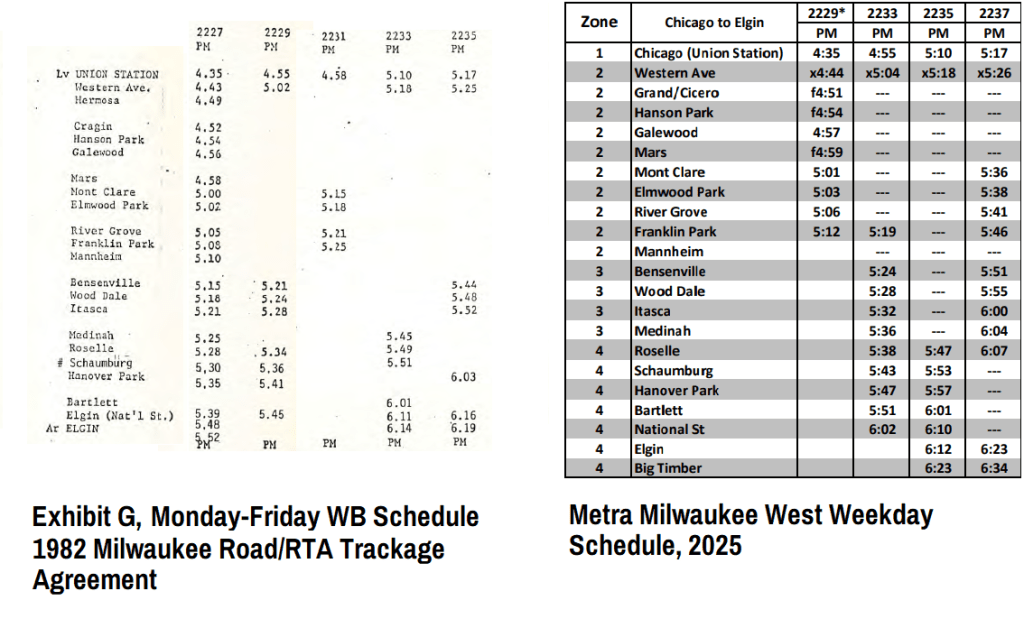
It’s also a bit uncomfortable how little the schedules have changed in the last 40+ years; other than train numbers and some station consolidations/expansions, the peak-of-the-peak westbound MD-W weekday schedule is nearly unchanged since 1982:
Sources: Metra CPKC Merger STB Filing (STB Finance Docket No. 36500, Exhibit A-1, PDF pages 167-169); Metra published schedules as of 3/12/2025
While a certain degree of these issues can more than likely chalked up to institutional inertia, Metra’s ongoing constraints to increasing service on the Grand Corridor — a line they already own — can best be described as parking-meter-deal-esque.
Illinois Department of Transportation
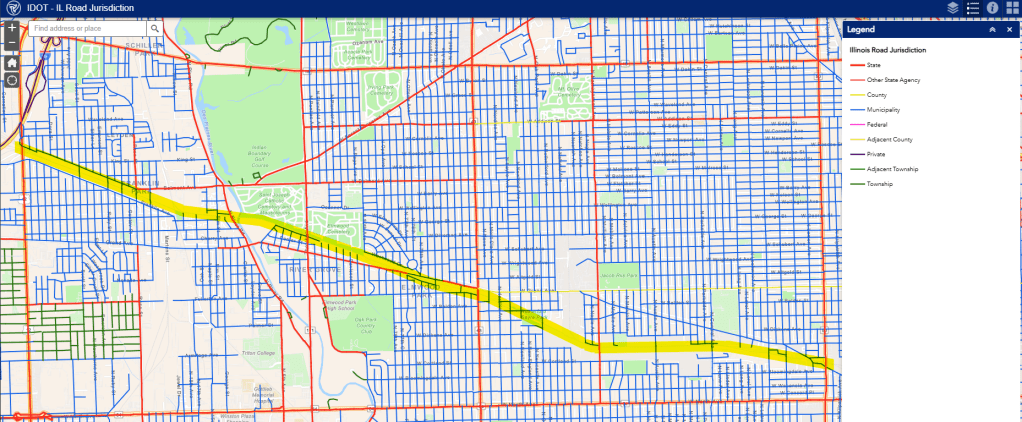
Like many parts of the city and near suburbs, IDOT has jurisdiction of many of the major streets along the Grand Corridor, above and beyond the three signed state highways (Thatcher Avenue/IL 171, Harlem Avenue/IL 43 and Cicero Avenue/IL 50). Other major crossings of the Grand Corridor under state control include Des Plaines River Road, Narragansett Avenue, and Grand Avenue itself.
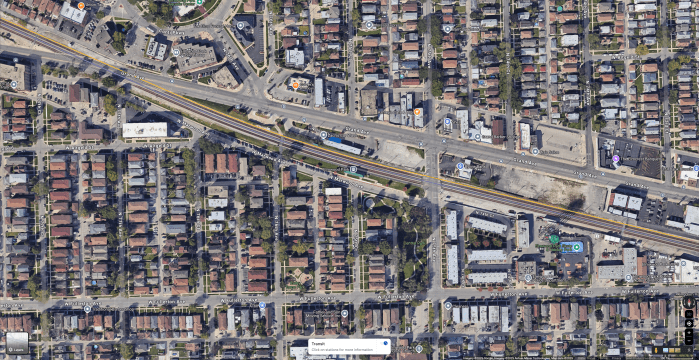
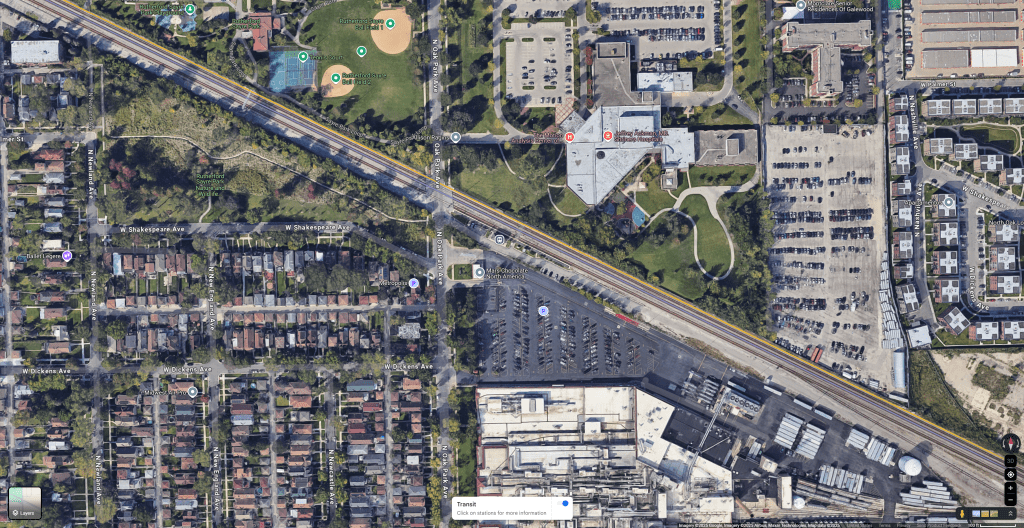
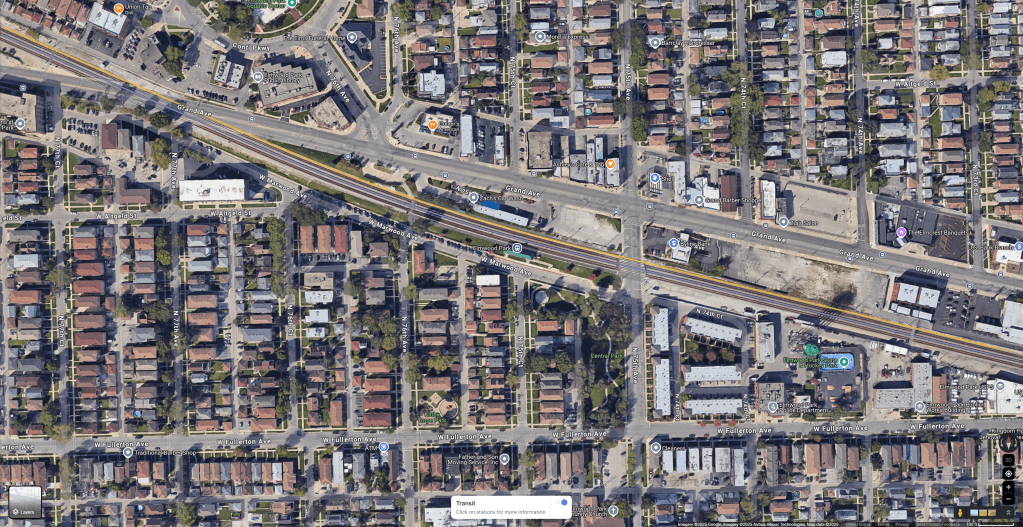
Google Maps aerial of the Elmwood Park station area, including the Grand Avenue grade crossing.
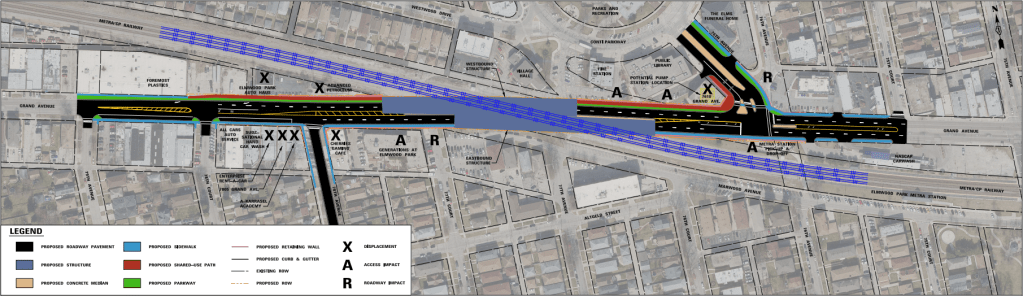
Following the infamous 2005 grade crossing crash that involved 18 vehicles and injured 10 people, IDOT began a grade separation feasibility study in 2007. Since then, under the branding of the “Grand Gateway”, IDOT and the Village of Elmwood Park have since been working on advancing plans for an underpass at this location, a $120 million project that recently secured $13 million for land acquisition.
“Alternative 2”, the preferred grade separation alternative as presented in 2022.
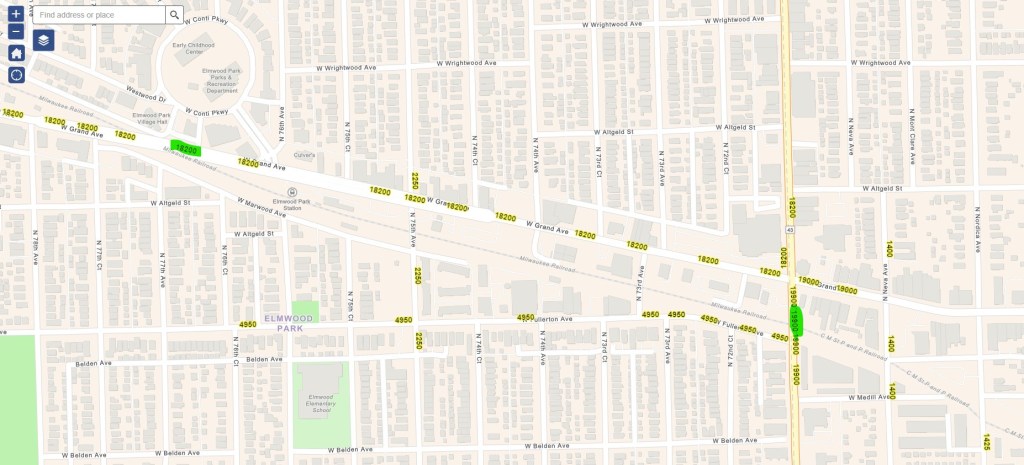
While separating the Grand Avenue crossing is justly considered a transportation priority, the state and Elmwood Park are treating this (nine-figure) project as a spot improvement rather than a corridor enhancement. In this case, just 3,500 feet east of this crossing is the Harlem Avenue grade crossing, which also happens to carry more traffic as well as two bus routes (for now, at least).
IDOT Annual Average Daily Traffic (AADT) map screenshot, showing 2023 figures. At the railroad crossing, Grand Avenue carries 18,200 vehicles a day, while Harlem Avenue carries 19,900 vehicles a day across the crossing.
If we were looking at the Grand Corridor as an actual corridor, this specific project could be the impetus for — or at least forward-compatible with — a larger-scale grade separation that includes Harlem Avenue to increase safety for all road users while speeding up our buses and trains. What’s particularly frustrating is how so many of the issues previously discussed could fall like dominoes if these efforts all lined up:
The corridor elevation could ensure that a fourth main could be reinstalled to separate freight and passenger rail traffic, an important infrastructure improvement that could help Metra convince CPKC to allow more frequent passenger rail service.
The corridor elevation would also allow (or require) relocating the Mont Clare Metra station to a location more suitable to also serve as a bus turnaround for CTA and Pace buses, creating a targeted intermodal hub to plan a proper, integrated neighborhood bus network around.
As part of designing the new station, even in the absence of a fourth main, an island platform could be included to allow express NCS trains between O’Hare and downtown to stop here — which, again, would now be an intermodal transfer point serving both CTA and Pace buses — instead of River Grove.
With this transit anchor near Harlem Avenue, the Harlem Avenue corridor — which intersects with and already has convenient stations for the CTA Green Line, CTA Blue Line, Metra Union Pacific West, and Metra BNSF Railway lines — could be properly prioritized by IDOT, CTA, and Pace to provide fast, frequent connections, opening up the entire West Side and near west suburbs to dramatically improved service to the O’Hare area.
With just a little bit of creativity — considering it lies just three miles east of Harlem Avenue — we could connect this Harlem Avenue line to Midway instead of the current 307 terminus at SeatGeek Stadium, which would be downright transformational for massive swaths of the entire Chicagoland region.
But instead, with four different transportation agencies going in four different directions because each of them are focused on the specific niche they specialize in, here we are, with so much potential just slipping through the cracks. Since this corridor isn’t fully city and it isn’t fully suburban, it doesn’t fit neatly into one of those silos we’ve built for ourselves over the decades, so we simply don’t do it.
This series of posts is called “Six Degrees of Separation” because these four major players — combined with the two designated regional players that should be tying them all together, namely the Chicago Metropolitan Agency for Planning (CMAP) and the Regional Transportation Authority (RTA) — have each been going their own way for too long, setting the table for the crisis we’re in now. While the current focus has been on the funding crisis for transit operations, and the governance reforms that will (hopefully) accompany a (hopefully) massive infusion of new funding into regional transit operations, what we really have is a crisis of vision, and a crisis of action: we need to be able to do big things again, and that starts with dreaming of the big — and even some of the more modest — things we want to make realities.
In Part 3, we’ll end on a high note by taking a look at what some of the current governance reform efforts could mean for the Grand Corridor, and present a potential new way forward for a transformative new vision for Chicagoland transit.
#BuildTheTunnel
Extending the 77-Belmont due west to the Franklin Park MD-W station would also accomplish the goal of connecting the route to both Metra routes since the NCS line also has a station at Belmont Avenue, but the extension would be a bit longer, go outside the CTA’s service area as currently defined, and may result in service delays in case of freight train interference at the grade crossing. Repurposing some of the existing River Grove Metra parking as a bus turnaround would allow the 77-Belmont to avoid crossing any additional tracks at-grade. ↩︎
Prior to 2024, the Pace 307 bus’s northern terminus was in Conti Circle in downtown Elmwood Park, via Grand Avenue west of Harlem Avenue. ↩︎
As we hurtle ever closer to the fiscal cliff, there’s been a lot of talk and discussions in Chicagoland about not only the importance of a safe, reliable, efficient transit network, but also what those investments — or forthcoming lack thereof — could mean for the city and the region as a whole. Concurrently, cost projections for the CTA’s Red Line Extension (RLE) have continued to increase, last year spiking from $3.6 billion to $5.75 billion in a matter of weeks. An unchecked 60% spike in projected costs should attract a lot of attention as we continue to discuss the best ways to maintain, operate, and expand our transit network to serve the entire Chicagoland region, especially chronically-disinvested areas like Chicago’s Far South Side. Given the rich history of CTA-vs.-Metra relations, how the RTA oversees (or doesn’t oversee) the service boards below them, and political promises for decades, there is undoubtedly a lot to unpack in a project that could very well become emblematic of the challenges our agencies and our transit network as a whole face in the 21st Century.
But let’s talk about a different corridor.
In the first of three Diverging Approach posts, we’re going to take a deep dive into the Grand Avenue corridor between Cicero Avenue and Mannheim Road: an ideal intermodal corridor that has come to encapsulate the siloed thinking and missed opportunities of the six major players of our current transit network: the three service boards, the RTA, CMAP, and our highway agencies. This post will set the table of the existing conditions in the corridor, how they came to be, and how tantalizingly close our missed connections are in what should — and could — be a dynamic, working-class, transit-oriented corridor between the two largest economic centers in the Midwest. Later posts will take a look at how reforms currently being discussed and debated in Springfield could reshape the transit user experience in this area, and how this corridor can become a keystone of a unified vision for 21st-Century Chicagoland transit.
RTA System Map showing the Grand Avenue corridor between Cicero Avenue and Mannheim Road, a distance of about seven miles.
Out on one of the further edges of the city, where the West Side meets the Northwest Side and spills into suburban Cook County, lies Grand Avenue and Metra’s Milwaukee West line. Working-class communities straddling the city limits along nine stations that date back to the 1870s, this corridor more than perhaps any other exemplifies the challenges our region faces when we have three transit agencies with three different missions that all overlap, but not necessarily interact, with each other in the same corner of the map. However, the innate potential advantages of this corridor — which includes Metra’s existing North Central Service that connects this area to both downtown and O’Hare — can make a very strong argument for a more regional perspective in how we plan and operate our transit network.
As of late, our three current service providers are all taking a closer look at this area in some capacity: Pace’s ReVision bus network redesign is ongoing; the CTA is beginning to roll out recommendations from its recent Bus Vision Project, including new 10-minute headways along the 54-Cicero and later this year, the 77-Belmont and 72-North corridors seen above; and Metra, perhaps perennially, is looking at adding more service between downtown and O’Hare via this rail corridor. However, these three efforts are mostly in parallel to each other, rather than a single coordinated effort to improve service. Each effort has its own goals: the CTA seeks to leverage its strong grid of bus routes to improve connectivity with other CTA routes; Pace is determining whether to concentrate its effort on increasing ridership, increasing service coverage, or some combination of the two; and news reports suggest Metra’s interest in improved O’Hare service thus far has been focused on express service similar to what was operated during last summer’s Democratic National Convention.
Demographics
Unlike many of Metra’s routes, the demographics immediately along this corridor are diverse and largely working-class. East of Harlem in the city proper, the tracks themselves define the community-area boundary between majority-Black Austin and majority-Hispanic Belmont Cragin and Montclare1. West of Harlem as the line leaves the city, the demographics shift to the majority-white — but quickly diversifying — suburbs of Elmwood Park and River Grove, which have bothdiversified from 85-87% white in 2000 to 57-62% white in 2020. After crossing the Des Plaines River, the rail line enters majority-minority Franklin Park, which covers the rest of the line to Mannheim Road. (West of Mannheim is three miles of rail yard.)
“Map of population distribution by race and ethnicity in Chicago and environs” from the CTA Bus Vision Program Framing Report. The Grand Corridor between Cicero Avenue and Mannheim Road is highlighted in yellow. (Figure 37).
Median household income along the corridor is comparable to other working-class portions of Chicago, both for the parts of the corridor in the city proper and for the suburban stretches.
“Map of median household income, divided by household size, in Chicago and environs” from the CTA Bus Vision Program Framing Report. The Grand Corridor between Cicero Avenue and Mannheim Road is lined in green. (Figure 45)
Unlike some of Metra’s other triple-track main lines through the city such as the Union Pacific Northwest, Union Pacific West, or BNSF Railway lines, there is no nearby CTA ‘L’ service and, as a result, this part of the city is something of a transit desert for city residents comparable to some parts of the Southwest and Far South Sides, despite the corridor’s proximity to O’Hare and airport-adjacent industries and businesses.
“Map of access to jobs, in 45 minutes or less on transit (including time spent walking, riding, waiting and transferring) in 2019” from the CTA Bus Vision Program Framing Report. The Grand Corridor between Cicero Avenue and Mannheim Road is lined in green. Note that figures outside of the CTA service area are not shown. (Figure 49)
The corridor overall has a healthy density of residents and workers that could sustain more robust transit service. Collectively within a mile of each of the nine stations in the corridor, the Census Bureau reports over 76,000 workers as of 2022, just under half of whom made less than $40,000 that year. To put this in the context of the Red Line Extension, this area is slightly more than double the size of the respective 1-mile areas around the four new RLE stations but includes well over three times as many potential commuters.
U.S. Census Bureau OnTheMap Home Area Profile Analyses for the Grand Corridor and the Red Line Extension, using one-mile buffers from stations. Click the images for larger versions.
Station Areas
The rail corridor within the city has a strong industrial history that, in some cases, continues through to today. However, as the industrial economy continues to evolve in Chicagoland, opportunities for higher-density transit-oriented development are emerging in this corridor — especially if fast, frequent, reliable transit service can be established. Some of these opportunities, and the challenges at many of these stations, are detailed below.
An important detail about this corridor is how the line itself was “modernized” following the creation of Metra’s North Central Service. For much of the 20th Century as part of the Milwaukee Road, this part of the line was somewhat unique in that it functioned as two side-by-side two-track railroads, with passenger trains using the north pair of tracks and freight trains using the southern tracks to provide relatively conflict-free operations between Bensenville Yard and Cragin Junction, just east of Cicero Avenue. Unfortunately, this resulted in station buildings being constructed on the “wrong” (outbound) platform due to space constraints, which was an inconvenience for mostly-city-bound riders. As the Milwaukee Road fell onto harder financial times in the final quarter of the century, the fourth (southernmost) track was largely removed, and eventually the railroad was sold to Metra. Regrettably, when Metra made a major investment to increase service on the North Central Service in 2006, the line was reconstructed as a “traditional” three-track shared corridor similar to the Union Pacific West or BNSF Railway lines, which does allow for station buildings to be on the inbound platform but now require mixed operations. As Canadian Pacific Kansas City, the new “host”2 of the line, plans to increase freight traffic on the line, freight/passenger conflicts will continue to increase.
Grand/Cicero
Google Maps aerial of Grand/Cicero.
Grand/Cicero opened in 2006 as part of the NCS “modernization” project as a consolidation of two former stations, Cragin to the west and Hermosa to the east. Grand/Cicero is ideally situated just north of the eponymous intersection, built into the grade separation embankment. Fully ADA-accessible, Grand/Cicero has elevators that can provide direct connections to the CTA’s 54-Cicero and 65-Grand buses, the former of which has been identified as one of the CTA’s inaugural Frequent Network routes. Despite these connections, Metra treats Grand/Cicero as a weekday-peak-only flag stop, where trains will only stop upon request, and only during the weekday peak, leaving the station unserved midday, nights, and on weekends. As of this publication, Grand/Cicero is only served by 10 inbound trains and 6 outbound trains each weekday, all of which are either before 8:32am or between 3:26 and 6:26pm.
The northeast quadrant of the site, directly adjacent to the station, is occupied by a 10.5-acre Home Depot and Chase Bank.
Hanson Park
Google Maps aerial of Hanson Park.
Hanson Park is located approximately one mile west of Grand/Cicero. Historically the site of a Milwaukee Road rail yard, the line is at-grade but Central Avenue crosses overhead just east of the platforms. While the station itself is officially ADA-accessible, access to Central Avenue is provided by a staircase that is not accessible to passengers with mobility disabilities. While there are bus stops in both directions for 85-Central buses — the only direct connection between the Milwaukee West line and Jefferson Park, the largest transit center on the Northwest Side — the stairs to the bridge are only on one side, and transferring to or from a northbound bus requires jaywalking in the middle of the bridge.
Connecting to a northbound bus is officially illegal since there is no pedestrian crossing, despite a posted northbound bus stop that is otherwise inaccessible. (Google Streetview)
Across the street from the Hanson Park train station is an overflow parking lot for the Chicago Police Department facility east of Central Avenue; the CPD facility also includes two Circuit Court of Cook County facilities for misdemeanor cases. South of the tracks, a large, low-density union hall sits west of Central; east of Central is one of the only active movie theaters on the Northwest Side. Like Grand/Cicero, Hanson Park is a weekday-peak-only flag stop, with 9 inbound trains and 6 outbound trains a day and no midday, evening, or weekend service.
Galewood
Google Maps aerial of Galewood.
One mile west of Hanson Park is Galewood, at Narragansett Avenue. In something of an inversion of Grand/Cicero and Hanson Park, this station is a full-time station for Metra with service seven days a week; however, this time it’s the CTA that operates limited connecting service as the 86-Narragansett/Ridgeland bus does not operate after 9pm during the week, and does not operate at all on weekends.
While active industrial uses are present on the northeast, southeast, and southwest quadrants, other than the Hostess bakery plant on the northeast corner the land uses are extremely low-intensity, with the southwest quadrant occupied by a self-storage facility and the southeast quadrant currently a surface parking lot used for CDL and truck driver training.
Mars
Google Maps aerial of Mars (the train station, not the planet)
Mars, everyone’s favorite station name, is located just a half-mile west of Galewood at Oak Park Avenue. Oak Park Avenue is not a bus route, and like Grand/Cicero and Hanson Park, Mars is also a weekday-peak-only flag stop. While the station is flanked by Sayre Park to the west and the Shriners Children’s Hospital to the northeast, the station is named for the Mars candy factory just to the south of the station, which is currently studying how to redevelop the 20-acre site once the production line shuts down soon. More frequent — or at least full-time — rail service would certainly be a boon for any transit-oriented redevelopment possibilities for the candy factory.
Mont Clare
Google Maps aerial of Mont Clare.
Less than half a mile away from Mars to the west lies the last station in the city proper, Mont Clare. Mont Clare is a full-time station, and absolutely infuriating from a network perspective. Harlem Avenue, one of the busiest north-south arterials in the area, is two blocks west; the CTA’s 90-Harlem bus does not directly serve the station. Grand Avenue, one of the busiest east-west arterials in the area, is one block north; the CTA’s 65-Grand and 74-Fullerton buses both do not directly serve the station either. Instead, these buses use the Grand/Nordica turnaround on the north side of Grand Avenue, which requires a short but unpleasant walk to connect from buses to trains. Pace’s 307 and 319 buses also use the Grand/Nordica turnaround, which means these routes also do not serve the Mont Clare station, even though the station is right there and Metra has more parking than they know what to do with and it would be just so easy to move the bus turnaround to the station itself and do literally anything better than what’s going on right now.
On weekends, even when trains are operating every two hours, the scheduled “meet” for these trains (where inbound and outbound trains pass each other) is scheduled just east of Mont Clare, with only a 4-minute separation between inbound trains (arriving on the :46) and outbound trains (arriving on the :50). With a bus terminal at the station, proactive scheduling means that this could be a perfect “pulse” location where buses come in on the :40 and leave on the :55 to provide plenty of time to make connections between buses and trains, while also providing operators with a solid 15-minute break and relief period. And yet…
If you want to know more about Mont Clare [missed] connections, just follow me on BlueSky and wait, I’m sure it’ll come up soon enough.
Despite the bus turnaround issue, the land use around the station is pretty good: mixed-density residential uses dominate the immediate areas that aren’t surface parking, with a neighborhood commercial corridor along Grand.
Elmwood Park
Google Maps aerial of the Elmwood Park train station.
Once we cross Harlem Avenue we’re officially in the suburbs; the Elmwood Park station is about half a mile further west of Harlem, at 75th Avenue. Grand Avenue is served by Pace’s 319 bus, with a convenient signalized crossing at 76th Avenue. The 319 is relatively typical for Pace operations in Suburban Cook: buses operate half-hourly between about 5:30am and 7:30pm, with more limited Saturday service and no Sunday service.
The Elmwood Park station area is perhaps best known for the extremely shallow-angle grade crossing at Grand Avenue, the site of numerous fatal train-vs.-car crashes including a single 2005 crash that injured ten people and involved 18 vehicles. As a result, trains must reduce speed to cross the intersection, including express trains (such as Metra NCS trains) that do not stop at Elmwood Park. The Village of Elmwood Park and the Illinois Department of Transportation have secured funding to begin preliminary work for a grade separation in this location — a topic we’ll go into deeper in Part 2.
Land use and density near the station is somewhat typical of Chicago’s “inner tier” suburbs. Residential uses are mostly single-family, but on smaller city-sized lots with some three-flats and modest apartment buildings intermingled. While Grand Avenue comprises one of Elmwood Park’s busiest commercial districts, the town center of Conti Circle lies about a block northwest of the station. This town center includes most of the village’s municipal buildings as well as additional commercial and mixed-use buildings. Pace’s 307 bus formerly terminated in Conti Circle until the pandemic era, when the route’s terminus was shifted to the aforementioned Grand/Nordica turnaround near Mont Clare after several Conti Circle closures for street festivals.
River Grove
Google Maps aerial of the River Grove station
A little over a mile west of Elmwood Park is the River Grove station, a somewhat unusual station for several reasons. First and foremost, as is plainly seen in the aerial, the station is adjacent to two large cemeteries that occupy half of the station’s potential walkshed. However, the station is situated on Illinois Route 171, known variously as Cumberland Avenue, Thatcher Avenue, or 1st Avenue depending on where exactly one happens to be located along 8400 West on the city address grid. Pace Route 331, which runs from the Cumberland Blue Line to the Metra BNSF Line via a stop at the Maywood UP-W station, also serves the station via Thatcher. Half a mile north of the station, the terminus of the CTA Frequent Network 77-Belmont bus is tantalizingly close, but does not serve River Grove.
River Grove was not upgraded as part of the 2006 “modernization” of the three-track railroad; as such, the station building itself is on the outbound platform, with an island platform serving inbound (and, occasionally, some outbound) trains. River Grove is the designated transfer station between Metra’s Milwaukee West and North Central Service trains before the latter branches off about a mile west of the station and heads north towards O’Hare and Antioch. While the infrastructure is built to accommodate transfers, unfortunately the schedules are not: of the North Central Service’s seven weekday round-trips, one does not even stop at River Grove, and the other six have limited capabilities to actually connect to Milwaukee West trains, either as a local-express pair or as a more traditional transfer between lines. (North Central Service trains do not operate at all on weekends.)
Metra River Grove Weekday Arrivals, Departures, and Transfers
NCS Train/Direction
NCS Arrival
MD-W Outbound
MD-W Inbound
Transfers?
5:02am
5:38am
6:08am
100 (Inbound)
6:32am
6:50am
6:46am
Yes (1, 2)
102 (Inbound) 101 (Outbound)
7:13am 7:31am
7:19am
7:19am
Yes (1, 2, 3, 4)
7:54am
7:50am
110 (Inbound)
8:15am
8:19am
Yes (2)
8:54am
9:13am
112 (Inbound)
9:15am
No
9:54am
10:13am
114 (Inbound)
10:25am
No
10:54am
11:13am
11:54am
12:13pm
12:54pm
1:13pm
105 (Outbound)
1:46pm
1:54pm
No
2:13pm
2:54pm
3:13pm
107 (Outbound)
3:46pm
3:59pm
No
4:13pm
109 (Outbound)
4:46pm
4:39pm*
Yes (3)
116 (Inbound)
4:52pm
5:06pm*
4:58pm
Yes (1, 2)
5:25pm
115 (Outbound)
5:56pm
5:41pm
Yes (3)
117 (Outbound)
6:21pm
6:14pm
6:13pm
Yes (3, 4)
Trains marked with an asterisk (*) terminate at Franklin Park. Train 117 is the final scheduled NCS train of the day.
Transfers (scheduled useful connections within 20 min): (1) NCS inbound to MD-W outbound; (2) NCS inbound to MD-W inbound; (3) MD-W outbound to NCS outbound; (4) MD-W inbound to NCS outbound.
Despite half the walkshed occupied by cemeteries, the Village of River Grove has been proactively adding more transit-oriented development near the station, including a recently-opened 90-unit apartment complex.
Franklin Park
Google Maps aerial of the Franklin Park station area and Tower B-12, where Metra NCS trains branch off from the Metra Milwaukee West line.
About a mile and a half west of River Grove and just past where NCS trains split off of the MD-W line at Tower B-12 is Franklin Park. The station is located just west of 25th Avenue, which carries Pace Route 303, a weekday3-only route linking the CTA Forest Park Blue Line and the CTA Rosemont Blue Line stations with an additional stop at the Melrose Park UP-W station. Similar to River Grove, the Franklin Park station also was not changed in the 2006 triple-track modernization and retains its (rarely-unlocked) station building on the outbound platform with an unsheltered island inbound platform. Its location between Tower B-12 and the east end of Bensenville Yard make this a chronic location for freight train interference and occasionally extensive delays as slow-moving freight trains stop and reverse. Metra also uses Franklin Park as the separation point between the “inner” (local) and “outer” (express) service patterns during weekday peak hours, which means that even when some of the useful NCS/MD-W connections are scheduled one stop east at River Grove, passengers riding to or from suburban MD-W stations may also have to make an additional transfer at Franklin Park to switch between express and local trains.
While the northeast quadrant of the station area was unfortunately recently redeveloped as a surface parking lot, the southwest quadrant has seen some relatively significant transit-oriented development within the last decade, including two six-story residential developments with ground-level retail. The southeast quadrant is currently occupied by the Park District of Franklin Park, another potential transit-oriented development opportunity in the future.
Mannheim
Google Maps aerial of the Mannheim station
Finally, just under a mile west of the Franklin Park station lies Mannheim, one of the least-utilized stations in Metra’s network. The station, which is little more than two small platforms and a warming shelter on the outbound track, lies at the throat to Bensenville Yard. A historic whistle-stop community whose only remnants are a small dive bar and a plaque in the sidewalk, Mannheim is surrounded by light industrial uses and single-family homes. Similar to Hanson Park, Mannheim’s strongest opportunity would lie in more reliable connections to the bus route that goes over the station; Pace Route 330 uses Mannheim Road to connect the O’Hare Multimodal Facility (MMF) to 55th/Archer via downtown La Grange and the LaGrange Road BNSF. The route operates seven days a week with relatively quick runtimes — MMF to La Grange in under an hour — but has no connection to the Mannheim MD-W station due to the viaduct over the tracks with no vertical circulation down to the station. More frustratingly, the exact same situation occurs a few miles south at the Union Pacific West Line, where the 330 similarly misses a connection to the Bellwood station due to a lack of pedestrian access.
Not that it matters much here: similar to Grand/Cicero, Hanson Park, and Mars, Mannheim only receives weekday-peak-only flag stops, with eight inbound trains a day making the stop on request and a paltry four trains in the outbound direction.
West of Mannheim, trains can really open up and often get to 70 miles an hour as the Milwaukee West runs around the airport out to Bensenville and DuPage County.
If a realtor also happened to be a transit advocate, they would almost definitely describe this corridor having “good bones”: decent existing infrastructure with a fair amount of existing service and current land uses that could be quite conducive to transit-oriented development, but no one has been able to put the pieces together quite the right way yet. As Chicagoland transit continues to approach the fiscal cliff and as conversations start up in earnest about not only how to save our transit network but how we move towards the future transit network we want, the Grand Corridor makes an ideal candidate to better understand the untapped potential in our network and our region.
In the next installments in this series, we’ll take a deeper look into understanding the various major stakeholders responsible for improving transit and transportation in the Grand Corridor, and how some of the governance reform efforts currently being discussed in Springfield could play a role.
Finally, we’ll wrap up the series with what we believe should happen in the Grand Corridor, and present a bold, achievable vision for the future that demonstrates what a unified network can do — and how to make that vision a reality.
#BuildTheTunnel
The Metra station is named “Mont Clare” — with a space — whereas the official community area is named “Montclare”, without a space. ↩︎
Metra owns, operates, and maintains the Milwaukee West; however, CPKC dispatches the line and has inherited a sweetheart trackage rights agreement from Metra’s purchase of the Milwaukee Road that allows CPKC to have a functional veto of any Metra service changes outside of the weekday peak period (page 41). ↩︎
Pace Route 303 also operates on Saturdays, but only between Forest Park and North Avenue without connecting to the Milwaukee West line or the Rosemont Blue Line. ↩︎
Editor’s Note: This post has been updated to correct the locations of the former Cragin and Hermosa MD-W stations, and to clarify the location of the freight turnoff at Cragin Junction.