Diverging Approach: A Regional Rail Road Map

Regular readers of this blog are already familiar with the benefits of a thru-running regional rail network, and why specifically here in Chicagoland we need to #BuildTheTunnel.

It can be challenging, however, to envision how such a system could be crafted, developed, built, and operated; indeed, it is one of the most common questions weโ€™ve received. There are multiple existing constraints that need to be identified and mitigated, and major capital projects that would need to be built. The Chicago Terminal, as railroaders generally refer to the Chicagoland rail network, is an incredibly complex place to operate trains.

To this end, this post will attempt to identify a potentially-plausible phased approach to get Chicagoland from today to the regional rail network our region deserves. The service plans and proposals included herein are, of course, entirely unofficial: the CrossTowner regional rail proposal has always been, and continues to be, an exercise in imagining what could be rather than an official or professional regional plan. These plans have not been vetted by any of Chicagolandโ€™s transit agencies, and rely exclusively on publicly-available materials and observations. Much further study and planning would be required before any implementation begins, but this post is an attempt to show how we could eat the proverbial elephant one bite at a time.

Before We Begin

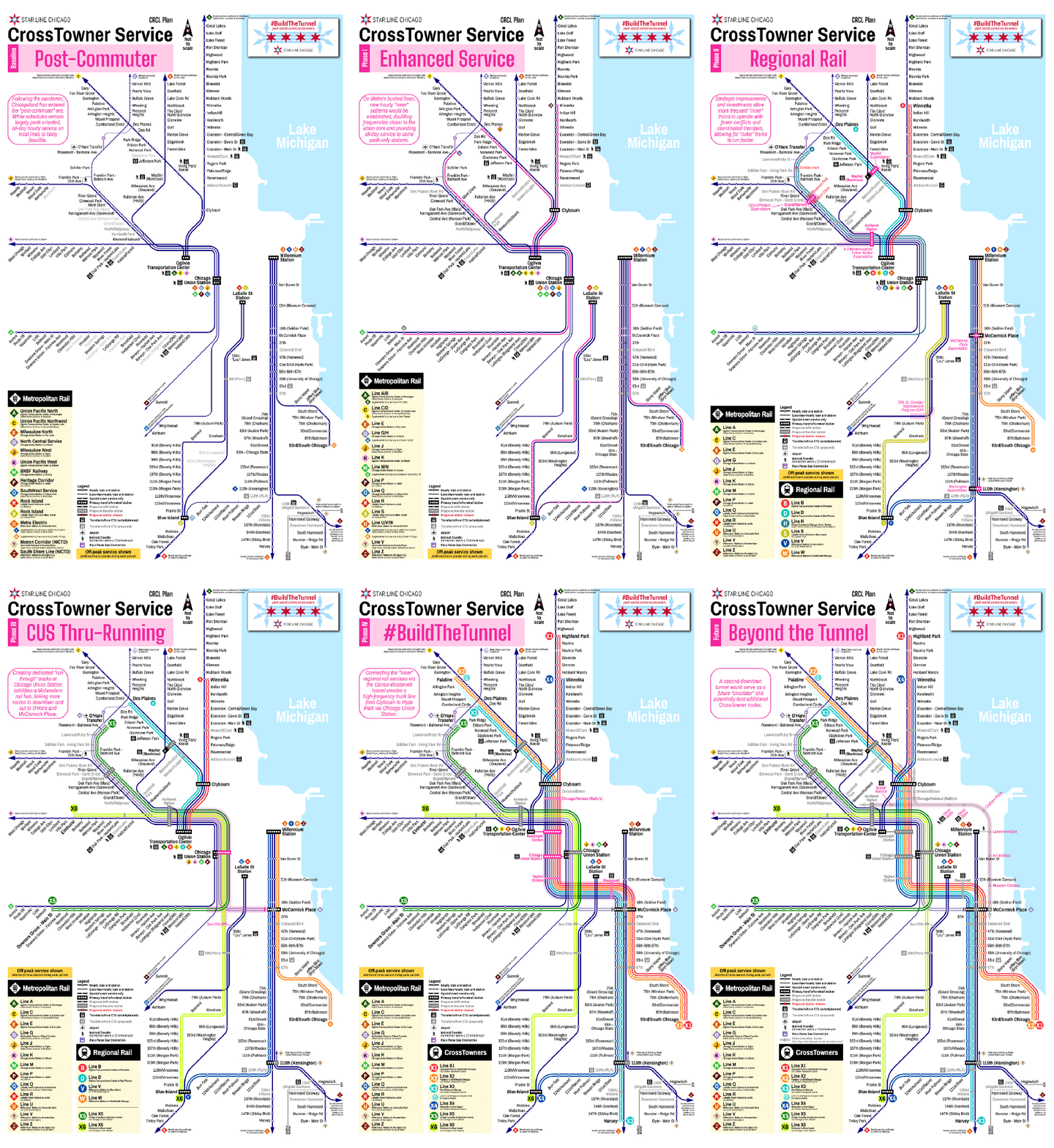
Some housekeeping before we get into the details: this post will rely heavily on maps that document different phased implementation components of the larger CrossTowner regional rail network vision. In some cases, the phases are irrelevant: some infill1 stations, for instance, could be constructed at any time (or not at all). In other cases, it may make sense to move certain components up or push them back based on cost, constructability, political realities, and so on.

These maps also use a standardized โ€œnetgraphโ€ approach to displaying service frequencies: each line represents one round-trip per hour. This allows an easier way to communicate average headways, or times between trains. Note, however, that these are averages: more detailed service planning would be required to determine more realistic schedules. Additionally, due to the realities of needing to balance local service with express service in some cases on shared tracks, perfectly-balanced headways all-day may not be entirely feasible.

Note that these maps all show proposed off-peak service levels. Additional trains would operate during peak periods, likely including Metraโ€™s typical battery of suburban express services; these trains are not shown.

A quick mathematics cheat sheet:

  • One line = one train per hour = 60 minutes between trains
  • Two parallel lines = two trains per hour = 30 minutes between trains
  • Three parallel lines = three trains per hour = 20 minutes between trains
  • Four parallel lines = four trains per hour = 15 minutes between trains
  • Five parallel lines = five trains per hour = 12 minutes between trains
  • Six parallel lines = six trains per hour = 10 minutes between trains
  • Eight parallel lines = eight trains per hour = 7.5 minutes between trains

Thinner lines indicate lines that operate less than hourly; these stations are shown โ€œinvertedโ€ (a solid-colored station with a white border, rather than a white circle with a colored border). Additionally, lines in future phases are shown by their โ€œYard Social Standardโ€ identification scheme that is also shown on other CrossTowner materials. The below โ€œbaselineโ€ map provides a comparison to that scheme and the existing line naming system.

The Regional Rail Road Map

Baseline: The Post-Commuter Era
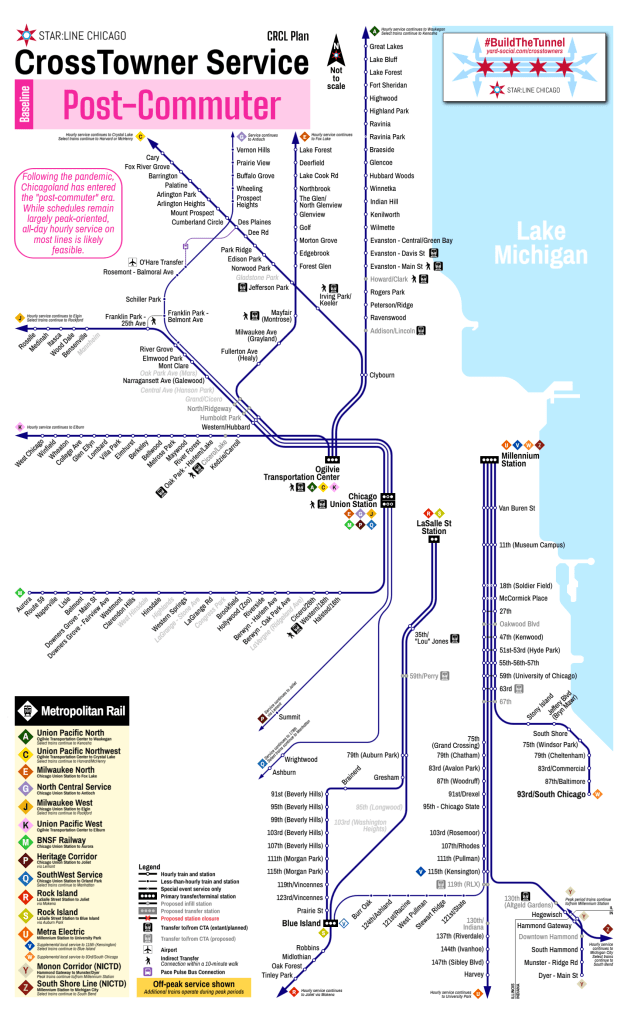
We begin with the โ€œPost-Commuterโ€ era: Metra has already committed to transitioning their fundamental operating model from โ€œcommuter railโ€ to โ€œregional railโ€. Preliminarily, this can be best summarized as โ€œhourly everywhereโ€: while some level of peak-period focus is warranted based on present ridership, the larger goal is to provide bi-directional all-day service throughout the service area. At present, Metra has been actively moving towards hourly headways wherever possible.

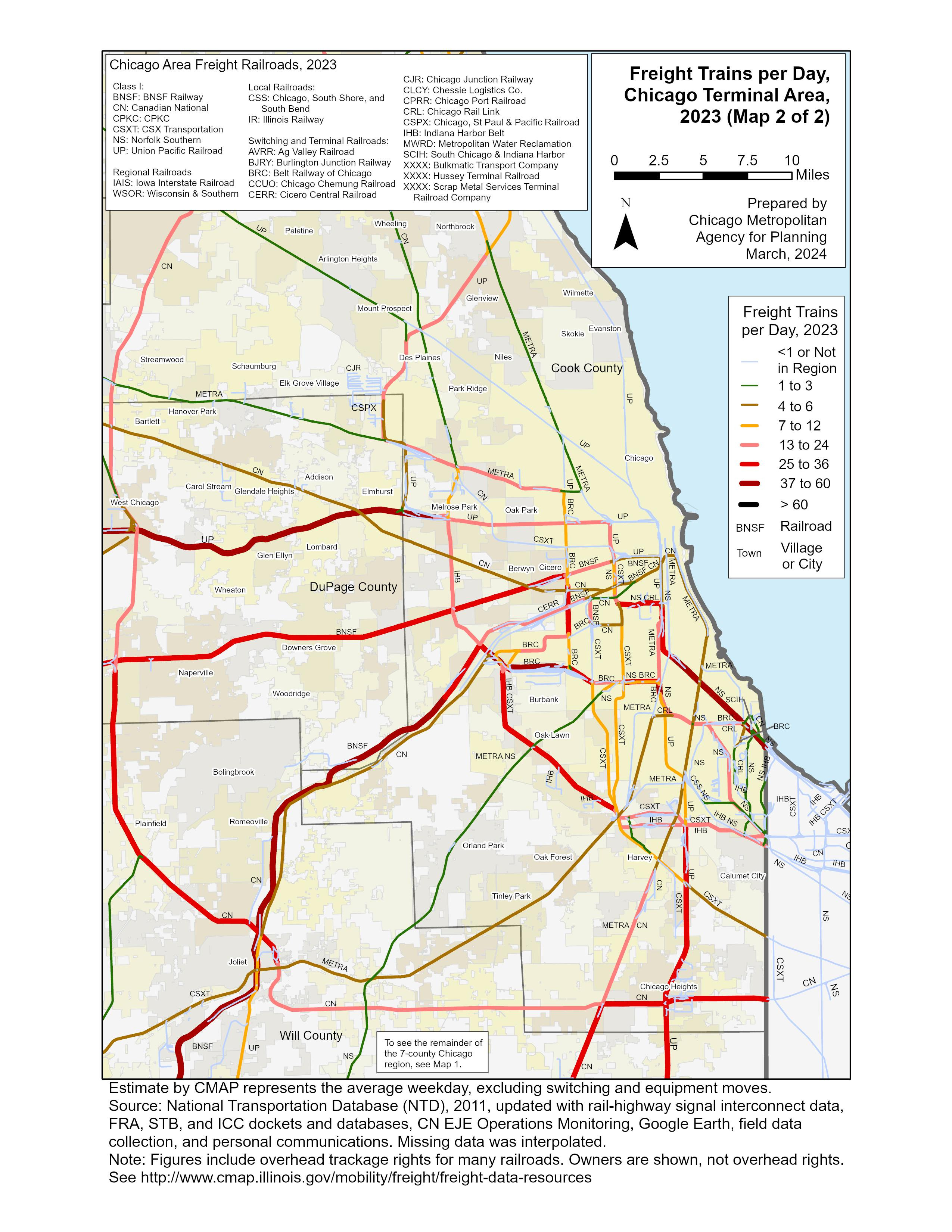
Unfortunately, that is not feasible everywhere: freight conflicts at numerous locations on the Heritage Corridor and SouthWest Service, as well as some single-track chokepoints on the North Central Service, will make all-day hourly service challenging from an infrastructure perspective. Additionally, on most lines Metra remains at the whims of freight railroads that either control the lines outright or exercise a high degree of autonomy that prevents Metra from easily increasing service. These constraints are one of the primary reasons why Metra cannot easily add additional service, and they need to be a political priority for our region as the NITA era begins.

For the purposes of this post, letโ€™s assume that they can be mitigated to some degree: Metra will need to continue to share tracks with freight traffic, and will need to ensure freight railroads can still reasonably operate throughout the day, but where freight traffic is lighter, Metra and the freights could come to some sort of agreement to add service.

For reference, here is a recent CMAP freight rail volume map, as of 2023.
Phase I: Enhanced Service

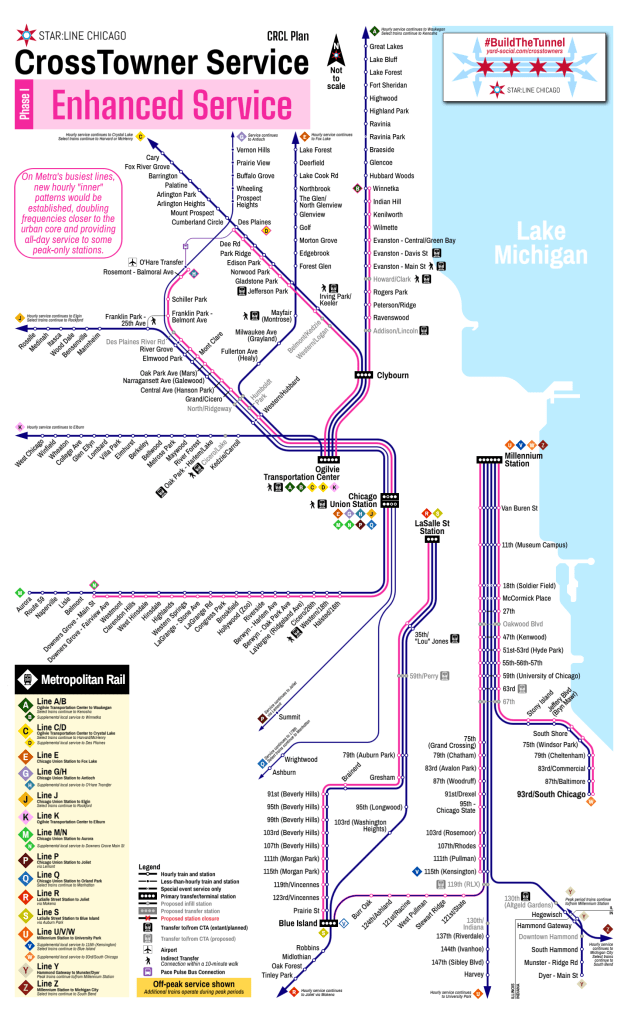
As Chicagoland takes concrete steps to move towards a proper โ€œregional railโ€ paradigm, the first step would be adding additional trains to the central part of the region, where population densities are more supportive of increased service on some of Metraโ€™s busiest routes. While โ€œhourly everywhereโ€ remains the goal for the region as a whole, supplemental service would be offered such that frequencies would improve to half-hourly closer to the urban core, while also beginning to provide all-day (hourly) service to some current peak-only stations, especially along the BNSF and Milwaukee West lines.

Supplemental hourly trains (to create half-hourly headways) would begin running on the Union Pacific North (โ€œA/Bโ€), Union Pacific Northwest (โ€œC/Dโ€), BNSF (โ€œM/Nโ€), Rock Island Beverly Branch (โ€œSโ€), and Metra Electric South Chicago (โ€œWโ€) lines. Supplemental trains would also operate on the Metra Electric Main Line and Blue Island Branch (โ€œVโ€), to provide half-hourly frequencies north of Kensington and hourly service on the Blue Island Branch. Combined with half-hourly service on the South Chicago Branch, this would provide 15-minute service between Hyde Park and Millennium Station, not including Main Line (โ€œUโ€) and South Shore Line (โ€œZโ€) express trains.

A โ€œnewโ€ line would also be created: Line โ€œHโ€ would serve as the supplemental hourly local pattern combining Milwaukee West and North Central Service stations between Chicago Union Station and Oโ€™Hare Transfer. Line โ€œHโ€ would also relieve the NCS of the need to make stops at Franklin Park, Schiller Park, and Rosemont, speeding trains up from the northern suburbs as well as speeding up express trains to Oโ€™Hare.

Following Phase I, most Metra stations in Chicago and some inner suburbs would be able to provide half-hourly service all day long, with only seven additional trains per hour region-wide.
Phase II: Regional Rail

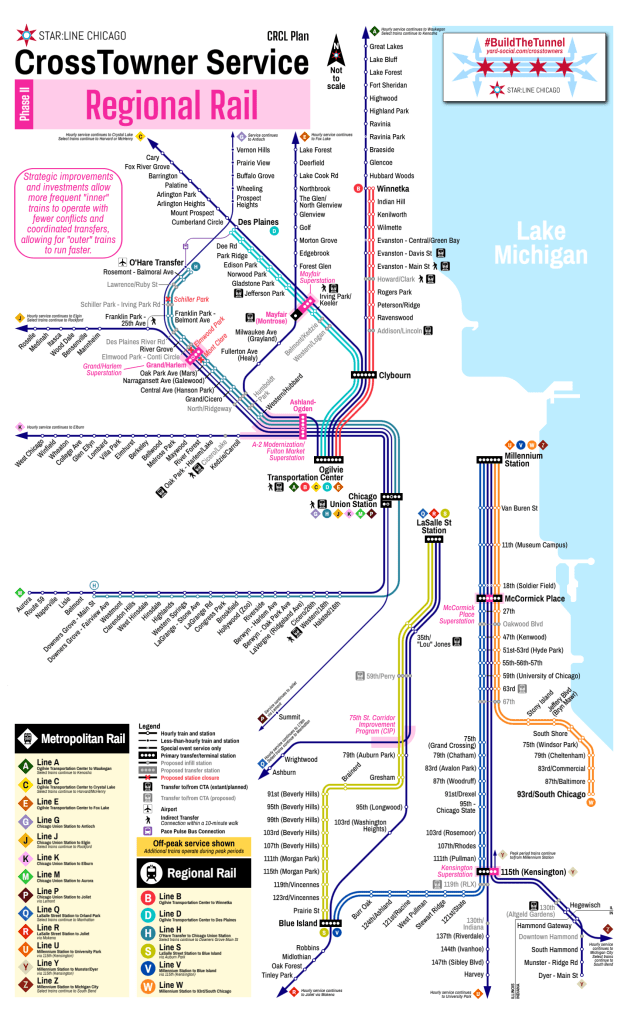
Following the Enhanced Service in Phase I, Phase II would take a stronger step towards a proper โ€œregional railโ€ network. At a high level, the goals of Phase II are to separate โ€œinnerโ€ supplemental service trains from โ€œouterโ€ suburban trains, allowing the latter to run express all day long.2 To allow this, strategic station investments are needed to create better transfer stations โ€” โ€œsuperstationsโ€ โ€” that allow โ€œinnerโ€ and โ€œouterโ€ trains to coordinate service, maintaining connectivity throughout the region while speeding up express services. The six โ€œregional railโ€ lines also now have their own distinct identification, and would likely also use a more modern rolling stock similar to Metraโ€™s forthcoming Stadler FLIRT fleet.

Phase II has six primary infrastructure improvements:

  • A-2 Modernization and Fulton Market Superstation: Perhaps the most important project in this phase, this effort would reorganize Metraโ€™s complicated A-2 interlocking on the West Side near Western Avenue, minimizing crossing conflicts by re-routing Line โ€œKโ€ (UP-W) trains into Chicago Union Station and Line โ€œEโ€ (MD-N) trains into Ogilvie Transportation Center. This reconfiguration would almost certainly be required before increasing frequencies between Chicago Union Station and Oโ€™Hare. This phase would also include a new Fulton Market Superstation to allow transfers and connections, as well as serve a burgeoning part of the city. (This project has been on Metraโ€™s radar for a while.)
  • Grand/Harlem Superstation: A station consolidation on the Northwest Side would create a contiguous Harlem Avenue bus corridor that connects express and local rail service to Oโ€™Hare to two other Metra lines (UP-W at Oak Park and BNSF at Harlem Avenue) as well as two3 CTA โ€˜Lโ€™ lines (Green Line at Harlem/Lake and Blue Line at Harlem-Congress). The full CrossTowner vision includes this bus route as a Pace Pulse corridor that would extend to Summit, then east on Archer/55th to the Orange Line โ€˜Lโ€™ terminal at Midway Airport.
  • Mayfair Superstation: A new station on Line โ€œC/Dโ€ (UP-NW) that would connect with the existing Line โ€œEโ€ (MD-N) Mayfair station and the existing Blue Line Montrose station. While the UP-NW also has Blue Line connections north and south of Mayfair, creating a unified Northwest Side superstation could anchor a future Brown Line western extension, as well as create far easier Amtrak connections between Hiawatha/Borealis/Empire Builder trains and Oโ€™Hare Airport via the Blue Line. Thinking far further into the future, a Mayfair superstation could also allow for reuse of the Weber Spur as a transit artery, as well as bookend a northern Cicero Avenue transitway.
  • 75th Street Corridor Improvement Program (CIP): Another project that has been on the books for years, the 75th Street CIP would allow Line โ€œQโ€ (SWS) trains to connect to LaSalle Street Station instead of Chicago Union Station while also bypassing key freight bottlenecks. While this project would not have a direct impact to the โ€œregional railโ€ lines, it would be a significant improvement that makes hourly SWS service more feasible.
  • Kensington Superstation: On the Far South Side, the existing 115th (Kensington) station would be (re-)expanded to (once again) allow for NICTD trains to make stops, supplementing the local/express patterns of the Metra Electric. Additionally, with NICTD operating the new Monon Corridor as an off-peak shuttle operation between Dyer and Hammond Gateway, Monon (Line โ€œYโ€) shuttle trains could be extended to the Kensington Superstation, doubling frequencies to Hegewisch.
  • McCormick Place Superstation: To better serve a major trip generator, as well as to provide another local/express transfer location along the Metra Electric, additional platforms would be added at McCormick Place in advance of future phases and service expansions. These new platforms would also allow special-event services on the express patterns to more easily serve McCormick Place without interfering with all-day local services.

On the North Side, these improvements, combined with three additional round-trips per hour, would allow for the busy โ€œAโ€ (UP-N) and โ€œCโ€ (UP-NW) lines to run express to speed up trips from the north and northwest suburbs, and on the West Side, local Line โ€œHโ€ trains could run twice an hour between Chicago Union Station and Oโ€™Hare Transfer to provide more robust all-day transit service connecting working-class neighborhoods to the regionโ€™s two largest job centers. The added hourly Line โ€œHโ€ train could also utilize the single existing thru-track at Chicago Union Station to replace the โ€œNโ€ BNSF supplemental pattern, creating a single-seat trip between Metraโ€™s busiest line and Oโ€™Hare. Furthermore, with half-hourly service, Line โ€œGโ€ (NCS) trains could skip more stations, providing an early โ€œOโ€™Hare Expressโ€ operation between Chicago Union Station and the airport.
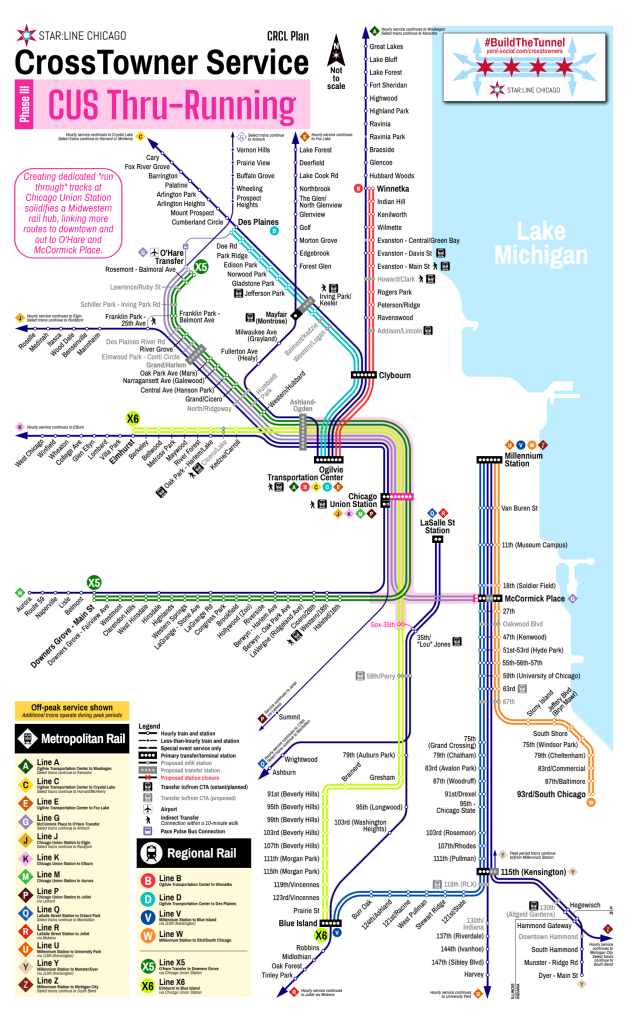
Phase III: CUS Thru-Running

The larger regional CrossTowner network starts to take shape in Phase III, when dedicated thru-running tracks at Chicago Union Station are constructed. This improvement can allow for proper thru-running operations at Chicago Union Station for regional rail service at higher frequencies. Combined with Amtrakโ€™s Chicago Hub Improvement Program (CHIP), three primary routes could be implemented:

  • X5: Building on the work of Phase II, the other hourly Line โ€œHโ€ train would also be thru-run to Downers Grove Main Street and rebranded as the X5 CrossTowner. This change would allow Line โ€œMโ€ (BNSF) trains to run essentially express east of Downers Grove, with stops only at Hinsdale, LaGrange Road, Harlem Avenue, Cicero, and Western.
  • X6: To create a future unified hub at Chicago Union Station, Line โ€œSโ€ (Beverly Branch) trains would turn off of the Rock Island District to connect with the vacated4 SouthWest Service tracks, run through Chicago Union Station, and provide regional rail service along Line โ€œKโ€ (UP-W). The CrossTowner vision suggests this connection be made through the parking lots of Rate Field, but several alternative options could be feasible and require further study. This route would be rebranded as the X6 CrossTowner.
  • Oโ€™Hare Express (Line โ€œGโ€): Thru-running Chicago Union Station, combined with fewer stops between downtown and Oโ€™Hare for Antioch-bound trains, and improving the St. Charles Air Line (SCAL) bridge over the Chicago River, creates the opportunity to operate an oft-desired airport express service between the McCormick Place Superstation, downtown, and Oโ€™Hare. Unlike other airport express operations, however, this would functionally be just an extension of Line โ€œGโ€ (NCS) suburban trains.5 6 While not officially a CrossTowner line, this service would be an important component of the larger system and would provide single-transfer connections from the Metra Electric lines to Chicago Union Station and Oโ€™Hare prior to the construction of the tunnel.
Phase IV: #BuildTheTunnel

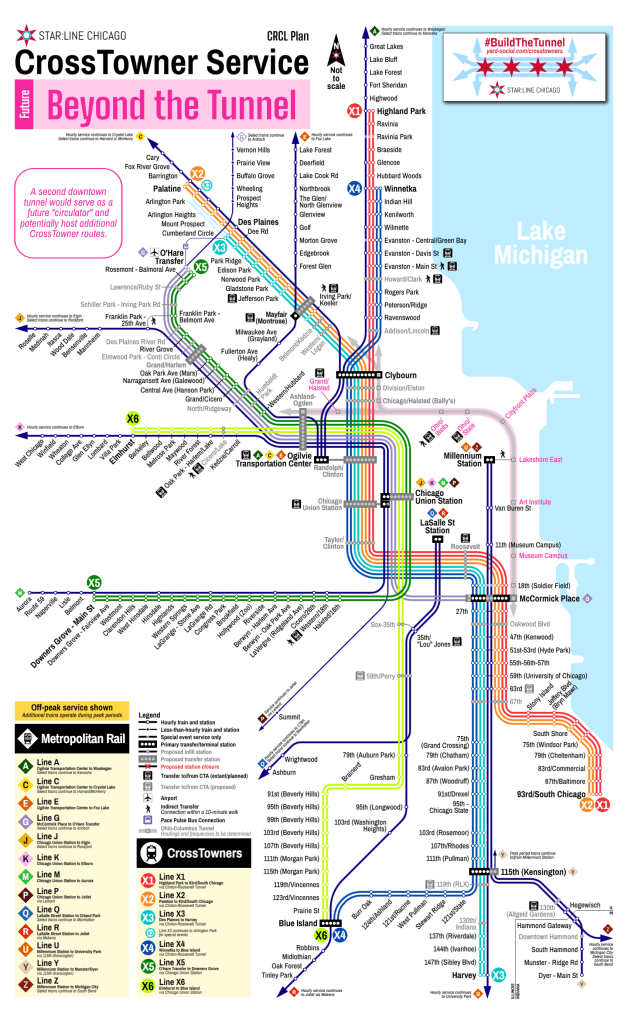
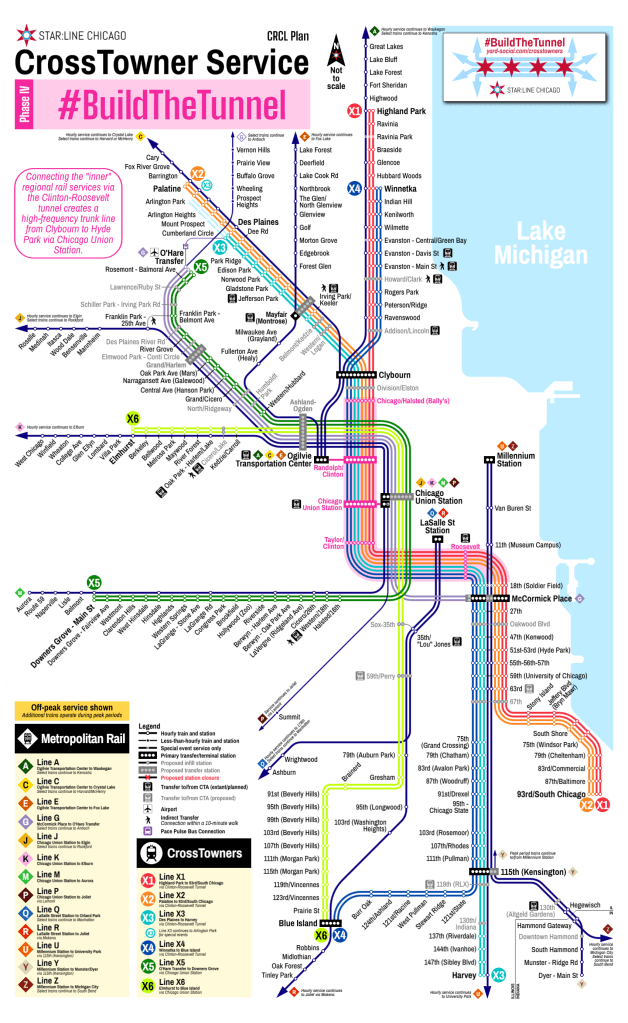
By the time we get to building the tunnel, operationally it ends up being an extremely straightforward enhancement. The tunnel gets built under Clinton Street and Roosevelt Road, and each of the four remaining regional rail lines (โ€œBโ€, โ€œDโ€, โ€œVโ€, and โ€œWโ€) simply continue through the tunnel and out to regional rail lines on the other side as CrossTowners. Doing so halves headways on the rest of the regional rail network, while expanding half-hourly service further out into the suburbs. Within the tunnel itself, and indeed down the entire โ€œtrunkโ€ between Clybourn and Hyde Park, CrossTowner trains now operate every 7.5 minutes, and every 15 minutes as far as Kensington, South Chicago, Winnetka, and Des Plaines.

The tunnel would greatly enhance regional intermodal connectivity with stations at Randolph/Clinton (connecting to Green and Pink Line โ€˜Lโ€™ trains at the existing Clinton/Lake station and Metra trains at Ogilvie), Chicago Union Station (connecting to Blue Line โ€˜Lโ€™ trains at the existing Clinton/Congress station as well as Amtrak, Metra, X5 and X6 trains at the station), Taylor/Clinton (to seed a new transit-oriented development neighborhood), and Roosevelt (connecting to Red, Orange, and Green Line โ€˜Lโ€™ trains at the existing Roosevelt station).

The core CrossTowner network is now complete.
Beyond The Tunnel

While the initial vision would be complete, that doesnโ€™t mean there wouldnโ€™t be additional opportunities for expansion. With no freight conflicts on the Metra Electric District, additional regional rail routes could be added later; more frequent service to Oโ€™Hare, or expanding regional rail to the Milwaukee North, or entirely new services could be added in the future. The original 2034sight Plan calls for a tunnel under Ohio Street and Columbus Drive, a corridor that remains ideal for additional high-frequency, high-capacity transit options to serve River North, Streeterville, and Lakeshore East. This alignment could also provide single-seat trips from the Far South Side to Oโ€™Hare more feasibly, and closer to downtown the Ohio-Columbus tunnel is bookended at each end by โ€œsuperstationsโ€ to provide universal connectivity between lines as needed. Rather than precluding these service alternatives, the CrossTowner vision is intentionally open-ended and forward-compatible for the continued growth of Chicagolandโ€™s transit network.

CrossTowner regional rail network map, showing 2034sight and CRCL Plan enhancements.

The time is now

As the new Northern Illinois Transit Authority (NITA) launches this summer, Chicagoland transit is in a position to not only survive but to thrive on regional coordination, integration, and bold visions for the future. Nothing worth having is ever easy, but CrossTowner regional rail can be the bold, achievable, pragmatic vision Chicagoland needs to once again shoot for the stars.

Itโ€™s time to unlock our regional potential. Itโ€™s time for regional rail.

And itโ€™s time to #BuildTheTunnel.


  1. Justification for individual infill stations are generally not included in this post, but additional information will eventually be posted somewhere. These posts are long enough without getting truly into the weeds. โ†ฉ๏ธŽ
  2. This operating paradigm was recommended as part of CMAP’s Plan of Action for Regional Transit (PART) report development following the pandemic (pages 23-27). โ†ฉ๏ธŽ
  3. Ideally three in the more distant future with a Pink Line extension to North Riverside. โ†ฉ๏ธŽ
  4. Metra operations would have been moved off of this segment following completion of the 75th Street CIP, but Amtrak and occasional freight traffic would still likely use portions of the route. โ†ฉ๏ธŽ
  5. Amtrak could plausibly extend Midwest intercity trains to Oโ€™Hare on the same routing; however, there is potential for that to be a net-negative at a local Chicagoland level if that operation would come at the cost of more frequent suburban service on the NCS. โ†ฉ๏ธŽ
  6. It is not shown on these maps, but Oโ€™Hare Express (Line โ€œGโ€) trains could also serve the proposed One Central megaproject near 18th Street in lieu of that projectโ€™s proposed reverse-branching of the BNSF. โ†ฉ๏ธŽ

Diverging Approach: Six Degrees of Separation (Part 1)

As we hurtle ever closer to the fiscal cliff, there’s been a lot of talk and discussions in Chicagoland about not only the importance of a safe, reliable, efficient transit network, but also what those investments — or forthcoming lack thereof — could mean for the city and the region as a whole. Concurrently, cost projections for the CTA’s Red Line Extension (RLE) have continued to increase, last year spiking from $3.6 billion to $5.75 billion in a matter of weeks. An unchecked 60% spike in projected costs should attract a lot of attention as we continue to discuss the best ways to maintain, operate, and expand our transit network to serve the entire Chicagoland region, especially chronically-disinvested areas like Chicago’s Far South Side. Given the rich history of CTA-vs.-Metra relations, how the RTA oversees (or doesn’t oversee) the service boards below them, and political promises for decades, there is undoubtedly a lot to unpack in a project that could very well become emblematic of the challenges our agencies and our transit network as a whole face in the 21st Century.

But let’s talk about a different corridor.

In the first of three Diverging Approach posts, we’re going to take a deep dive into the Grand Avenue corridor between Cicero Avenue and Mannheim Road: an ideal intermodal corridor that has come to encapsulate the siloed thinking and missed opportunities of the six major players of our current transit network: the three service boards, the RTA, CMAP, and our highway agencies. This post will set the table of the existing conditions in the corridor, how they came to be, and how tantalizingly close our missed connections are in what should — and could — be a dynamic, working-class, transit-oriented corridor between the two largest economic centers in the Midwest. Later posts will take a look at how reforms currently being discussed and debated in Springfield could reshape the transit user experience in this area, and how this corridor can become a keystone of a unified vision for 21st-Century Chicagoland transit.


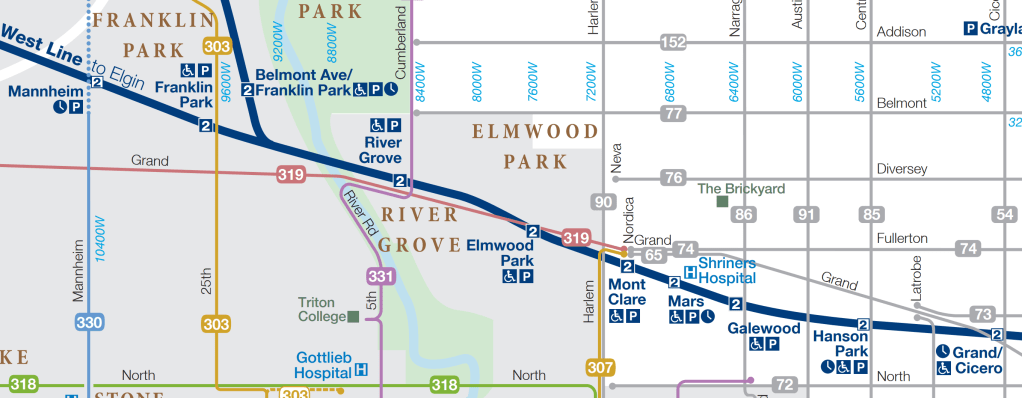
RTA System Map showing the Grand Avenue corridor between Cicero Avenue and Mannheim Road, a distance of about seven miles.

Out on one of the further edges of the city, where the West Side meets the Northwest Side and spills into suburban Cook County, lies Grand Avenue and Metra’s Milwaukee West line. Working-class communities straddling the city limits along nine stations that date back to the 1870s, this corridor more than perhaps any other exemplifies the challenges our region faces when we have three transit agencies with three different missions that all overlap, but not necessarily interact, with each other in the same corner of the map. However, the innate potential advantages of this corridor — which includes Metra’s existing North Central Service that connects this area to both downtown and O’Hare — can make a very strong argument for a more regional perspective in how we plan and operate our transit network.

As of late, our three current service providers are all taking a closer look at this area in some capacity: Pace’s ReVision bus network redesign is ongoing; the CTA is beginning to roll out recommendations from its recent Bus Vision Project, including new 10-minute headways along the 54-Cicero and later this year, the 77-Belmont and 72-North corridors seen above; and Metra, perhaps perennially, is looking at adding more service between downtown and O’Hare via this rail corridor. However, these three efforts are mostly in parallel to each other, rather than a single coordinated effort to improve service. Each effort has its own goals: the CTA seeks to leverage its strong grid of bus routes to improve connectivity with other CTA routes; Pace is determining whether to concentrate its effort on increasing ridership, increasing service coverage, or some combination of the two; and news reports suggest Metra’s interest in improved O’Hare service thus far has been focused on express service similar to what was operated during last summer’s Democratic National Convention.

Demographics

Unlike many of Metra’s routes, the demographics immediately along this corridor are diverse and largely working-class. East of Harlem in the city proper, the tracks themselves define the community-area boundary between majority-Black Austin and majority-Hispanic Belmont Cragin and Montclare1. West of Harlem as the line leaves the city, the demographics shift to the majority-white — but quickly diversifying — suburbs of Elmwood Park and River Grove, which have both diversified from 85-87% white in 2000 to 57-62% white in 2020. After crossing the Des Plaines River, the rail line enters majority-minority Franklin Park, which covers the rest of the line to Mannheim Road. (West of Mannheim is three miles of rail yard.)

“Map of population distribution by race and ethnicity in Chicago and environs” from the CTA Bus Vision Program Framing Report. The Grand Corridor between Cicero Avenue and Mannheim Road is highlighted in yellow. (Figure 37).

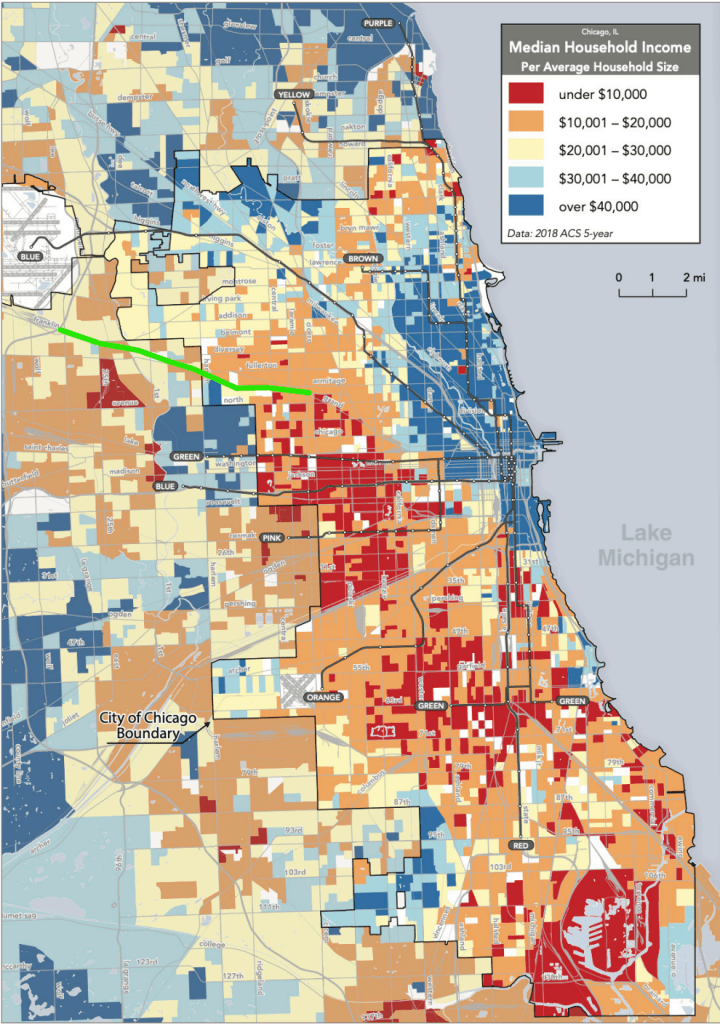
Median household income along the corridor is comparable to other working-class portions of Chicago, both for the parts of the corridor in the city proper and for the suburban stretches.

“Map of median household income, divided by household size, in Chicago and environs” from the CTA Bus Vision Program Framing Report. The Grand Corridor between Cicero Avenue and Mannheim Road is lined in green. (Figure 45)

Unlike some of Metra’s other triple-track main lines through the city such as the Union Pacific Northwest, Union Pacific West, or BNSF Railway lines, there is no nearby CTA ‘L’ service and, as a result, this part of the city is something of a transit desert for city residents comparable to some parts of the Southwest and Far South Sides, despite the corridor’s proximity to O’Hare and airport-adjacent industries and businesses.

“Map of access to jobs, in 45 minutes or less on transit (including time spent walking, riding, waiting and transferring) in 2019” from the CTA Bus Vision Program Framing Report. The Grand Corridor between Cicero Avenue and Mannheim Road is lined in green. Note that figures outside of the CTA service area are not shown. (Figure 49)

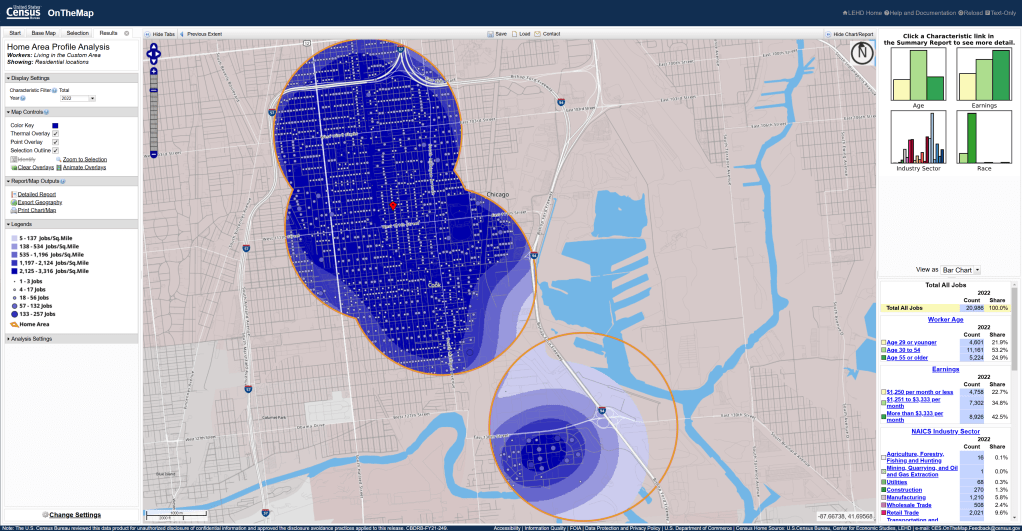
The corridor overall has a healthy density of residents and workers that could sustain more robust transit service. Collectively within a mile of each of the nine stations in the corridor, the Census Bureau reports over 76,000 workers as of 2022, just under half of whom made less than $40,000 that year. To put this in the context of the Red Line Extension, this area is slightly more than double the size of the respective 1-mile areas around the four new RLE stations but includes well over three times as many potential commuters.

U.S. Census Bureau OnTheMap Home Area Profile Analyses for the Grand Corridor and the Red Line Extension, using one-mile buffers from stations. Click the images for larger versions.

Station Areas

The rail corridor within the city has a strong industrial history that, in some cases, continues through to today. However, as the industrial economy continues to evolve in Chicagoland, opportunities for higher-density transit-oriented development are emerging in this corridor — especially if fast, frequent, reliable transit service can be established. Some of these opportunities, and the challenges at many of these stations, are detailed below.

An important detail about this corridor is how the line itself was “modernized” following the creation of Metra’s North Central Service. For much of the 20th Century as part of the Milwaukee Road, this part of the line was somewhat unique in that it functioned as two side-by-side two-track railroads, with passenger trains using the north pair of tracks and freight trains using the southern tracks to provide relatively conflict-free operations between Bensenville Yard and Cragin Junction, just east of Cicero Avenue. Unfortunately, this resulted in station buildings being constructed on the “wrong” (outbound) platform due to space constraints, which was an inconvenience for mostly-city-bound riders. As the Milwaukee Road fell onto harder financial times in the final quarter of the century, the fourth (southernmost) track was largely removed, and eventually the railroad was sold to Metra. Regrettably, when Metra made a major investment to increase service on the North Central Service in 2006, the line was reconstructed as a “traditional” three-track shared corridor similar to the Union Pacific West or BNSF Railway lines, which does allow for station buildings to be on the inbound platform but now require mixed operations. As Canadian Pacific Kansas City, the new “host”2 of the line, plans to increase freight traffic on the line, freight/passenger conflicts will continue to increase.

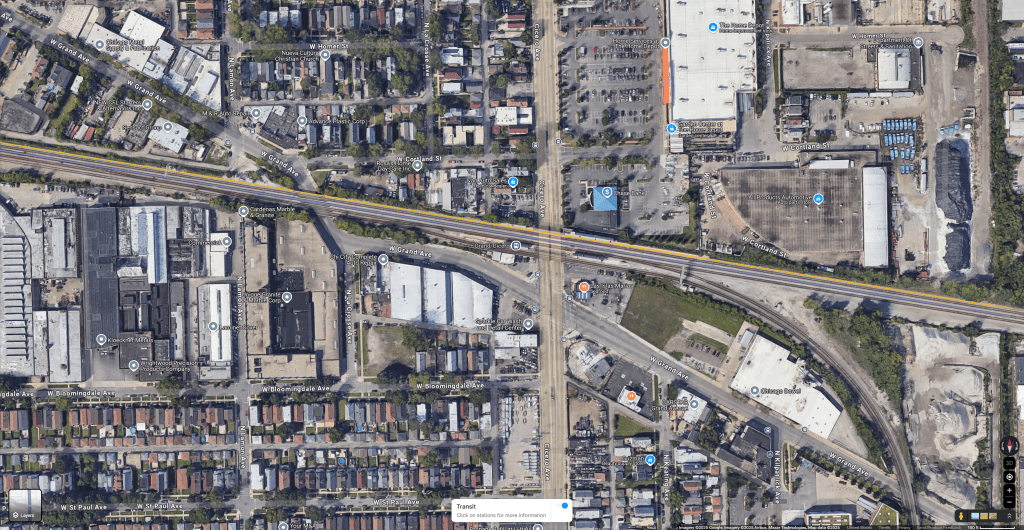
Grand/Cicero

Google Maps aerial of Grand/Cicero.

Grand/Cicero opened in 2006 as part of the NCS “modernization” project as a consolidation of two former stations, Cragin to the west and Hermosa to the east. Grand/Cicero is ideally situated just north of the eponymous intersection, built into the grade separation embankment. Fully ADA-accessible, Grand/Cicero has elevators that can provide direct connections to the CTA’s 54-Cicero and 65-Grand buses, the former of which has been identified as one of the CTA’s inaugural Frequent Network routes. Despite these connections, Metra treats Grand/Cicero as a weekday-peak-only flag stop, where trains will only stop upon request, and only during the weekday peak, leaving the station unserved midday, nights, and on weekends. As of this publication, Grand/Cicero is only served by 10 inbound trains and 6 outbound trains each weekday, all of which are either before 8:32am or between 3:26 and 6:26pm.

The northeast quadrant of the site, directly adjacent to the station, is occupied by a 10.5-acre Home Depot and Chase Bank.

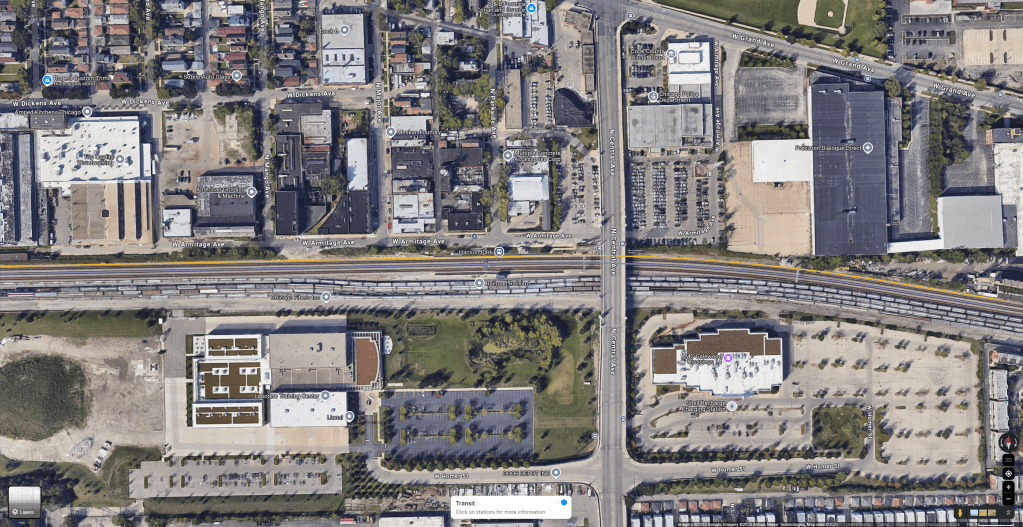
Hanson Park

Google Maps aerial of Hanson Park.

Hanson Park is located approximately one mile west of Grand/Cicero. Historically the site of a Milwaukee Road rail yard, the line is at-grade but Central Avenue crosses overhead just east of the platforms. While the station itself is officially ADA-accessible, access to Central Avenue is provided by a staircase that is not accessible to passengers with mobility disabilities. While there are bus stops in both directions for 85-Central buses — the only direct connection between the Milwaukee West line and Jefferson Park, the largest transit center on the Northwest Side — the stairs to the bridge are only on one side, and transferring to or from a northbound bus requires jaywalking in the middle of the bridge.

Connecting to a northbound bus is officially illegal since there is no pedestrian crossing, despite a posted northbound bus stop that is otherwise inaccessible. (Google Streetview)

Across the street from the Hanson Park train station is an overflow parking lot for the Chicago Police Department facility east of Central Avenue; the CPD facility also includes two Circuit Court of Cook County facilities for misdemeanor cases. South of the tracks, a large, low-density union hall sits west of Central; east of Central is one of the only active movie theaters on the Northwest Side. Like Grand/Cicero, Hanson Park is a weekday-peak-only flag stop, with 9 inbound trains and 6 outbound trains a day and no midday, evening, or weekend service.

Galewood

Google Maps aerial of Galewood.

One mile west of Hanson Park is Galewood, at Narragansett Avenue. In something of an inversion of Grand/Cicero and Hanson Park, this station is a full-time station for Metra with service seven days a week; however, this time it’s the CTA that operates limited connecting service as the 86-Narragansett/Ridgeland bus does not operate after 9pm during the week, and does not operate at all on weekends.

While active industrial uses are present on the northeast, southeast, and southwest quadrants, other than the Hostess bakery plant on the northeast corner the land uses are extremely low-intensity, with the southwest quadrant occupied by a self-storage facility and the southeast quadrant currently a surface parking lot used for CDL and truck driver training.

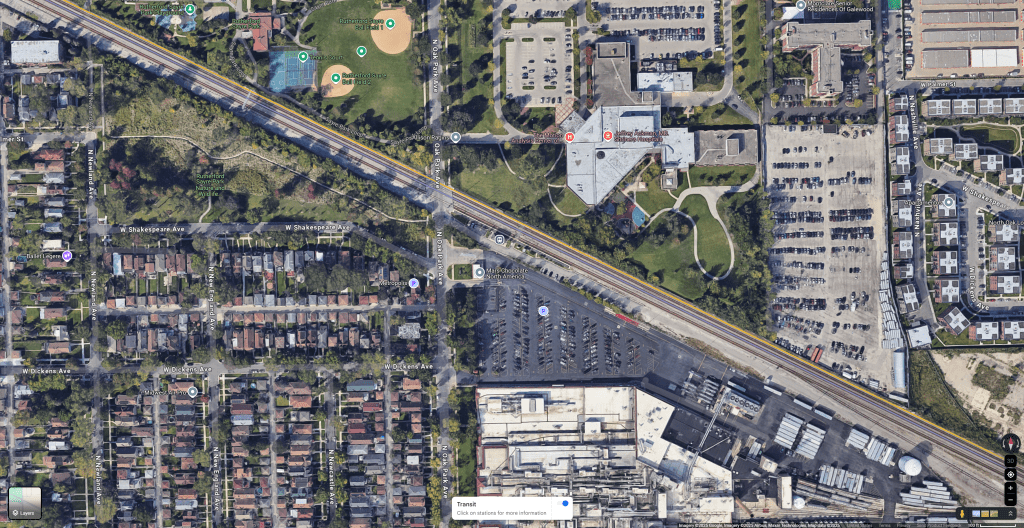
Mars

Google Maps aerial of Mars (the train station, not the planet)

Mars, everyone’s favorite station name, is located just a half-mile west of Galewood at Oak Park Avenue. Oak Park Avenue is not a bus route, and like Grand/Cicero and Hanson Park, Mars is also a weekday-peak-only flag stop. While the station is flanked by Sayre Park to the west and the Shriners Children’s Hospital to the northeast, the station is named for the Mars candy factory just to the south of the station, which is currently studying how to redevelop the 20-acre site once the production line shuts down soon. More frequent — or at least full-time — rail service would certainly be a boon for any transit-oriented redevelopment possibilities for the candy factory.

Mont Clare

Google Maps aerial of Mont Clare.

Less than half a mile away from Mars to the west lies the last station in the city proper, Mont Clare. Mont Clare is a full-time station, and absolutely infuriating from a network perspective. Harlem Avenue, one of the busiest north-south arterials in the area, is two blocks west; the CTA’s 90-Harlem bus does not directly serve the station. Grand Avenue, one of the busiest east-west arterials in the area, is one block north; the CTA’s 65-Grand and 74-Fullerton buses both do not directly serve the station either. Instead, these buses use the Grand/Nordica turnaround on the north side of Grand Avenue, which requires a short but unpleasant walk to connect from buses to trains. Pace’s 307 and 319 buses also use the Grand/Nordica turnaround, which means these routes also do not serve the Mont Clare station, even though the station is right there and Metra has more parking than they know what to do with and it would be just so easy to move the bus turnaround to the station itself and do literally anything better than what’s going on right now.

On weekends, even when trains are operating every two hours, the scheduled “meet” for these trains (where inbound and outbound trains pass each other) is scheduled just east of Mont Clare, with only a 4-minute separation between inbound trains (arriving on the :46) and outbound trains (arriving on the :50). With a bus terminal at the station, proactive scheduling means that this could be a perfect “pulse” location where buses come in on the :40 and leave on the :55 to provide plenty of time to make connections between buses and trains, while also providing operators with a solid 15-minute break and relief period. And yet…

If you want to know more about Mont Clare [missed] connections, just follow me on BlueSky and wait, I’m sure it’ll come up soon enough.

Despite the bus turnaround issue, the land use around the station is pretty good: mixed-density residential uses dominate the immediate areas that aren’t surface parking, with a neighborhood commercial corridor along Grand.

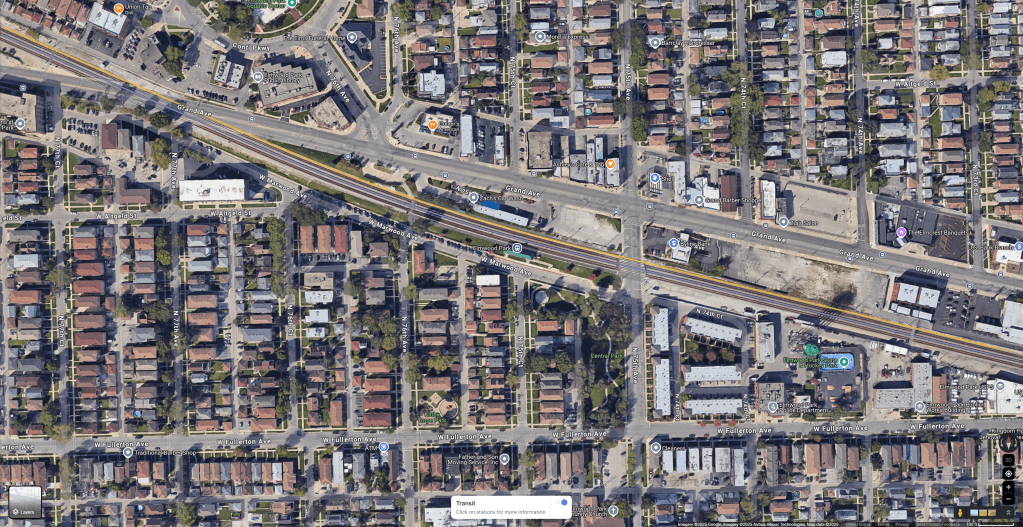
Elmwood Park

Google Maps aerial of the Elmwood Park train station.

Once we cross Harlem Avenue we’re officially in the suburbs; the Elmwood Park station is about half a mile further west of Harlem, at 75th Avenue. Grand Avenue is served by Pace’s 319 bus, with a convenient signalized crossing at 76th Avenue. The 319 is relatively typical for Pace operations in Suburban Cook: buses operate half-hourly between about 5:30am and 7:30pm, with more limited Saturday service and no Sunday service.

The Elmwood Park station area is perhaps best known for the extremely shallow-angle grade crossing at Grand Avenue, the site of numerous fatal train-vs.-car crashes including a single 2005 crash that injured ten people and involved 18 vehicles. As a result, trains must reduce speed to cross the intersection, including express trains (such as Metra NCS trains) that do not stop at Elmwood Park. The Village of Elmwood Park and the Illinois Department of Transportation have secured funding to begin preliminary work for a grade separation in this location — a topic we’ll go into deeper in Part 2.

Land use and density near the station is somewhat typical of Chicago’s “inner tier” suburbs. Residential uses are mostly single-family, but on smaller city-sized lots with some three-flats and modest apartment buildings intermingled. While Grand Avenue comprises one of Elmwood Park’s busiest commercial districts, the town center of Conti Circle lies about a block northwest of the station. This town center includes most of the village’s municipal buildings as well as additional commercial and mixed-use buildings. Pace’s 307 bus formerly terminated in Conti Circle until the pandemic era, when the route’s terminus was shifted to the aforementioned Grand/Nordica turnaround near Mont Clare after several Conti Circle closures for street festivals.

River Grove

Google Maps aerial of the River Grove station

A little over a mile west of Elmwood Park is the River Grove station, a somewhat unusual station for several reasons. First and foremost, as is plainly seen in the aerial, the station is adjacent to two large cemeteries that occupy half of the station’s potential walkshed. However, the station is situated on Illinois Route 171, known variously as Cumberland Avenue, Thatcher Avenue, or 1st Avenue depending on where exactly one happens to be located along 8400 West on the city address grid. Pace Route 331, which runs from the Cumberland Blue Line to the Metra BNSF Line via a stop at the Maywood UP-W station, also serves the station via Thatcher. Half a mile north of the station, the terminus of the CTA Frequent Network 77-Belmont bus is tantalizingly close, but does not serve River Grove.

River Grove was not upgraded as part of the 2006 “modernization” of the three-track railroad; as such, the station building itself is on the outbound platform, with an island platform serving inbound (and, occasionally, some outbound) trains. River Grove is the designated transfer station between Metra’s Milwaukee West and North Central Service trains before the latter branches off about a mile west of the station and heads north towards O’Hare and Antioch. While the infrastructure is built to accommodate transfers, unfortunately the schedules are not: of the North Central Service’s seven weekday round-trips, one does not even stop at River Grove, and the other six have limited capabilities to actually connect to Milwaukee West trains, either as a local-express pair or as a more traditional transfer between lines. (North Central Service trains do not operate at all on weekends.)

Metra River Grove Weekday Arrivals, Departures, and Transfers
NCS Train/DirectionNCS ArrivalMD-W OutboundMD-W InboundTransfers?
5:02am
5:38am
6:08am
100 (Inbound)6:32am6:50am6:46amYes (1, 2)
102 (Inbound)
101 (Outbound)
7:13am
7:31am
7:19am7:19amYes (1, 2, 3, 4)
7:54am7:50am
110 (Inbound)8:15am8:19amYes (2)
8:54am
9:13am
112 (Inbound)9:15amNo
9:54am
10:13am
114 (Inbound)10:25amNo
10:54am
11:13am
11:54am
12:13pm
12:54pm
1:13pm
105 (Outbound)1:46pm1:54pmNo
2:13pm
2:54pm
3:13pm
107 (Outbound)3:46pm3:59pmNo
4:13pm
109 (Outbound)4:46pm4:39pm*Yes (3)
116 (Inbound)4:52pm5:06pm*4:58pmYes (1, 2)
5:25pm
115 (Outbound)5:56pm5:41pmYes (3)
117 (Outbound)6:21pm6:14pm6:13pmYes (3, 4)
Trains marked with an asterisk (*) terminate at Franklin Park. Train 117 is the final scheduled NCS train of the day.
Transfers (scheduled useful connections within 20 min): (1) NCS inbound to MD-W outbound; (2) NCS inbound to MD-W inbound; (3) MD-W outbound to NCS outbound; (4) MD-W inbound to NCS outbound.

Despite half the walkshed occupied by cemeteries, the Village of River Grove has been proactively adding more transit-oriented development near the station, including a recently-opened 90-unit apartment complex.

Franklin Park

Google Maps aerial of the Franklin Park station area and Tower B-12, where Metra NCS trains branch off from the Metra Milwaukee West line.

About a mile and a half west of River Grove and just past where NCS trains split off of the MD-W line at Tower B-12 is Franklin Park. The station is located just west of 25th Avenue, which carries Pace Route 303, a weekday3-only route linking the CTA Forest Park Blue Line and the CTA Rosemont Blue Line stations with an additional stop at the Melrose Park UP-W station. Similar to River Grove, the Franklin Park station also was not changed in the 2006 triple-track modernization and retains its (rarely-unlocked) station building on the outbound platform with an unsheltered island inbound platform. Its location between Tower B-12 and the east end of Bensenville Yard make this a chronic location for freight train interference and occasionally extensive delays as slow-moving freight trains stop and reverse. Metra also uses Franklin Park as the separation point between the “inner” (local) and “outer” (express) service patterns during weekday peak hours, which means that even when some of the useful NCS/MD-W connections are scheduled one stop east at River Grove, passengers riding to or from suburban MD-W stations may also have to make an additional transfer at Franklin Park to switch between express and local trains.

While the northeast quadrant of the station area was unfortunately recently redeveloped as a surface parking lot, the southwest quadrant has seen some relatively significant transit-oriented development within the last decade, including two six-story residential developments with ground-level retail. The southeast quadrant is currently occupied by the Park District of Franklin Park, another potential transit-oriented development opportunity in the future.

Mannheim

Google Maps aerial of the Mannheim station

Finally, just under a mile west of the Franklin Park station lies Mannheim, one of the least-utilized stations in Metra’s network. The station, which is little more than two small platforms and a warming shelter on the outbound track, lies at the throat to Bensenville Yard. A historic whistle-stop community whose only remnants are a small dive bar and a plaque in the sidewalk, Mannheim is surrounded by light industrial uses and single-family homes. Similar to Hanson Park, Mannheim’s strongest opportunity would lie in more reliable connections to the bus route that goes over the station; Pace Route 330 uses Mannheim Road to connect the O’Hare Multimodal Facility (MMF) to 55th/Archer via downtown La Grange and the LaGrange Road BNSF. The route operates seven days a week with relatively quick runtimes — MMF to La Grange in under an hour — but has no connection to the Mannheim MD-W station due to the viaduct over the tracks with no vertical circulation down to the station. More frustratingly, the exact same situation occurs a few miles south at the Union Pacific West Line, where the 330 similarly misses a connection to the Bellwood station due to a lack of pedestrian access.

Not that it matters much here: similar to Grand/Cicero, Hanson Park, and Mars, Mannheim only receives weekday-peak-only flag stops, with eight inbound trains a day making the stop on request and a paltry four trains in the outbound direction.

West of Mannheim, trains can really open up and often get to 70 miles an hour as the Milwaukee West runs around the airport out to Bensenville and DuPage County.


If a realtor also happened to be a transit advocate, they would almost definitely describe this corridor having “good bones”: decent existing infrastructure with a fair amount of existing service and current land uses that could be quite conducive to transit-oriented development, but no one has been able to put the pieces together quite the right way yet. As Chicagoland transit continues to approach the fiscal cliff and as conversations start up in earnest about not only how to save our transit network but how we move towards the future transit network we want, the Grand Corridor makes an ideal candidate to better understand the untapped potential in our network and our region.

In the next installments in this series, we’ll take a deeper look into understanding the various major stakeholders responsible for improving transit and transportation in the Grand Corridor, and how some of the governance reform efforts currently being discussed in Springfield could play a role.

Finally, we’ll wrap up the series with what we believe should happen in the Grand Corridor, and present a bold, achievable vision for the future that demonstrates what a unified network can do — and how to make that vision a reality.

#BuildTheTunnel


  1. The Metra station is named “Mont Clare” — with a space — whereas the official community area is named “Montclare”, without a space. โ†ฉ๏ธŽ
  2. Metra owns, operates, and maintains the Milwaukee West; however, CPKC dispatches the line and has inherited a sweetheart trackage rights agreement from Metra’s purchase of the Milwaukee Road that allows CPKC to have a functional veto of any Metra service changes outside of the weekday peak period (page 41). โ†ฉ๏ธŽ
  3. Pace Route 303 also operates on Saturdays, but only between Forest Park and North Avenue without connecting to the Milwaukee West line or the Rosemont Blue Line. โ†ฉ๏ธŽ

Editor’s Note: This post has been updated to correct the locations of the former Cragin and Hermosa MD-W stations, and to clarify the location of the freight turnoff at Cragin Junction.