As Illinois and Chicago barrel forward into Phase 3 of the coronavirus recovery, our world is slowly starting to get back to normal – or at least, our new normal that will follow COVID-19 is coming into clearer focus.
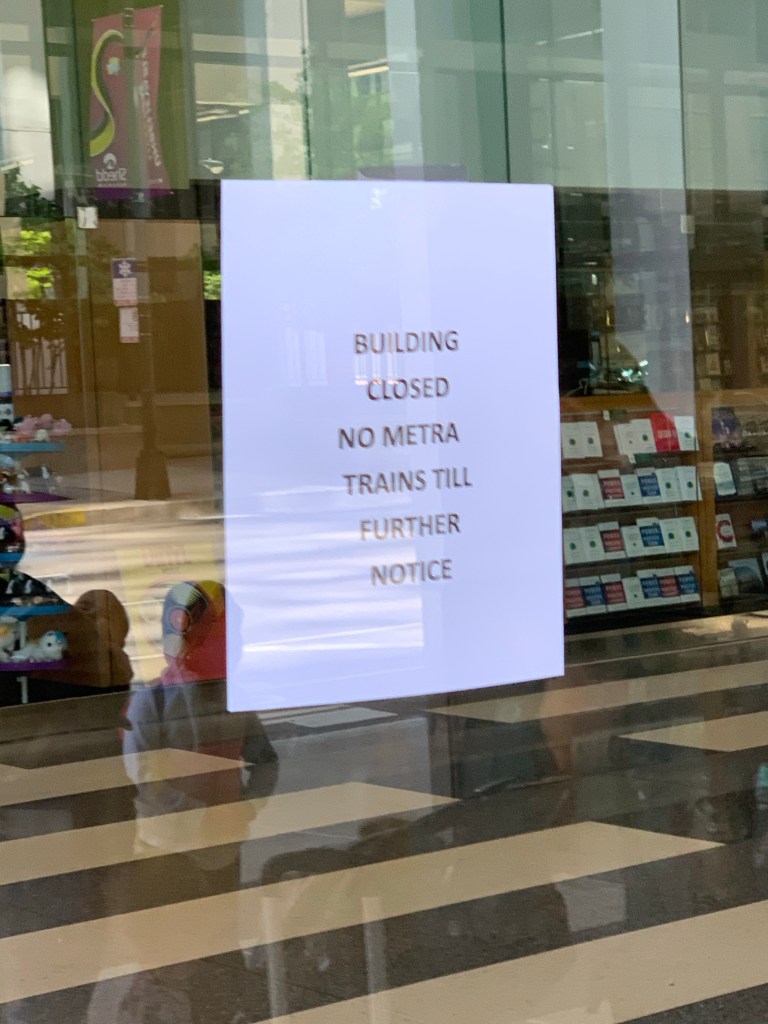
Unfortunately, despite our hardest efforts, transit has become something of a public health punching bag, with a common sentiment that public transit (and/or those who use it) are unclean or unsafe in light of the ongoing pandemic. Even worse, just when there was a light at the end of the tunnel, Chicago executed its first-ever citywide shutdown of all transit in an (ill-advised) attempt to quell protesting and looting following the George Floyd murder: CTA and Pace stopped running entirely overnight, while Metra shut down for over 60 consecutive hours.
This can be – or possibly will be – a fatal one-two punch for our transit network as we know it. Metra has straight-up abandoned off-peak service on three of its 11 lines and the rest of the system has ridership losses north of 95%. Additionally, Metra seems content to let ridership drive service restoration rather than vice versa; in planning parlance this is known as a “death spiral”: less service means fewer riders, which means less service, which means fewer riders, and so on.
While Metra’s long-term strategy should be acknowledging a new normal with much more work-from-home for their white collar commuter base and adjusting schedules accordingly to flatten the peak while adding off-peak service to attract new non-traditional commuters (or riders who travel for reasons unrelated to commuting entirely), even systems like the CTA and Pace, who have had far fewer service reductions during the pandemic, will continue to struggle getting ridership back as riders stay home and as commuters have less reason to commute with work-from-home opportunities.
Work-from-home can be great on occasion, and as workplaces reopen it’s likely that many will still require workers to work from home several times a week. Transit’s recovery – if it ever comes – will be a slow, drawn-out, painful affair.
But work from home has no shortage of downsides, too. Beyond issues of distractions and productivity, it’s healthy to have some distance – figuratively and literally – between your work life and your home life. Whether that’s the idea that you can get just one more task done before calling it for the night, or that your boss now feels comfortable calling or texting you on your personal cell phone whenever, or just a little spike in anxiety you get whenever you pass your laptop during your “off” hours, some sort of buffer space is good for you and your health.
That’s why The Yard Social Club and Star:Line Chicago is finally launching our Commit to the Commute campaign. Commuting – especially on foot or on transit – shouldn’t be a chore as much as it is a release: catch up on a podcast, read Twitter, dive into a book, or just stare out the window and daydream. Commuting is “me” time, and the best part is at the end of the day, you can leave work at work and disconnect once more on your way home.
Our Commit to the Commute campaign has three prongs:
- Tag us on social media. Show us what you enjoy about your commute! What can you do on transit that you can’t do while working from home or when you’re driving? Tag us on Twitter or Instagram (@StarLineChicago), use the #CommitToTheCommute and #LeaveWorkAtWork hashtags, and we’ll share.
- Join us for Happy Hours. Once indoor bars get rolling again (hopefully later this summer), we’ll be hosting a few regular downtown meetups to connect commuters and grab a quick one before heading home.
- Hop on a train crawl. When Illinois moves into Phase 4 and groups of up to 50 are allowed again, we’ll help ease you back into a comfort zone using transit with our famous train crawls throughout the city and suburbs. Get reintroduced to our region’s transit system with a safe, fun way to explore where the buses and trains can take you.
These are challenging times, but here at The Yard Social Club and Star:Line Chicago, we want to do whatever small things we can to bend the commuting curve back and remind everyone in Chicagoland how vital our transit network is to everyone.
#CommitToTheCommute