

Earlier this year, the United States Government Accountability Office published a report focused on transit access to American airports. The report, officially titled “Accessing Airports: Available Public Transit Options and Efforts to Promote Their Use”, is worth a read if that’s the kind of thing you’re into. As part of the study, both of Chicago’s airports were included, and unfortunately the report doesn’t shed too much new information on any O’Hare- or Midway-specific trends or findings.
There was, however, one larger key takeaway that I wanted to highlight. Buried in Appendix II of the report are published findings regarding transit mode share for selected major airports. Regrettably, the GAO report is mostly a synthesis of existing data sources rather than a new national-level study, so airport-by-airport mode splits are self-reported with likely inconsistent methodologies. Neither Chicago airport was included, but the report nonetheless provides an interesting cross-section of major American aviation hubs.
Here’s a brief list of airports that reported traveler transit mode-share, in order from highest public-transit mode share1 to lowest:
- Boston (BOS): 11-22%
- Seattle-Tacoma (SEA): 9-20%
- New York (JFK): 19%
- Washington (DCA): 12-14%
- Newark (EWR): 13%
- New York (LGA): 13%
- Oakland (OAK): 4-13%
- Kansas City (KCI): 10%
- Washington (IAD): 8-10%
- Denver (DEN): 6-10%
- San Francisco (SFO): 5-10%
- Baltimore (BWI): 4-6%
To put a back-of-the-napkin best-guess for where Chicago lands on this list, let’s focus2 on O’Hare. Last summer, O’Hare set several single-day records for TSA screenings, with well over 110,000 passengers screened on some days. Not every day is a record-breaker, however, and there will invariably be some weekly variability, so let’s conservatively assume that on a typical day about 95,000 passengers clear security screening at ORD. For the sake of conversation, let’s further assume that for every passenger screened entering security for an outbound flight, one passenger arrives who is not connecting and has Chicago as their final destination, so on a typical summer day last year there are approximately 95,000 Chicago-bound passengers3 who will be looking for a way to their final destination after landing and leaving security. According to RTAMS, last July, O’Hare was the second-busiest ‘L’ station in the network with 10,944 average weekday boardings, behind Lake/State (11,731) and just ahead of Clark/Lake (10,887). With the caveat that there are non-zero (but, at a high level, negligible4) numbers of travelers who also use Metra and Pace to get to and from O’Hare, we can reasonably estimate O’Hare’s public transit mode share in the neighborhood of 11,000 / 95,000 = 11.6%.
…or can we?
Anyone who has taken the Blue Line to or from O’Hare likely notices another key constituency of airport-bound riders: airport workers. According to the Mayor’s Office, as of last summer over 46,000 workers work at O’Hare, which means all else being equal about one out of every three5 Blue Line riders to or from the airport are employees, not travelers. On a typical day travelers will outnumber workers taking the Blue Line to and from the airport, but even the busiest frequent-fliers may only ride to and from the airport a few times a month, whereas airport workers are each making that commute north of 250 times a year.
Whenever there’s a political conversation about enhancing transit access to the airport, the focus is rarely on providing better commutes for workers heading to a regional job center: instead, “airport express” service for business travelers and deep-pocketed tourists tends to suck the oxygen out of the room, even though here in Chicagoland we’ve been burned by airport express proposals time and time again. Even after a “lackluster” showing during the 2024 Democratic National Convention, $1.5 million has recently materialized to once again study express rail service to O’Hare.
Getting the obvious out of the way now: O’Hare Transfer, where Metra’s North Central Service trains stop, kinda sucks. It’s far from the terminal core, and when the Chicago Department of Aviation built the new Multimodal Facility and extended the Airport Transit Service (airport train) in that general direction, they quite literally turned their back to the Metra station.
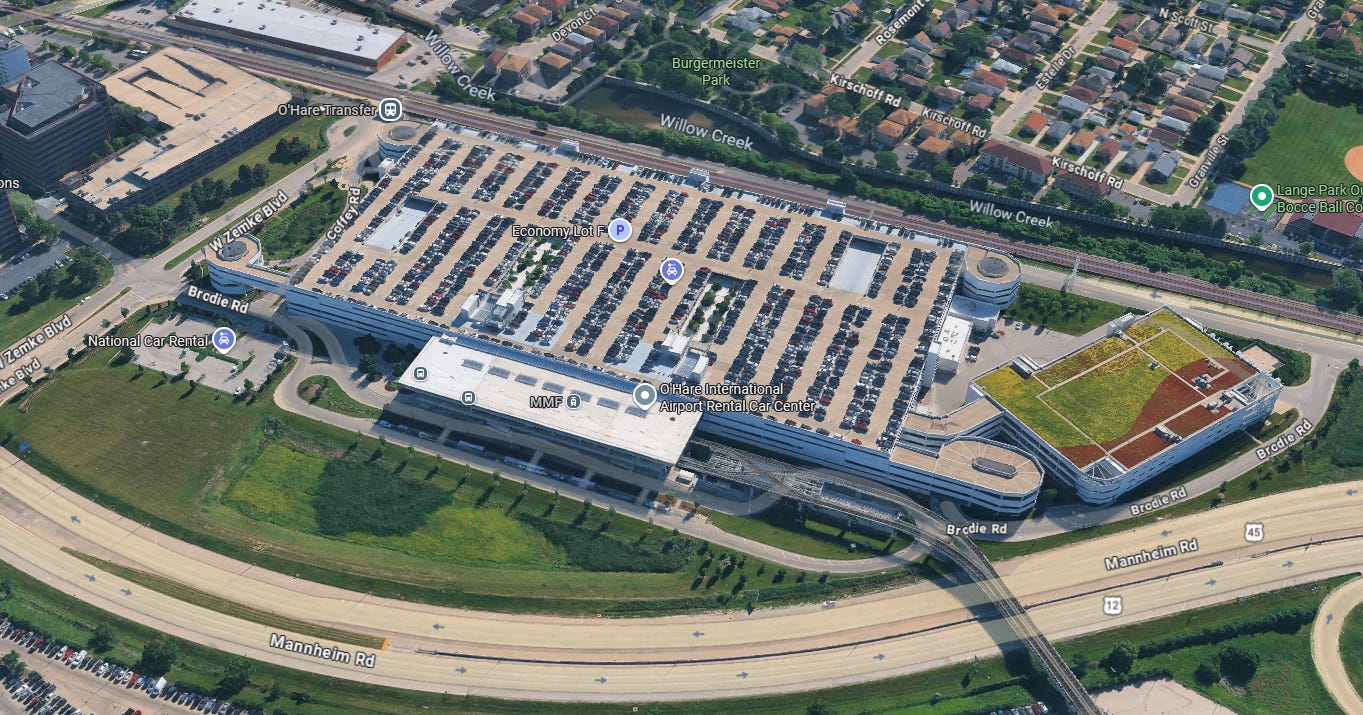
While there has been some further study to make the six-minute walk between the ATS station and O’Hare Transfer less unpleasant, for most airport travelers, express rail service to O’Hare Transfer must overcome a trifecta of challenges to be competitive with existing Blue Line service:
- The additional travel time from Terminals 1, 2, and 3 to the MMF via the ATS and then making the walk to O’Hare Transfer will add at least 10-15 minutes6 of travel time.
- Sharing tracks with freight traffic as well as other Metra and Amtrak trains will greatly reduce the maximum service frequencies. Even under the most optimistic scenarios, it is unlikely any Metra operation could compete with the CTA Blue Line from a frequency standpoint, which once again adds more effective travel time for airport express travelers.
- The time savings — exacerbated by points 1 and 2 above — would need to be substantial to justify a premium ticket price, as opposed to the $5 CTA Blue Line fare7 8.
These are significant challenges to any new airport express operation, and can only be partially mitigated by substantial infrastructure investments: namely, to bring the airport express service into the Terminal Core, some relatively extensive tunneling would be required to connect the existing rail lines to the terminals. This blog obviously does not consider substantial tunneling operations to be a fatal flaw, but it does require making a stronger fiscal case for airport express service a vital part of the pitch, which means the new premium service would almost certainly require attaching a premium fare.
Premium fares can also dramatically impact ridership, as Toronto discovered when they first launched the Union Pearson Express (UPX) operation between Toronto Union Station and their major airport: initial fares had to be slashed in more than half within the first two years of operation due to low ridership9.
Without extensive additional infrastructure, there is also a risk that airport express trains can cannibalize capacity for local trains on shared tracks. While the inverse of this concept is what ultimately doomed the Block 37 Superstation airport express concept — “express” trains would have to slot in between local trains on the Blue Line with no capacity for passing tracks between downtown and Jefferson Park, resulting in far fewer time savings — Metra-based airport express services could result in less capacity for North Central Service and Milwaukee West riders, and potentially Milwaukee North and Amtrak Hiawatha/Borealis riders as well.
But maybe we’re approaching better O’Hare transit service from the wrong direction.
“In one physical model of the universe, the shortest distance between two points is a straight line… in the opposite direction.”
-Ty Webb, Caddyshack
Many of the challenges that launching a premium airport express operation would face are far fewer, or at least more easily mitigated, for a local operation that caters to regional airport workers rather than travelers:
- Not all airport employees work in the terminals themselves, and for those who do, the predictability of a consistent commute time can justify a longer walk. A family of four (who also has to walk past half a dozen rental car counters) may not be willing to walk beyond the MMF to potentially wait another 20+ minutes for a Metra train, but a worker heading home after their shift can better balance when they leave their worksite with when their train is scheduled to arrive. Additionally, since Pace already has established services at the MMF (Dempster Pulse/250 and Route 330), workers have more options for last-mile connections to and from jobsites beyond the airport’s footprint.
- Similarly, many workers with standardized shift times can better plan around lower frequency services if the additional service expands beyond the service already offered by the Blue Line. In other words, while one of O’Hare’s legendary taxi times might kill an convenient connection to a half-hourly express train for a business traveler, an airport worker with consistent work shift start and end times can easily plan their commute around the train schedule, and may be willing to wait longer at the airport for a more direct transit option to head back home.
- As a local operation, fares under NITA will be unified and coordinated, which means fare differential between a new local operation and existing CTA service should be much less significant.
What’s unique about focusing on local service first is that, given where the North Central Service and Milwaukee West operate, local service will not compete with the Blue Line. An express operation, on the other hand, would generally face more competition from the Blue Line since an express operation would be focused on connecting downtown to the airport, which the Blue Line directly does.
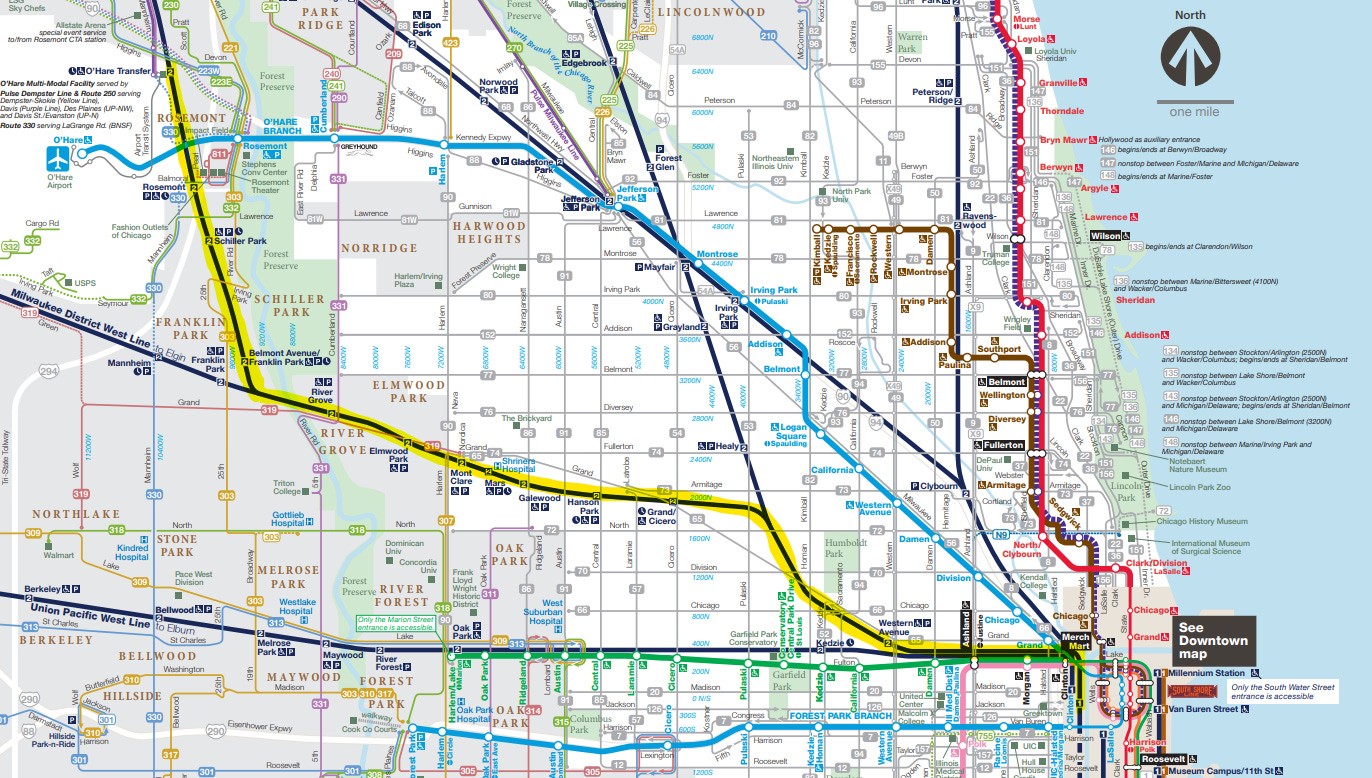
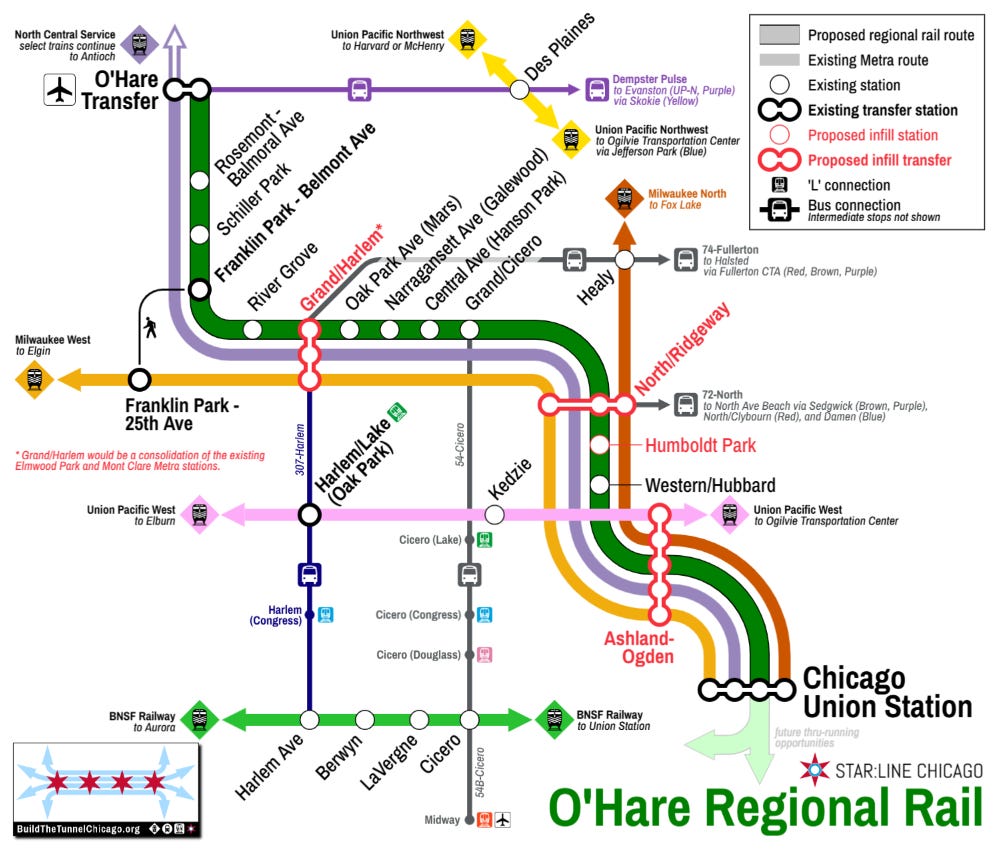
As a quirk of history, the North Central Service was the first — and to date, only — “new” service launched in Metra’s 41-year history. When it was created in 1996, however, the service was simply overlaid on the Milwaukee District West Line, with NCS trains operating express between River Grove and Western Avenue. While this somewhat makes sense at a regional level — riders from Antioch to downtown already have a 98-minute travel time to Union Station10, so why should they have to make additional local stops if they don’t need to — this service pattern leaves a lot of potential airport commute trips on the proverbial table for working-class communities along Grand Avenue.
If we look at potential commuters along this corridor, within one mile of an existing Metra station (MD-W between River Grove and Western Avenue, and NCS between River Grove and O’Hare Transfer), a strong potential bidirectional commuting corridor emerges: the top two zip codes that these regional residents are commuting to are 60603 (the heart of the Loop) and 60018 (Des Plaines, Rosemont, and O’Hare). Among the top 10 zip codes, all of them are generally colinear along the Metra tracks when including downtown.
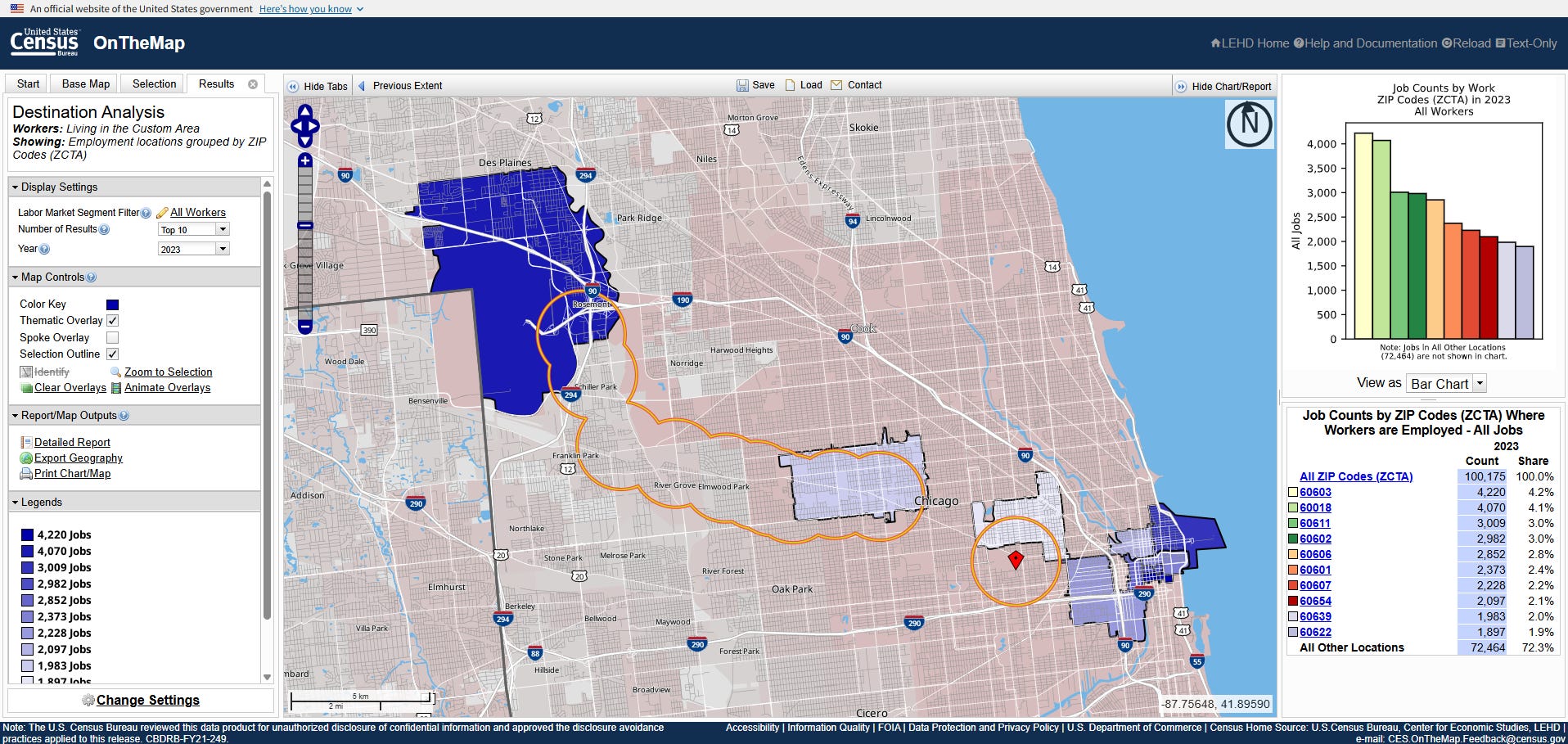
This is precisely the kind of relatively-underutilized transit corridor that a regional rail operating model should be focusing on: a relatively dense, working-class corridor with bidirectional all-day demand, far from the existing reach of the existing ‘L’ network, with ideal opportunities for additional urban infill stations.
And something special happens once local service is “spun off” into its own operation: other trains don’t need to make those stops any more. In this case, if a new local service began operating and making all the stops between Chicago Union Station and O’Hare Transfer, existing North Central Service trains don’t have to stop at places like Franklin Park or Schiller Park.
Rather than standing up a totally-new airport express service, creating a Union Station-O’Hare Transfer all-day local regional rail service means every existing NCS train becomes an airport express service by default. Prior to the pandemic, as part of their typical battery of peak period services, Metra operated a daily NCS round-trip that ran “express” between O’Hare Transfer and Union Station, making only two stops and completing the trip in half an hour.
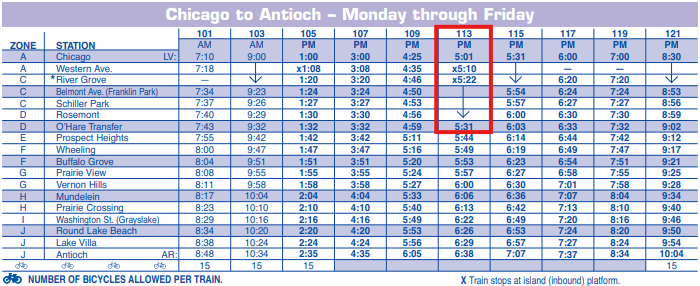
In other words, on existing infrastructure, using existing fleet, Metra could make the trip from downtown to O’Hare in 30 minutes flat, and every NCS train could make that trip under a regional rail operating model. With some proactive planning and some stop rebalancing, we could also make sure the two intermediate stops have strong north-south transit connectivity to create even more possibilities to extend the benefits of fast and frequent airport transit beyond a gold-plated operation for downtown businesspeople and conventioneers. Likewise, DNC-style supplemental NCS service that operates only between Union Station and O’Hare Transfer could more reasonably provide higher “express” frequencies between downtown and the airport without impacting freight congestion and infrastructure limitations on the NCS north of the airport.
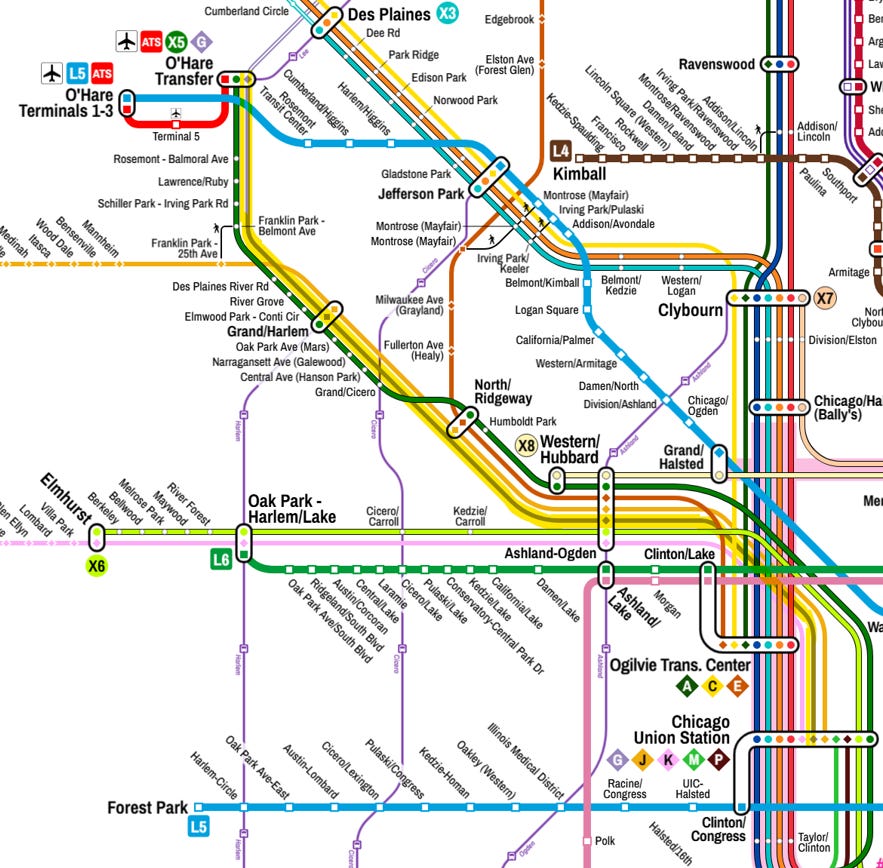
As we enter the NITA era, these opportunities for improved service through interagency and intergovernmental cooperation will multiply. By leaning into NITA’s “one network, one timetable, one ticket” mantra, Chicagoland is well-positioned to finally start thinking regionally when it comes to our transit network, unlocking potential for new transit trips in every corner of northeastern Illinois.
And the sky’s the limit.
- Some airports separated regional shuttles, charter buses, hotel shuttles, etc. separately from more traditional public transit (e.g., city bus or metro train); others did not. Airports shown with a range of percentages should be read with “traditional public transit” at the low end, and combined with other private transit modes at the high end. ↩︎
- Since the Midway Orange Line station also serves as a hub for numerous CTA and Pace bus routes, raw CTA ridership figures may not be as representative as at O’Hare, where the Rosemont Blue Line mostly serves that purpose instead. ↩︎
- Note that there are far more travelers flying into O’Hare on most days, but a majority of travelers are connecting through ORD, and therefore do not leave security. If anything, this number may still be a high estimate in the context of a potential transit market, given the high number of international connecting flyers who land at Terminal 5, clear customs, and then have to go back through TSA for their domestic connecting flight. ↩︎
- Pre-pandemic (2018), Metra’s O’Hare Transfer station had 113 typical weekday boardings; in February 2026, average weekday ridership of the combined Pace Dempster Pulse, 250 Dempster, and 330 Mannheim buses was 3,273 for their entire routes. Note that all other Pace access to the O’Hare terminals would be via the CTA Blue Line at Rosemont. ↩︎
- 1 out of every 3.07 riders, assuming ~46,000 workers and ~95,000 travelers. ↩︎
- This is less applicable to travelers heading to or from Terminal 5, which is both closer to the MMF and would require an additional ATS trip in the opposite direction to use the Blue Line instead. ↩︎
- $5 for an inbound trip from the airport, of course; outbound trips to the airport would have to compete even harder with the CTA’s base fare of $2.50. ↩︎
- This also assumes that all business travelers are part of an actually-attainable market, as opposed to acknowledging that some business travelers will always ultimately expense a taxi/Uber/black car/rental car regardless of how good the transit connection to downtown is. ↩︎
- Notably, UPX’s fare restructuring also included instituting local GO Transit fares for intermediate trips to encourage use by a wider variety of travelers. ↩︎
- Compare to 87 minutes for a milk-run Big Timber Road train. ↩︎